Key takeaways
- Slope: about 5 to 8 degrees. Too shallow and cans stop mid-lane; too steep and they slam into the front stop and dent the rims.
- Lane width: roughly 0.25–0.5 inch wider than the can height when cans lie on their side. A 15-ounce can (4.4 in tall) wants a lane about 4.6–4.9 inches wide.
- Clean rims: a dented can or one with a sticky label will stall a whole lane. Keep dented cans out of the rack and use them first.
The best canned food storage rack for most homes is a gravity-fed rotating rack sized to your most common can (usually the 15-ounce #300 can), because it automatically serves the oldest can first and holds 30 to 60 cans in the footprint of a standard pantry shelf. If you keep fewer than two dozen cans, a simple tiered riser does the job; if you buy in bulk, a freestanding rolling rack or a shelving unit fitted with can dispensers is the better match.
The rest of this guide covers the measurements that decide which rack works: can dimensions, shelf depth, weight per shelf and how many cans each style really holds.

Simple Houseware 3-Tier Stackable Can Organizer Rack Hold 36 Cans, Chrome
Included for 'Canned Food Storage Rack: Can Sizes, FIFO Lanes and Shelf Weight Limits' because the listing specifies Chrome, details this guide uses to compare options.
View on Amazon
Simple Houseware 3-Tier Stackable Can Organizer Rack Hold 36 Cans, Bronze
Included for 'Canned Food Storage Rack: Can Sizes, FIFO Lanes and Shelf Weight Limits' because the listing specifies Bronze, details this guide uses to compare options.
View on Amazon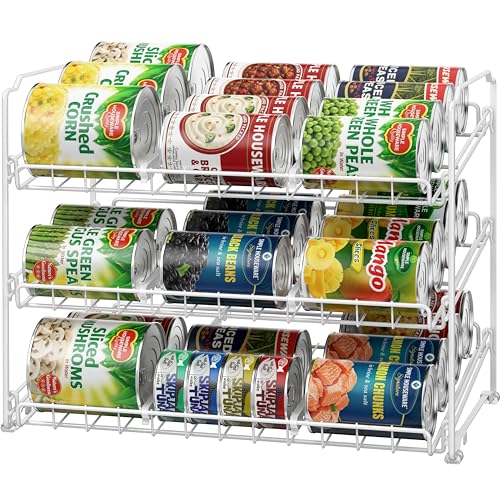
Simple Houseware 3-Tier Stackable Can Organizer Rack Hold 36 Cans, White
Included for 'Canned Food Storage Rack: Can Sizes, FIFO Lanes and Shelf Weight Limits' because the listing specifies White, details this guide uses to compare options.
View on Amazon
Simple Houseware Stackable Can Rack, Silver, Adjustable Plastic Dividers, Holds 36 Cans
Included for 'Canned Food Storage Rack: Can Sizes, FIFO Lanes and Shelf Weight Limits' because the listing specifies Silver and Adjustable Plastic Dividers, details this guide uses to compare options.
View on AmazonStart With Your Cans, Not the Rack
Can racks fail most often because the lanes are sized for one can and the household buys another. Gravity racks rely on cans rolling on their sides, so diameter and height both matter. Before shopping, pull your three most common can sizes from the pantry and measure them.
| Common can (US trade size) | Typical contents | Diameter | Height | Approx. full weight |
|---|---|---|---|---|
| 8 oz (#211 x 304) | Tomato sauce, small fruit | 2.7 in | 3.3 in | 0.6 lb |
| 10.75 oz condensed soup | Condensed soup | 2.7 in | 4.0 in | 0.8 lb |
| 15 oz (#300) | Beans, vegetables, broth | 3.0 in | 4.4 in | 1.0 lb |
| 28 oz (#2.5) | Crushed tomatoes, large fruit | 4.1 in | 4.7 in | 1.9 lb |
| #10 can | Bulk vegetables, long-term storage | 6.2 in | 7.0 in | 6.5–7 lb |
Two takeaways: the 8-ounce and soup cans share a diameter but not a height, so they can share an adjustable lane but not a fixed one, and the 28-ounce can is wide enough that it jams most lanes built for 15-ounce cans.
The Five Rack Styles and What Each Holds
Tiered shelf riser
A two- or three-step riser stands cans upright so labels face you. It holds roughly 18 to 30 standard cans across a 15–24 inch shelf and usually costs $15–$40. There is no rotation; you still have to push old cans forward yourself. Best for small pantries and cabinets with 10–12 inches of depth.
Countertop or cabinet gravity dispenser
A compact unit with two to four sloped lanes, loaded from the top back and dispensing at the front bottom. Typical capacity is 24 to 36 cans, depth around 12–16 inches, price $20–$50. Plastic versions often have adjustable lane dividers; wire versions are usually fixed-width.
Stackable can organizer
Interlocking wire or plastic modules, each holding 9 to 12 cans on a slope, stacked two to four high. Useful when you want to expand gradually. Watch the stacking limit — most modules are rated to stack three or four high before they start to lean.
Freestanding rolling can rack
A tall unit, often 4 to 6 feet high, with many sloped shelves that feed a front stop. Capacity ranges from about 80 to more than 200 cans depending on depth and height. Prices usually run $60–$250 for steel or wire units, and more for solid-wood builds. These suit basements, garages and pantry closets where you keep a deep stock.
Shelving unit with can-rotation inserts
A standard 18-inch-deep steel or wire shelving unit fitted with sloped can trays. This is the most flexible bulk option because the shelving remains useful if you change your storage later.
Capacity, Footprint and Price at a Glance
| Rack type | Typical footprint (W x D) | 15 oz can capacity | Rotation | Typical price |
|---|---|---|---|---|
| Tiered riser | 15–24 x 10 in | 18–30 | Manual | $15–$40 |
| Gravity dispenser | 12–17 x 12–16 in | 24–36 | Automatic FIFO | $20–$50 |
| Stackable modules (x3) | 12 x 14 in | 27–36 | Automatic FIFO | $30–$60 |
| Freestanding rolling rack | 24–36 x 16–24 in | 80–220 | Automatic FIFO | $60–$250+ |
| Shelving + can inserts | 36–48 x 18 in | 120–250 | Automatic FIFO | $100–$300 |
How Gravity Rotation Works (and When It Doesn’t)
FIFO — first in, first out — means newly bought cans are loaded at the back or top and the oldest can sits at the front. For a gravity rack to roll reliably, three things need to be right:
- Slope: about 5 to 8 degrees. Too shallow and cans stop mid-lane; too steep and they slam into the front stop and dent the rims.
- Lane width: roughly 0.25–0.5 inch wider than the can height when cans lie on their side. A 15-ounce can (4.4 in tall) wants a lane about 4.6–4.9 inches wide.
- Clean rims: a dented can or one with a sticky label will stall a whole lane. Keep dented cans out of the rack and use them first.
Rotation also only helps if you load from the correct end. Mark the loading side with a strip of tape if several people restock the pantry.
Weight: Where Racks Actually Fail
Cans are heavy for their size. Fifty 15-ounce cans weigh about 50 pounds, and a full rolling rack can carry 150 pounds or more. Check these numbers before you load:
- Pantry shelf: a 3/4-inch particleboard shelf spanning 36 inches typically sags under 40–50 pounds of distributed load. Put heavy gravity racks on the bottom shelf or on a floor unit.
- Wire shelving: light-duty wire shelves are often rated around 250–350 pounds per shelf; heavier commercial-style units are commonly rated 600–800 pounds per shelf, evenly distributed.
- Tall racks: anything over 4 feet should be anchored to a wall stud. Weight loaded at the top shifts the center of gravity, and pulling cans from a front-loaded lane creates a forward tug.
- #10 cans: at roughly 7 pounds each, a lane of six weighs over 40 pounds. Keep #10 cans on the lowest level.
Material Trade-Offs
| Material | Strengths | Weak points | Best location |
|---|---|---|---|
| Powder-coated steel wire | Strong, ventilated, easy to clean | Thin wires can bend at lane stops | Pantry, basement |
| Rigid plastic | Light, adjustable dividers, will not rust | Can creep or crack under heavy loads over time | Cabinets, countertops |
| Solid wood or plywood | Quiet, attractive, can be custom-sized | Swells in damp basements; heavier | Open pantry, kitchen |
| Galvanized or chrome steel | Highest load ratings | Chrome can rust in humid spaces | Garage, utility room |
Canned goods themselves last longest in a cool, dry space. Storage below about 75°F with low humidity helps prevent rusted seams, so a damp, unheated garage is a poor spot regardless of how good the rack is.
Which Rack Fits Your Situation
| Your situation | Recommended rack | Why |
|---|---|---|
| Apartment cabinet, 12–20 cans | Tiered riser or two-lane dispenser | Fits 12-inch cabinet depth, no assembly |
| Reach-in pantry, family of four | Two stackable modules plus a riser for odd sizes | FIFO for staples, upright space for 28 oz cans |
| Walk-in pantry, monthly bulk buying | Shelving unit with can inserts | High capacity, reusable shelving |
| Basement emergency stock | Freestanding rolling rack, anchored | 100+ cans with automatic rotation |
| Mixed sizes, frequent recipe changes | Plastic dispenser with adjustable dividers | Lanes reset as your shopping changes |
Assembly and Setup Notes
- Measure shelf depth and the vertical gap above it. Gravity dispensers need 12–16 inches of depth and often 10–14 inches of height.
- Assign lanes by product, not by can size alone. A “beans” lane and a “tomatoes” lane are easier to shop against than a “15 oz” lane.
- Load one lane fully before checking roll. If cans hesitate, raise the back slightly with a shim or remove the can with a sticky label.
- Anchor any rack taller than 48 inches with the included strap or an L-bracket into a stud.
- Label the front stop with the product name so restocking stays consistent.
Common Questions
Can a canned goods storage rack hold jars?
Not in rolling lanes. Glass jars should stand upright on a flat shelf; rolling them risks chipped rims and broken seals.
How many cans does a typical family need a rack for?
A household eating three to five canned items a week, with a one-month buffer, usually keeps 20 to 40 cans on hand — well within a dispenser or two stacked modules.
Do I need a rack for #10 cans?
Only if you store several. Most standard racks cannot fit a 6.2-inch diameter, so #10 cans typically go upright on a low, sturdy shelf or in a dedicated wide-lane rack.