Key takeaways
- The question that decides a feeding booster is not the color but whether it fits your chair and holds your child safely. A good booster seat for dining chair use publishes a weight limit, a restraint type, and the chair…
The question that decides a feeding booster is not the color but whether it fits your chair and holds your child safely. A good booster seat for dining chair use publishes a weight limit, a restraint type, and the chair dimensions it needs, so it attaches securely instead of perching precariously.
As an Amazon Associate we earn from qualifying purchases.
By KK Home Furnishings Editorial Team
How to Choose a Booster Seat for Dining Chair Use
A feeding booster lives or dies on how it attaches to an adult chair and how it restrains a child. These criteria start with chair compatibility and the harness, then cover weight and age limits and the cleaning and portability details that decide whether it survives daily meals at the table.
Chair Compatibility and Attachment
The booster must match your chair, not the other way around, so measure before you buy. Chicco’s Pocket Snack, for example, lists a minimum chair seat of 14 by 14 inches and a backrest at least 12 inches tall; a smaller or armchair seat may not take the straps securely, which is the whole point of the fit.
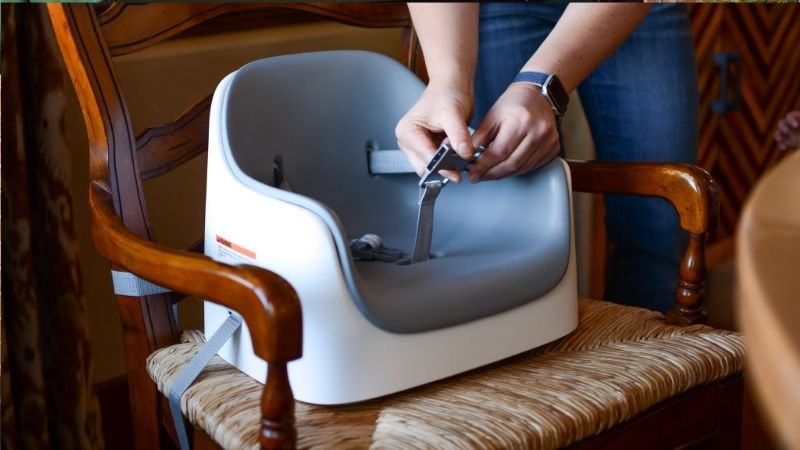
Every booster straps to the chair seat and usually the backrest, so check that your chair has both anchor areas clear of arms or decorative rails. Measure the seat depth and width against the booster’s base, then confirm the straps reach around your chair’s frame before a child ever sits in the seat.
Avoid any product or claim that says it fits any chair, because booster fit is specific. A round bistro seat, a padded dining chair, and a bench each change how the base sits and how the straps tension. When the fit is marginal, choose a different booster rather than forcing the straps to almost reach.
Harness and Restraint
Restraint is the safety spec that matters most. The OXO Tot Perch uses a three-point harness to hold a child at the table, while some simpler boosters rely on a tray or a lap strap. A harness keeps a wriggly toddler seated, and feeding boosters are covered by a US safety standard, ASTM F2640, worth confirming on the box.
Match the restraint to your child’s stage: a younger child who cannot yet sit steadily needs a full harness, while an older, steadier child may manage with a lap belt. Fisher-Price’s Healthy Care booster, for instance, states the child must be able to sit upright unassisted, which is a real gate, not a suggestion.
Check that the harness adjusts and latches firmly and that the buckle resists small fingers. A harness that loosens in use defeats its purpose, so test the tension after attaching and before each meal. Keep the straps clear of the chair’s moving parts so nothing pinches when the child shifts their weight around.
Weight and Age Limits
Published limits set who the booster is for, and they vary widely. The OXO Tot Perch is rated to 70 pounds and from about 15 months, Chicco’s Pocket Snack to 50 pounds, and the Fisher-Price Healthy Care to 45 pounds. Pick for your child’s current weight with room to grow, not the highest number on the shelf.
Age guidance pairs with weight: most feeding boosters start once a child can sit upright with support or unassisted, depending on the model. Read both the lower and upper limits, since a booster outgrown on weight is unsafe even if the child still fits the seat physically at the dinner table.
A feeding booster is not a car booster seat; the two serve completely different purposes and standards. Never substitute one for the other. For the dinner table, judge a booster on its stated weight range, restraint, and chair fit, and retire it once your child passes the upper limit the maker publishes.
Cleaning, Straps and Portability
Mealtime boosters get messy, so cleanability is a daily concern. Look for a wipeable seat, a removable tray if included, and straps that detach or wipe clean, since food works into every crevice. A smooth, one-piece shell is easier to keep hygienic than a padded seat with seams that trap crumbs and spills.
Portability matters if the booster travels to grandparents or restaurants. Compact models like the Pocket Snack fold flat, while a sturdier harness booster is bulkier but more secure. Weigh how often you will move it against how steady it needs to be at your own table before deciding which trade-off suits your routine.
Straps and buckles are the parts that wear, so check they are replaceable or that the maker sells spares. A cracked buckle or frayed strap is a reason to stop using the seat, not to improvise, so confirm parts availability and keep the model and date in case you need a warranty replacement later.
Top Picks
With three current models publishing clear fit and restraint specs for a booster seat for dining chair use, the fourth row below is a chair-fit checklist rather than a padded pick. Each leads with its restraint and weight limit; measure your own chair against the booster before trusting that any of them will attach securely.
| Product | Best For | Key Spec | Watch Out For |
|---|---|---|---|
| OXO Tot Perch | Best overall restraint | 70 lb; 3-point harness; 15+ mo | Bulkier; confirm straps reach your chair |
| Chicco Pocket Snack | Best for confirmed chair fit | 50 lb; needs 14×14 in seat, 12 in back | Smaller or armchair seats may not fit |
| Fisher-Price Healthy Care | Best budget option | 45 lb; child must sit upright unassisted | Older legacy model; confirm availability |
| What to verify on any chair | Chair fit and standard | Seat size, strap anchors, ASTM F2640 | A booster never fits every chair |
OXO Tot Perch: Best Overall Restraint
The OXO Tot Perch takes the top slot for restraint, pairing a three-point harness with a 70-pound limit and a stated start around 15 months. It suits families who want a secure harness for a younger or wrigglier child. It sits in the budget-to-mid tier, so check the current price before ordering.
Its advantage is the harness: three points keep a toddler held at the table far better than a lap strap, and the higher weight limit means a longer useful life. Confirm your chair’s seat and backrest are clear enough for the straps to wrap and tension, since a secure attachment is what makes the harness work.
The honest downside is bulk: a harness booster is larger and less packable than a flat fold-up model, so it is less ideal for frequent travel. Check that the straps and buckle stay firm over months of use, and that OXO offers replacement straps, since those are the parts that wear before the shell does.
Chicco Pocket Snack: Best for Confirmed Chair Fit
Chicco’s Pocket Snack earns its slot by publishing the chair it needs: a seat at least 14 by 14 inches and a backrest at least 12 inches tall, with a 50-pound limit. It suits parents who want to measure and confirm fit in advance. It lands in the budget tier, so verify today’s price at checkout.
Its strength is clarity and portability: the stated minimums let you check your chair before buying, and the compact design folds for travel to restaurants or grandparents. Measure your own chair against those numbers first, since a smaller dining seat or an armchair may not give the straps a secure anchor.
The trade-off is that the same clear minimums rule out some chairs: a round bistro seat or a narrow armchair may fall short of 14 by 14 inches. It relies on a tray and lap restraint rather than a full harness, so for a very young, unsteady child the OXO harness is the more secure call at the table.
Fisher-Price Healthy Care: Best Budget Option
The Fisher-Price Healthy Care is the budget pick, a long-running booster rated to 45 pounds that states the child must be able to sit upright unassisted. It suits an older, steadier toddler and a tight budget. It sits in the budget tier, so confirm the current price and, importantly, that the model is still in stock.
Its advantage is simplicity and low cost: a straightforward seat that straps to a dining chair and cleans easily. Because it expects a child who already sits upright on their own, it is not the pick for the youngest eaters. Measure your chair and confirm the straps anchor to both the seat and the backrest.
The caveat is availability: as an older legacy model, stock and versions vary, so verify you are buying a current, undamaged unit with intact straps. Check that replacement straps or trays are obtainable, and retire the seat once your child passes the 45-pound limit rather than stretching it past the published rating.
What to Verify on Any Dining Chair
Because fit is specific, verify the chair yourself before trusting any booster. Measure the seat width and depth and the backrest height, then compare them to the booster’s stated minimums, the way Chicco publishes 14 by 14 inches. If your chair is smaller, choose a different booster rather than forcing a marginal attachment.
Confirm the chair gives the straps something to grip: a clear seat base and a backrest without arms or wide rails in the way. Tension both straps and tug the booster firmly in several directions; it should not slide or lift. A chair with a slippery cushion or a curved bistro seat often fails this simple test.
Finally, check the safety basics: look for conformance with the feeding-booster standard, ASTM F2640, an intact harness or restraint, and no cracked buckles. A feeding booster is never a car seat, so keep the two uses separate, and stop using any booster whose straps or buckle show wear rather than improvising a fix.
Frequently Asked Questions
Parents shopping for a mealtime booster ask the same safety-first questions about fit, restraint, and age. Each answer below opens with the direct version, then the condition that changes it, so you can match a booster seat for dining chair use to your child’s stage and your own chairs rather than a generic pick.
Is a feeding booster the same as a car booster seat?
No, and the two should never be swapped. A feeding booster raises a child at the dining table and is covered by a feeding-seat standard, ASTM F2640, while a car booster is a crash-tested restraint governed by entirely different rules. Each is designed and tested for its own use and nothing else.
Using one for the other is unsafe: a feeding booster offers no crash protection, and a car seat is not made to strap to a dining chair. Keep them separate, and judge a dining booster only on its table-use specs, the weight limit, the restraint, and how securely it attaches to your particular chair.
If you need both, buy both to their own standards. For the table, confirm the booster meets ASTM F2640 and fits your chair; for the car, follow your vehicle and car-seat maker’s guidance. Mixing the two is one of the clearest lines to hold, since the consequences of getting it wrong are serious.
At what age or weight can a child use one?
It depends on the model, so read both limits. Many feeding boosters start once a child can sit upright, with or without support, and run to an upper weight limit between about 45 and 70 pounds across these picks. Match the booster to your child’s current weight and sitting ability, not just their age in months.
The lower gate is sitting stability: the Fisher-Price model, for instance, states the child must sit upright unassisted. A younger, less steady child needs a harnessed booster like the OXO Perch instead. Confirm your child clears the lower limit before using any booster, since a seat used too early is not safe.
The upper gate is weight. Retire the booster once your child passes the published limit, even if they still physically fit, because the restraint and attachment are rated only to that figure. Keep the manual so you know both numbers, and step up to a standard chair when your child outgrows the seat entirely.
Will a booster fit any dining chair?
No, and no reputable booster claims to. Fit is specific to your chair’s seat size and backrest, which is why Chicco publishes a minimum of 14 by 14 inches with a 12-inch backrest. A smaller seat, a deep cushion, or armrests in the way can all prevent the straps from anchoring securely at the table.
Measure your chair’s seat width, depth, and backrest height, then compare them to the booster’s stated minimums before buying. Armchairs, round bistro seats, and benches are the usual problem cases, since they leave the straps nothing firm to grip or change how the base sits on the surface underneath.
If the fit is marginal, choose a different booster rather than forcing it. A booster that almost attaches is not secure, and a child can tip it. When in doubt, pick a model whose published chair minimums comfortably match your actual chairs, and test the attachment by tugging it before the first meal.
Does a feeding booster need a harness?
For younger or wrigglier children, yes. A harness, like the OXO Perch’s three-point design, holds a child who cannot yet sit still safely at the table, while a steadier, older child may be fine with a lap belt. Match the restraint to your child’s stability rather than assuming every booster needs the same one.
The deciding factor is whether your child sits upright reliably on their own. If they lean, climb, or slide, a full harness is the safer choice; if they sit steadily and follow mealtime rules, a lap restraint can suffice. Always tension and check the restraint before each meal, whichever type you choose.
Whatever the restraint, keep the buckle and straps in good condition and clear of the chair’s moving parts. A worn or cracked buckle is a reason to replace the booster, not to tape over it, so confirm the maker sells spare straps and retire the seat if the restraint can no longer be trusted.
Final Thoughts
The right booster seat for dining chair use is the one whose published minimums match the chair you own and whose restraint suits your child, not the highest weight number. Before ordering, measure your chair’s seat and backrest and tug-test the attachment, since a booster that only almost fits is the one that shifts at the worst moment.