Our Top Picks
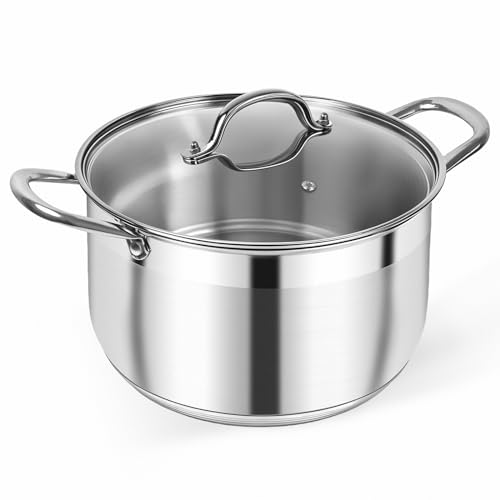 Kirecoo 8 Quart Stainless Steel Induction Stock Pot8 Quarts10.8 x 14.9 x 8.1 inches5.3 poundsCheck on Amazon
 T-fal Specialty Stainless Steel 12 qt Stock Pot12 Quarts10 x 14 x 14 inches3.15 PoundsCheck on Amazon
The best stock pot for most kitchens in 2026 is a 12-quart, fully clad stainless-steel pot with a 2.6–3.0 mm base, riveted side handles, and a tight-fitting lid. It holds enough stock, pasta water, or chili for four to six people, works on every stovetop type including induction, and stays serviceable for 20 years. Cook for one or two and an 8-quart is the smarter buy; can, brew, or fry turkeys and you want 16–24 quarts in aluminum. Everything below is the reasoning behind those three picks, with the measurements, base thicknesses, and weights that actually decide the choice.
The Three-Pot Answer, By Situation
Stock pots are one of the few kitchen purchases where the “buy one good one” advice mostly holds — but only if you buy the right one. A clad stainless pot at 12 quarts covers soup, pasta, beans, braises, and stock for a normal household. What it does not cover is volume cooking, where the physics of a 20-quart pot on a residential burner stop working in your favor, and canning, where aluminum and enameled steel beat stainless on both price and heat transfer.
Kirecoo 8 Quart Stainless Steel Induction Stock Pot with Visible Lid
Picked as a relevant option in this category.
View on AmazonT-fal Specialty Stainless Steel 12 qt Stock Pot with Lid, Induction
Chosen because it specifies Induction.
View on Amazon
SUNHOUSE 12 Quart Stock Pot with Lid, Stainless Steel Large Pot for Cooking
Chosen because it specifies Stainless Steel Large Pot for Cooking.
View on Amazon
HOMICHEF LARGE STOCK POT 24 Quart With Lid - Nickel Free Stainless Steel Cookware Stockpot 24 Quart - Healthy Cookware Polished Stockpots - Heavy Duty Induction Pot Soup Pot With Lid
Chosen because it specifies Nickel Free Stainless Steel Cookware Stockpot 24 Quart and Healthy Cookware Polished Stockpots.
View on Amazon- One or two people, induction cooktop: 8-quart fully clad stainless. Roughly 9 inches across, 6.5 inches deep, about 5 lb empty. Usually $150–$350.
- Family of four to six, mixed stovetop: 12-quart fully clad stainless. Usually $200–$450 for a good tri-ply, $60–$150 for a disc-bottom version.
- Batch cooking, stock, big-batch tomato sauce: 16- to 20-quart aluminum or clad stainless. Usually $80–$250.
- Canning, brewing, outdoor frying: 24- to 40-quart aluminum with a flat bottom and a basket. Usually $70–$250.
- Lowest budget that still cooks well: 12-quart enamel-on-steel or commercial aluminum. Usually $30–$90.
What the Quart Number Actually Means
The quart rating is a volume figure, and it is measured to the brim — not to a useful fill line. In practice you never fill a stock pot past two-thirds for boiling (foam needs headroom) or three-quarters for simmering stock. So a “12-quart” pot gives you about 8 quarts of working volume, which is roughly 32 cups of soup. That is eight generous bowls, or six bowls plus leftovers.
Diameter matters more than capacity for two reasons. First, surface area drives evaporation: a wide 12-quart pot reduces stock faster than a tall, narrow one. Second, diameter determines whether the pot sits properly on your burner. A pot base that overhangs a gas grate by more than an inch loses efficiency and can scorch the handles; a pot base narrower than the element on a glass-top range wastes heat and can leave a ring-shaped hot spot.
| Capacity | Typical diameter × height | Empty weight (tri-ply) | Weight full of water | Working volume at ⅔ fill | Best for |
|---|---|---|---|---|---|
| 8 qt | 9 in × 6.5 in | ~5 lb | ~22 lb | ~5.3 qt | 1–3 people, pasta, small stock |
| 12 qt | 10 in × 8 in | ~7 lb | ~32 lb | ~8 qt | 4–6 people, all-purpose |
| 16 qt | 11 in × 9.5 in | ~9 lb | ~42 lb | ~10.6 qt | Batch soup, large stock |
| 20 qt | 12.5 in × 10.5 in | ~11 lb | ~53 lb | ~13.3 qt | Canning, big batches |
| 24 qt | 13.5 in × 11.5 in | ~13 lb | ~63 lb | ~16 qt | Turkey frying, brewing |
| 32 qt | 15 in × 13 in | ~16 lb | ~83 lb | ~21 qt | Outdoor boils, tamales |
Two numbers in that table change how you shop. The first is the full weight. A 12-quart pot of water weighs 32 pounds — that is a two-handed lift, and it is the reason side handles matter more than a long handle on anything above 8 quarts. The second is height. A 10.5-inch-tall 20-quart pot plus a lid needs about 12 inches of vertical clearance, which is fine on a range with an open hood but a genuine problem under a low microwave or a fixed upper cabinet at 18 inches above the counter.
Also check your sink. A 12.5-inch-diameter pot with handles projecting 1.5 inches each side needs about 15.5 inches of clear sink width to sit flat for soaking. Most double-bowl sinks have 14–16 inch bowls, so the largest pots often have to be washed at an angle or in a bathtub-sized single bowl.
Construction: The Trade-Off That Decides Everything
There are four constructions you will actually encounter, and each is a different answer to the same problem: stainless steel is inert and durable but conducts heat about 15 times worse than aluminum and 25 times worse than copper. Manufacturers solve that by sandwiching a conductor inside stainless, or by bonding an aluminum disc to the bottom, or by abandoning stainless altogether.
| Construction | Typical base thickness | Induction ready? | Oven safe to | Warp risk | Typical price, 12 qt |
|---|---|---|---|---|---|
| Disc-bottom (aluminum slug, stainless cap) | 3–6 mm disc | Sometimes — magnet test it | 350–450°F | High over time | $60–$150 |
| Tri-ply fully clad | 2.4–2.8 mm total | Yes | 500–600°F | Low | $150–$350 |
| 5-ply fully clad | 2.8–3.2 mm total | Yes | 500–600°F | Very low | $250–$500 |
| Copper-core clad | 2.6–2.8 mm with copper layer | Yes | 500–600°F | Very low | $400–$800 |
| Hard-anodized aluminum | 3–4 mm | No (unless a steel base is bonded) | 400–450°F | Low | $80–$200 |
| Raw/commercial aluminum | 3–5 mm | No | Not oven rated | Moderate | $40–$120 |
| Enamel on steel | 0.5–1 mm steel | No | 400–450°F | Chipping, not warping | $30–$80 |
| Enameled cast iron | Solid, 4–6 mm wall | Yes (iron core) | 500°F | None, but cracks if shocked | $300–$600 |
Thermal conductivity in watts per meter-kelvin tells you why these behave differently: copper runs about 385–400, aluminum 205–237, cast iron and carbon steel around 50, and 304 stainless only 14–17. A fully clad pot with a 2.6 mm wall is mostly stainless by thickness but mostly aluminum by heat path, because the aluminum layer carries the heat sideways. A disc-bottom pot concentrates all of its conductor in the base, which means the base heats evenly and the walls stay cooler — great for simmering, less great for reducing, because the walls never get hot enough to drive evaporation.
That is the real trade-off in one sentence: clad pots heat the walls, disc-bottom pots heat only the floor. For soup and stock, either works. For searing a batch of beef before adding liquid, clad wins. For boiling water, neither matters much — you are just moving heat into water.
Aluminum has a second problem: it reacts with acid. Long-simmered tomato sauce or a wine-based braise in raw aluminum will darken the metal and can pick up a metallic note. Hard-anodized aluminum is fine, because the anodized layer is inert. Raw aluminum is fine for water, stock, and frying, which is exactly what commercial kitchens use it for.
Base Thickness: The Number That Predicts Warping
Thin bases warp. That is the whole story, and it happens for a predictable reason: heat the center of a 2 mm aluminum disc faster than its edges and the center expands more, so the bottom domes upward and starts spinning on a flat glass cooktop. Once a pot spins, it has lost contact with the surface and its effective performance drops sharply.
Practical thresholds:
- Under 2.5 mm total base: acceptable only for water boiling. Expect some warping within a few years on high heat.
- 2.5–3.0 mm: the sweet spot for a home stock pot. Stable on induction and glass, still light enough to lift when full.
- 3.0–4.0 mm: near-bulletproof. Noticeably heavier — a 12-quart at this thickness can run 9–10 lb empty.
- 5–6 mm disc bases: common on premium European lines, excellent heat spreading, but the transition from disc edge to pot wall is a stress point if you shock the pot with cold water while hot.
Never run a hot pot under cold water. Thermal shock is the single most common cause of disc delamination and enamel crazing. Let it cool on the stovetop for 15 minutes first.
| Pot base diameter | Burner or element it suits | Notes |
|---|---|---|
| 6–7 in | 6 in induction element, small gas burner | 4-quart pots; good for sauces |
| 8–9 in | 7–8 in element, medium gas burner | 8-quart pots; near-universal fit |
| 9.5–10.5 in | 8–9 in element, large gas burner | 12-quart pots; the standard pairing |
| 11–12.5 in | 10 in element, or a dedicated outdoor burner | 16–20 qt; overhangs most residential grates |
| 13 in and up | Outdoor propane burner only | 24 qt+; will not fit a standard range grate |
On induction, the base must be ferromagnetic — test with a fridge magnet before buying. Induction elements typically run 4 to 6 inches in diameter, and the pot base should be at least as wide as the element, ideally no more than an inch wider. A 12-inch aluminum pot on a 6-inch induction element will heat in a ring and never come to a rolling boil across the whole surface.
Handles, Lids, and the Ergonomics Nobody Mentions
Handle design is where inexpensive stock pots fail, and it fails in a specific way: the rivets loosen or the spot welds pop. Riveted handles are mechanically stronger than welded ones and are the standard on anything worth buying. Look for four to five rivets per handle on a large pot, or a single continuous welded handle on premium European lines where the weld is done under pressure and is genuinely as strong.
The measurement that matters is the gap between the two side handles. On a 12-quart pot this is usually 10–11 inches outside-to-outside, which is comfortable for two hands in oven mitts. Below 9 inches, mitts collide. Above 12 inches, the pot becomes awkward to carry through a doorway — a standard interior door is 32 inches wide, so a 15-inch-diameter 24-quart pot leaves only about 8 inches of clearance on each side. You will carry it sideways or not at all.
Handle material matters for oven use. Bare stainless and cast stainless handles stay usable with a dry towel up to about 400°F; above that, they need mitts. Silicone-wrapped handles are comfortable but often capped at 350–400°F, and some are not oven-safe at all — check before you put the pot in the oven. Hollow cast handles with venting stay cooler longer than solid bar stock.
Lids are underrated. A heavy lid that seals well traps steam and lets you simmer at a lower flame, which reduces scorching and evaporation. A loose lid on a wide pot can lose a quart of liquid an hour at a hard simmer. Glass lids let you monitor without lifting, but they are heavier, breakable, and typically rated lower for oven use than metal lids. If you plan to use the pot in the oven, get a metal lid or plan to cook uncovered.
Stovetop Compatibility, By Cooktop
| Cooktop | What works | What to avoid |
|---|---|---|
| Gas | Anything, including raw aluminum and enamel-on-steel | Bases much narrower than the grate — flames lick the handles |
| Electric coil | Flat bases 2.5 mm+; disc-bottom works well | Thin aluminum (warps and rocks), concave bottoms |
| Glass/ceramic radiant | Perfectly flat bases; clad stainless and enameled cast iron | Rough cast-iron bottoms that scratch; anything that spins; pots over ~50 lb loaded |
| Induction | Fully clad stainless, enameled cast iron, carbon steel, magnetic disc bases | Raw aluminum, copper, most hard-anodized aluminum without a steel plate |
| Portable induction hob | 8- to 12-quart clad pots with bases matching the element | Anything over 12 in diameter; the hob shuts down on overheat |
| Outdoor propane burner | Aluminum 20–60 qt, flat-bottom kettles | Thin stainless — it discolors badly and warps at 100,000 BTU |
Glass-top ranges deserve a specific warning. Most manufacturers specify a maximum load per cooking zone, commonly in the 25–50 pound range, and a 12-quart clad pot full of water is right at 32 pounds. It is generally fine, but sliding a loaded pot across the surface is what cracks glass — lift, don’t drag. Also avoid setting a pot down hard; the impact is what does the damage, not the steady weight.
The Batch-Cooking Decision Matrix
| Your situation | Capacity | Construction | Why |
|---|---|---|---|
| Small apartment, one burner, induction | 8 qt | Tri-ply clad | Fits a 6–8 in element, stores in a cabinet, 22 lb when full |
| Renter, electric coil, tight budget | 12 qt | Disc-bottom stainless | $60–$120, works fine on coils, replaceable |
| Family of five, gas range | 12 qt | Tri-ply or 5-ply clad | 8 qt working volume, oven-safe for finishing |
| Weekly stock and bone broth | 16 qt | Clad stainless or disc-bottom | Tall enough to reduce without scorching; fits a large burner |
| Tomato sauce and canning in summer | 20–24 qt | Raw aluminum or enamel-on-steel | Acid tolerance varies; aluminum is cheap and heats fast |
| Deep frying and turkey frying | 24–32 qt | Aluminum kettle + outdoor burner | Residential ranges cannot hold 350°F in 5 gallons of oil |
| Tamales, corn, lobster boils | 32–40 qt | Aluminum with steamer insert | Needs a rack and a very wide opening |
| Small kitchen, want one pot total | 8 qt Dutch oven instead | Enameled cast iron | Braise, fry, bake bread, and boil — but heavy and slow to heat |
Two rules of thumb help size a batch. For soup, budget 1 to 1.5 quarts per person per serving; a 12-quart pot at two-thirds fill feeds six with leftovers. For pasta, use 4 to 6 quarts of water per pound of dry pasta and keep the pot no more than two-thirds full — a pound of spaghetti in 5 quarts of water in a 12-quart pot will not boil over, but the same pound in 3 quarts in an 8-quart pot will.
Fully Clad Stainless Steel: The All-Purpose Tier
All-Clad D3 12-Quart Stock Pot
The reference point for the category. D3 is a three-ply bonded construction — stainless, aluminum core, stainless — with a total wall thickness around 2.6 mm, an 18/10 stainless interior that will not react with stock or wine, and a starburst-finished exterior. Oven-safe to 600°F, which means you can start a braise on the stovetop and move it straight into a hot oven. Made in the United States. The 12-quart is roughly 10 inches across and 8 inches deep, and weighs about 7 pounds empty. The handles are riveted and stay reasonably cool on a gas flame. The trade-offs are real: it is expensive relative to disc-bottom pots that boil water just as well, the exterior shows scratches and heat tint, and the flared rim can dribble if you pour fast. Typical market range for the 12-quart: $250–$400, with the 8-quart running $180–$300. This is the pot to buy if you want one that outlives your kitchen.
All-Clad D5 8-Quart Stock Pot
D5 adds two more layers and a magnetic stainless exterior ply, bringing total thickness to roughly 2.8 mm and improving heat distribution slightly. In practice, the difference between D3 and D5 in a pot full of water is small — water is an extremely forgiving load. Where D5 shows its advantage is in a partial fill or a wide, shallow braise, where a hot spot would otherwise scorch. The cost is weight and money: expect $300–$450 for the 8-quart. If you already own D3 and are happy, there is no urgent reason to upgrade. If you are buying your first good pot and want the most even heating available in a mainstream American brand, D5 is the pick.
All-Clad Copper Core
A five-ply construction with a copper core sandwiched between aluminum and stainless. Copper’s thermal conductivity — roughly 385–400 W/m·K versus aluminum’s 205–237 — makes the response to burner changes faster and the edge-to-edge uniformity tighter. In a stock pot, the practical benefit is a slightly quicker recovery when you add cold ingredients to a simmer. The price is steep: $450–$800 depending on capacity, with 8- and 12-quart sizes available. The copper layer is fully encapsulated, so there is no polishing and no reactivity. Worth it if you also use the pot as a wide sauté or reduction pan; hard to justify if it only ever holds boiling water.
Cuisinart MultiClad Pro 12-Quart
A tri-ply clad pot that gets you most of the way to premium performance for a fraction of the price. 18/10 interior, aluminum core, riveted handles, oven-safe to 500°F, induction compatible. Wall thickness is in the 2.4–2.6 mm range, which is enough to avoid warping under normal use. Where it differs from the premium tier is in finishing: the rims are less refined, the exterior takes on heat tint more readily, and the handles are a little less comfortable over long carries. Typical price: $150–$250 for the 12-quart, sometimes less on sale. This is the most common recommendation for a first serious stock pot, and it is a defensible one.
Cuisinart Chef’s Classic 12-Quart
A disc-bottom pot: stainless body, aluminum disc bonded to the base, stainless cap. The base heats evenly; the walls stay cooler, which is actually fine for stock and soup. Oven-safe to about 350°F, which rules out high-heat oven finishing. Induction compatibility varies by production run — check with a magnet before you buy, and if the listing does not confirm it, assume it will not work. At $60–$120, it is the best value in the category for someone whose cooking is mostly boiling and simmering.
Tramontina Tri-Ply Clad 12-Quart
A strong mid-tier clad pot, often the least expensive genuinely three-ply option on the shelf. 18/10 cooking surface, riveted handles, oven-safe to 450°F, induction compatible. The clad layer runs slightly thinner than the premium brands, so it is a little more prone to heat tint and slightly faster to react to burner changes. Typical price: $100–$180. If you want clad construction at a disc-bottom price, this is the category to shop in — and there are several store-brand clad lines in the same bracket that perform similarly.
Made In 12-Quart Stock Pot
A five-ply clad pot with a stainless exterior, roughly 2.8 mm thick, 18/10 interior, and a nicely flared rim that pours without dribbling. The handles are comfortable and well-positioned for two-handed lifting. Oven-safe to 550°F, induction compatible. Typical price: $250–$350. The finish is a little more refined than the mid-tier, and the rim detail is a genuine functional advantage when you are decanting 8 quarts of stock into containers.
Demeyere Industry5 and Atlantis Lines
Belgian-made cookware with thick, heavy bases — the Industry5 line runs about 3.7 mm through the base with a five-layer construction, and the Atlantis line adds a copper layer for even faster response. Both are induction compatible and oven-safe to high temperatures. The Silvinox surface treatment resists discoloration better than most, which matters if you dislike the rainbow heat tint that shows up on ordinary stainless after a few months. Expect $350–$600 for stock pot sizes. Heavy, expensive, and among the most durable stainless options you can buy.
Fissler Original Profi Collection
German-made with the distinctive CookStar base — a thick, slightly concave base designed to flatten as it heats, which improves contact with glass and induction surfaces. Base thickness is in the 5–6 mm range, among the thickest in consumer cookware. Oven-safe to 450–500°F depending on the model. Typical price: $300–$550. The concave-to-flat behavior is genuinely useful on glass-top ranges, where a warped pot is worthless. Note the care requirement: avoid thermal shock, because a thick disc base is exactly the kind that delaminates when shocked.
Zwilling Aurora and Spirit Lines
Zwilling’s clad stainless lines offer a middle path: tri-ply or five-ply construction depending on the series, comfortable handles, induction compatibility, and oven ratings in the 400–500°F range. Typical price: $150–$300 for a 12-quart. The Aurora line is the heavier, more premium of the two. Both are widely available and often discounted, which makes them a reasonable value pick if you want a known brand without the flagship price.
Heritage Steel 12-Quart Stock Pot
An American-made five-ply clad pot with a titanium-strengthened stainless exterior and 316Ti interior on some models, which improves corrosion resistance against long-simmered salted stocks. Total thickness around 2.8 mm, oven-safe to 800°F in some configurations. Typical price: $250–$400. The higher-alloy interior is a real advantage if you make stock weekly and have had pitting problems with ordinary 18/10 in the past.
Viking 3-Ply and 5-Ply Stock Pots
Viking’s clad lines are built to similar specifications as the other premium American brands — three- or five-ply, riveted handles, oven-safe to 500–600°F, induction compatible. Typical price: $250–$450. They are heavier than average for their size and have a distinctly commercial feel. Worth considering if you find them discounted, less compelling at full price against the more widely reviewed alternatives.
Hestan ProBond and NanoBond
Hestan’s clad stainless uses a titanium-based surface layer on the NanoBond line that is significantly harder than conventional stainless and resists scratching and discoloration. Both lines are fully clad, induction compatible, and oven-safe to 600°F. Typical price: $400–$700. The durability claim is the selling point; the price is the obstacle. If your main frustration with stainless has been surface scuffing and rainbow tint, this is the line that addresses it directly.
Misen 12-Quart Stock Pot
A direct-to-consumer five-ply clad stainless pot, roughly 2.8 mm thick, with a 18/10 interior and a well-shaped rim. Induction compatible, oven-safe to 500°F, and usually priced below comparable clad pots from established cookware brands. Typical price: $200–$300. The construction is genuinely comparable to the mid-premium tier; what you give up is the track record.
Disc-Bottom and Budget Stainless
Disc-Bottom Stainless Under $150
This is the largest and most confusing category, because dozens of brands sell nearly identical pots. What to check: base thickness (aim for 4 mm or more), whether the disc is fully encapsulated in stainless (a bare aluminum edge will pit in the dishwasher), whether the handles are riveted, and whether the listing explicitly says induction compatible. A 12-quart with a 5 mm encapsulated base and riveted handles at $80–$150 is a genuinely good pot for soup and pasta, and it will outlast three cheap nonstick pots. What it will not do: sear well, go into a 500°F oven, or heat evenly above the fill line.
Granite Ware Enamel-on-Steel
The cheapest functional option, and a genuinely good one for specific jobs. A speckled porcelain-enamel coating over a thin steel body, available in 12- to 21.5-quart sizes at $30–$60. It heats fast, it is light — a 21.5-quart pot weighs only about 6 pounds empty — and the enamel is inert, so it handles tomato sauce and acidic stock without reacting. The limitations are real: it is not induction compatible, it is not oven-safe above about 400°F, the enamel chips if you drop it or bang it against a sink, and the thin steel body scorches easily if you walk away from a high flame. For canning, big-batch chili for a crowd, and turkey frying on a propane burner, it is hard to beat on price per quart.
Commercial Aluminum: Winco, Vollrath, Update International
Restaurant supply aluminum stock pots run 8 to 60 quarts, with thick flat bottoms, no coatings, and prices of $40–$200 depending on size. A 20-quart commercial aluminum pot typically costs less than $100 and will out-boil any clad stainless pot twice its price because aluminum moves heat so much faster. They are not induction compatible, they discolor and pit over time, they should not be used for long acidic simmers, and they are not dishwasher safe. For stock, water, frying, and brewing — the jobs commercial kitchens actually use them for — they are the rational choice.
Hard-Anodized Aluminum: Anolon, Circulon, and Similar
Hard-anodized pots have a thick, abrasion-resistant aluminum body with an inert surface, often with a nonstick interior. Typical price: $80–$200 for a 12-quart. They heat fast and evenly, they handle acid without reacting, and they are lighter than clad stainless. Most are not induction compatible unless a steel base plate is bonded on — check specifically. Nonstick interiors on stock pots are of questionable value, since almost nothing you cook in a stock pot sticks, and the coating limits you to plastic and wooden utensils and typically to 400–450°F in the oven.
Ceramic Nonstick: GreenPan, Ballarini, and Similar
Ceramic (sol-gel) coatings are PTFE-free and handle moderate heat well, but they degrade faster than conventional nonstick under sustained high heat — and a stock pot spends a lot of time at a hard boil. Typical price: $80–$180. If you want a coated pot, buy it for the aluminum body rather than the coating, and expect the coating to be the first thing to fail.
Enamel-on-Steel by Le Creuset and Similar Brands
Premium enamel-on-steel stock pots — Le Creuset’s 12-quart is the best known — run $200–$350 and are a genuinely different product from the $40 hardware-store version. The steel is heavier, the enamel is applied in more layers and adheres better, the handles are riveted and comfortable, and the rims are rolled rather than cut. They are not induction compatible, they are oven-safe to about 400–450°F, and they weigh around 6–7 pounds empty. What you get over stainless is faster heating and no metallic reactivity; what you give up is induction compatibility and searing performance.
Enameled Cast Iron: Le Creuset, Staub, Lodge
Not technically stock pots, but frequently the better answer. A 7- to 7.5-quart enameled cast iron Dutch oven holds nearly as much as an 8-quart stock pot, works on induction, goes into a 500°F oven, and can sear, braise, fry, and bake bread. The trade-offs: a 7-quart round oven weighs 13–14 pounds empty, so 7 quarts of stock means lifting about 28 pounds; cast iron heats slowly and responds sluggishly to burner changes; and the enamel chips if abused. Prices span a wide range — around $80–$150 for a Lodge, $300–$450 for a Staub or Le Creuset, and $400–$600 for the largest 13.25-quart round ovens. If you have room for exactly one heavy pot, this is the more versatile purchase. If you make stock weekly, a dedicated stock pot is easier to handle and easier to clean.
Specialty Pots and the Jobs They Solve
Stock Pots With a Pasta or Steamer Insert
A set with a perforated insert turns one pot into a pasta cooker, a steamer, and a fryer. Typical price: $60–$200. The insert lets you lift a pound of pasta out in one motion and drain it without a colander, and the same insert steams tamales, dumplings, and vegetables. The catch: the insert occupies volume, so a “12-quart” set gives you about 8 quarts of actual cooking space in the pot and less inside the basket. If you buy a set, check that the insert has sturdy side handles — a full basket of pasta is heavy and hot.
Tamale Steamers and 32-Quart Kettles
Wide aluminum kettles with a rack and a lid, 20 to 40 quarts, $50–$150. These exist because tamales, crab boils, and corn need a wide opening and a rack that keeps food out of the water. They are not useful for much else — the wide diameter overhangs every residential burner, and the thin walls scorch anything that is not sitting in liquid.
Outdoor Fry and Boil Kettles: Bayou Classic, King Kooker, and Similar
Aluminum kettles of 24 to 100 quarts paired with a high-output propane burner, $100–$300 for a kit. The burner is the important part: a residential gas range delivers roughly 10,000–18,000 BTU, while an outdoor fry burner runs 50,000–200,000 BTU. That is the difference between reaching 350°F in 5 gallons of oil and never getting there. Use these outdoors only, on a level non-combustible surface, well away from walls and overhangs.
Pressure Canners: Presto 23-Quart and All American 921
For actual canning — not just large-batch cooking — you need a pressure canner rated for the process, typically 16 to 23 quarts, $120–$400. The All American models use a metal-to-metal seal with no gasket to replace; Presto models use a gasket and a dial gauge that should be checked annually. These are not stock pots and should not be used as such; the walls are thin and the base is not designed for sustained high-heat simmering. But if your reason for wanting a 20-quart pot is preserving tomatoes in August, this is the correct purchase.
Electric Multi-Cookers: Instant Pot, Ninja Foodi, and Similar
A 6- to 8-quart electric pressure cooker or multi-cooker can replace a stock pot for stock, beans, and braises, and it does those jobs faster and with less attention. Typical price: $100–$350. What it cannot do is boil a pound of pasta properly, reduce a sauce, or sear at high heat, and the nonstick or stainless inner pot is limited in volume — an “8-quart” multi-cooker should not be filled past about two-thirds for pressure cooking, giving roughly 5.3 quarts of usable space. If your stock pot mostly makes stock, this is a legitimate alternative. If it mostly boils pasta, it is not.
Rondeaus and Braising Pans as Stock Pot Alternatives
A rondeau is a wide, shallow pot with straight sides and two handles; a braising pan is similar with slightly flared sides. Both are common in professional kitchens because the wide surface area reduces liquid fast and the low walls make it easy to reach in with a spoon. A 7- to 9-quart rondeau at $200–$500 is an excellent one-pot braiser, and it can hold a batch of stock, but it will not hold 8 quarts of pasta water without splashing. Choose a rondeau if you reduce more than you boil; choose a stock pot if you boil more than you reduce.
Slow Cookers as the Low-Effort Option
A 6- to 8-quart slow cooker at $40–$150 is a different tool with a different output: unattended simmering without evaporation. It cannot brown, it cannot reduce, and it produces stock with a flatter flavor because nothing ever gets above a simmer. It is genuinely useful for overnight bone broth in a small kitchen where leaving a gas burner lit is not acceptable.
What Wears Out First, and How to Delay It
Stock pots rarely fail dramatically. They fail in one of five ways, and knowing which is which tells you what to spend money on.
- Disc delamination. The aluminum disc separates from the stainless body, usually after years of thermal shock. Once the base has a gap, heat transfer collapses. Prevention: never run a hot pot under cold water, and never heat an empty disc-bottom pot.
- Base warping. Most common on thin aluminum and thin stainless. A warped pot spins on glass and rocks on coil. Prevention: match the base to the burner, avoid maximum heat on an empty pot, and let the pot cool before washing.
- Loose rivets. Rivets work loose from years of lifting a heavy pot by the handles. Prevention: lift with two hands and support the base when the pot is full; do not use the handles as a lever to slide a loaded pot.
- Coating failure. Nonstick and ceramic coatings degrade fastest at high heat and with metal utensils. Prevention: medium heat, silicone or wood tools, and hand washing.
- Pitting and discoloration. Stainless pits when salt sits in cold water on the surface before the water boils. The chloride attacks the passive layer and leaves small dark spots. Prevention: add salt after the water comes to a boil, and do not leave salted water sitting in the pot overnight.
Discoloration — the blue, brown, and rainbow tint that appears on stainless after a few uses — is cosmetic and harmless. A paste of baking soda and water, or a dedicated stainless cleaner, removes most of it. Dishwasher use accelerates discoloration and can leave a dull gray film on aluminum disc edges that are not fully encapsulated, which is why disc-bottom pots should be hand washed if the base has any exposed aluminum.
Frequently Asked Questions
Is a 12-quart stock pot too big for a family of four?
No, but it is at the upper end of useful. A 12-quart pot at two-thirds fill gives about 8 quarts of working volume, which is six to eight servings of soup with leftovers. The downside is that a 12-quart pot needs a lot of water to cover a small batch of pasta, and it takes longer to come to a boil than an 8-quart. If you rarely cook for more than four and never make stock, an 8-quart is the better daily pot, with a 16-quart aluminum pot for the occasional big batch.
Does a stock pot need to be fully clad, or is a disc bottom enough?
For water, stock, and soup, a disc bottom is enough. The disc heats the floor of the pot evenly, and the food sits in liquid anyway. Fully clad construction matters when you sear, sauté, or reduce, because those jobs need heat in the walls, not just the base. If your stock pot is also your braising pot, pay for clad. If it only boils, save the money.
How thick should the base be?
Aim for 2.5 mm or more of total base thickness on a clad pot, or a 4–6 mm disc on a disc-bottom pot. Below 2.5 mm, warping on electric and glass cooktops is a matter of when, not if. Above 3 mm on a clad pot, you are paying for weight you have to lift every time the pot is full.
Will a stock pot work on an induction cooktop?
Only if the base is ferromagnetic. Fully clad stainless, enameled cast iron, and carbon steel all work. Raw aluminum, copper, and most hard-anodized aluminum do not, unless the manufacturer bonded a magnetic steel plate to the base. The reliable test is a refrigerator magnet: if it sticks firmly to the bottom, the pot will work on induction.
How much does a full stock pot weigh?
Water weighs about 2.08 pounds per quart. A 12-quart pot holds 25 pounds of water, plus roughly 7 pounds of pot, for about 32 pounds total. A 20-quart pot full is around 53 pounds. Anything over 30 pounds should be lifted with two hands and carried close to your body, and anything over 50 pounds should be drained in place rather than carried to a sink.
Can I use a stock pot in the oven?
Fully clad stainless and enameled cast iron are typically oven-safe to 500°F or higher. Disc-bottom stainless is usually limited to 350–450°F because the adhesive or bond between disc and body can fail at higher temperatures. Raw aluminum is generally not oven-safe at all. Always check the manufacturer’s rating, and remember that a metal lid rated for the oven is not the same as a glass lid.
What is the best stock pot for making bone broth?
A 12- to 16-quart clad stainless pot with a heavy base and a tight lid. You want volume for long simmers, an inert interior so the slightly acidic broth does not react with the metal, and a heavy base so a 12-hour simmer at the lowest flame does not scorch. An electric multi-cooker is a good alternative if you want to leave it unattended, though the resulting broth is less reduced and needs finishing on the stovetop.
Should I buy a set or a single pot?
A single pot, almost always. Stock pot sets bundle a steamer insert, a pasta insert, and sometimes a smaller pot, and the inserts are useful — but the bundled pots are usually the same construction as the standalone version at a price that only makes sense if you would have bought the inserts anyway. Buy the size and construction you need first, then add an insert if you find yourself wanting one.
Final Picks
For most households, the answer is a 12-quart fully clad stainless stock pot with a base between 2.5 and 3.0 mm, riveted handles, and a metal lid — in the $200–$400 range from any of the established clad brands. It works on every cooktop, goes in the oven, handles acid and salt without reacting, and will still be in your kitchen in 2046.
If you cook for one or two, drop to 8 quarts; the pot will come to a boil faster, weigh about 22 pounds full, and fit in a cabinet. If you batch cook or can, add a 20-quart aluminum or enamel-on-steel pot for $60–$150 alongside the stainless one — that combination covers more ground than any single pot can. And if you want one heavy pot that does everything except boil large volumes of water, buy a 7-quart enameled cast iron Dutch oven instead and accept the 28-pound lift.