Key takeaways
- Chill the beer and glass, but do not freeze the glass. Extreme temperature changes can stress the material.
- Hold the glass at roughly a 45-degree angle and pour slowly down the inside wall.
- As the beer reaches the widest part of the bowl, gradually straighten the glass to build a thick head.
- Leave the bottle with a small amount of beer and yeast sediment at the bottom.
- Swirl the bottle gently, then pour the remaining yeast into the center of the glass.
- Wait briefly for the foam to settle before topping up if the head rises above the rim.
Best Wheat Beer Glasses for Hefeweizen
The best wheat beer glasses for hefeweizen are tall, gently tapered glasses with a wide upper bowl, a narrow foot, a capacity of about 500–700 ml, and a rim that is wide enough to support a thick, persistent head.
Hefeweizen is naturally cloudy, highly carbonated, and rich in banana, clove, citrus, and bread-like aromas. The glass is not just presentation: its shape controls how much beer can be poured with yeast sediment, how quickly carbonation escapes, and where aromas collect before each sip.

Wheat Beer Glasses Erdinger 0.5 L Set of 2
Included for 'Best Wheat Beer Glasses for Hefeweizen' as a relevant option in this category; details come from the product listing.
View on Amazon
Schott Zwiesel Tritan Crystal 14.2 Oz Wheat Beer Glass, Set Of 6
Included for 'Best Wheat Beer Glasses for Hefeweizen' because the listing specifies Set Of 6, details this guide uses to compare options.
View on Amazon
Spiegelau Craft Beer Wheat Beer Glasses, Set of 1, European-Made Lead-Free Crystal, Modern Beer Glasses, Dishwasher Safe, Professional Quality Witbier Glass Gift Set, 26.5 oz
Included for 'Best Wheat Beer Glasses for Hefeweizen' because the listing specifies Set of 1 and European-Made Lead-Free Crystal, details this guide uses to compare options.
View on Amazon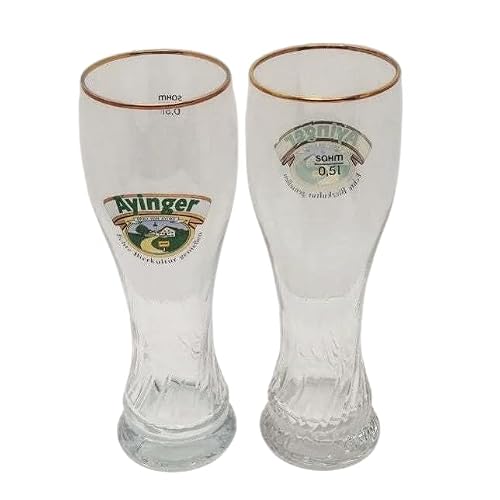
Ayinger Premium Beer Glass Set, Traditional Weizen Style, Gold Rim, 0.5L Capacity, Crystal Clear Glass - 1 Glass
Included for 'Best Wheat Beer Glasses for Hefeweizen' because the listing specifies Traditional Weizen Style and Gold Rim, details this guide uses to compare options.
View on AmazonWhat to look for before buying
Shape: tall below, broad above
A traditional hefeweizen glass has a relatively narrow lower section that expands through the middle and becomes wider near the rim. This shape gives the beer enough surface area for aroma while keeping the glass visually balanced on a narrow foot.
The lower bowl helps guide the initial pour, while the wider upper bowl gives the foam room to rise. A glass that is too straight-sided behaves more like a pint glass: it may release aroma quickly, but it provides less headroom and less visual separation between the cloudy beer and its foam.
Look for an opening that is slightly wider than the middle of the bowl, rather than a narrow tulip-style opening. Hefeweizen benefits from aroma space, but an extremely wide rim can make the head spread thin and allow carbonation to dissipate faster.
Capacity: match the glass to the bottle or pour
For a standard 500 ml bottle of hefeweizen, a 700 ml glass is the most useful size. It leaves enough room for the beer, foam, and the final yeast-rich pour from the bottle. A 500 ml glass can work, but it may overflow when the beer is poured aggressively or when a large head forms.
| Glass capacity | Best use | Practical limitation |
|---|---|---|
| 400–500 ml | 330 ml bottles, smaller servings, compact cabinets | Limited room for a tall head and sediment swirl |
| 600–700 ml | Most 500 ml bottles and traditional full pours | Needs more storage height and a stable base |
| 750–1000 ml | Large shared pours, dramatic presentation, beer halls | Heavier when full and easier to knock over |
Capacity figures are often measured to the rim, not to the recommended fill line. For everyday use, leave approximately 25–35% of the glass empty so the head has space to develop. A 700 ml glass therefore has a comfortable working volume of roughly 450–525 ml.
Rim design: head retention versus drinking comfort
A moderately thin rim gives a clean drinking edge and directs beer smoothly onto the tongue. It also makes the glass feel lighter. However, extremely thin rims can be more vulnerable to chips, especially around a tall glass that is frequently placed in a dishwasher.
A slightly rolled or reinforced rim is more durable and can help maintain the shape of the foam at the top of the glass. It is a practical choice for households with children, busy kitchens, or frequent dishwasher use. Avoid a heavily flared rim if preserving a compact, stable head matters more than theatrical presentation.
Stem and foot: stability matters more than elegance
Many traditional wheat beer glasses have a short stem or pedestal. The stem keeps hands away from the bowl, reducing heat transfer from your fingers and leaving the beer cooler for longer. A short stem also lowers the center of gravity compared with a wine glass.
For everyday use, choose a foot at least 75–90 mm wide and a stem that keeps the bowl clear of the table by about 20–40 mm. Tall, narrow-footed glasses may look authentic but are more likely to tip when placed near a laptop, serving board, or crowded dining setting.
A stemless wheat beer glass is usually easier to store and less likely to break at the stem. The trade-off is that your hand warms the beer more quickly, particularly if the lower bowl is broad.
Best choices by drinking situation
| Your situation | Best glass type | Why it fits |
|---|---|---|
| Traditional bottle pour | 600–700 ml tall hefeweizen glass | Leaves room for foam and the yeast-rich final pour |
| Small apartment or limited cabinet space | 400–500 ml stemless or short-stem glass | Needs less vertical clearance and is easier to store |
| Children, pets, or busy entertaining | Thicker-walled, reinforced-rim glass with a broad foot | Better resistance to knocks and everyday handling |
| Slow sipping outdoors | Heavy-base glass or durable dishwasher-safe glass | More stable and less concerning around patio furniture |
| Beer tasting or aroma comparison | Thin-rimmed 600–700 ml glass with a gently widening bowl | Balances aroma collection, head space, and tasting clarity |
Head-to-head: traditional glass versus modern beer glass
Traditional tall hefeweizen glass
This is the strongest all-purpose choice for people who want the classic presentation. Its tall profile showcases the beer’s color and cloudiness, while the broad top supports a substantial head. It is especially suitable for bottles labeled hefeweizen, weissbier, or weizen because the final yeast sediment can be rolled into the remaining beer and poured into the glass.
The disadvantages are storage and handling. Many are 230–270 mm tall, so measure the gap between your shelf and cabinet before buying. A cabinet with only 250 mm of usable height may not accommodate the glass once it is placed on a shelf or stored in a hanging rack.
Stemmed tulip or snifter
A tulip-shaped glass concentrates aroma more strongly and can be useful for tasting beers with pronounced fruit or spice notes. Its rounded bowl also supports a generous head. However, the narrower opening can make a traditional hefeweizen pour less convenient, and the stem may be more fragile than a pedestal base.
Choose this style when aroma analysis is the priority, not when you want the most recognizable weissbier presentation.
Standard pint glass
A pint glass is inexpensive, versatile, and easy to clean, but it is not usually the best match for hefeweizen. Straight sides provide less aroma concentration and may not leave enough vertical space for a large head. It is a sensible backup glass, particularly for mixed drinkware, but a dedicated wheat beer shape gives better control over foam and sediment.
Dishwasher safety and construction trade-offs
| Construction | Advantages | Trade-offs |
|---|---|---|
| Thin soda-lime glass | Light, inexpensive, crisp rim | More vulnerable to chips and thermal shock |
| Thicker soda-lime glass | Better for family use and frequent washing | Heavier and less delicate at the rim |
| Lead-free crystal | Brilliant clarity and refined feel | Often costs more and may require gentler handling |
| Tempered or durable glass | Useful for entertaining and repeated dishwasher cycles | May feel less thin and may show water spots |
“Dishwasher safe” does not mean immune to damage. Use the upper rack when the manufacturer permits it, keep glasses separated from plates and cutlery, and select a moderate cycle rather than the hottest sanitizing setting. Avoid stacking tall glasses. Repeated contact between glass rims is a common cause of tiny chips.
Hand-washing is preferable for very thin crystal or glasses with printed decoration. Rinse beer residue soon after use because dried yeast can require vigorous scrubbing, which increases the chance of knocking the rim against a sink or brush.
How to pour hefeweizen in the right glass
- Chill the beer and glass, but do not freeze the glass. Extreme temperature changes can stress the material.
- Hold the glass at roughly a 45-degree angle and pour slowly down the inside wall.
- As the beer reaches the widest part of the bowl, gradually straighten the glass to build a thick head.
- Leave the bottle with a small amount of beer and yeast sediment at the bottom.
- Swirl the bottle gently, then pour the remaining yeast into the center of the glass.
- Wait briefly for the foam to settle before topping up if the head rises above the rim.
The final swirl is optional for drinkers who prefer a brighter, less yeasty pour. It is traditional for cloudy wheat beer and adds body and yeast character, but it can also make the beer appear more opaque.
Our buying recommendation
For most homes, choose a 600–700 ml tall hefeweizen glass with a broad foot, a gently flared bowl, a moderately thin but reinforced rim, and clear dishwasher-safety instructions. If storage height is limited, select a 400–500 ml stemless version and reserve space for at least 220 mm of vertical clearance.
Pay more attention to balance and construction than decoration. A beautiful glass that tips easily, cannot fit in the dishwasher, or leaves no room for a bottle-sized pour will be used less often. The right wheat beer glass should make the traditional pour easy, preserve a stable head, release banana and clove aromas, and remain practical enough for ordinary evenings at home.