Key takeaways
- A genuine small dining table for 2 is defined by its tabletop footprint, since that is what has to fit a tight kitchen or apartment. A table that seats two but sprawls across the room misses the point, so compare…
A genuine small dining table for 2 is defined by its tabletop footprint, since that is what has to fit a tight kitchen or apartment. A table that seats two but sprawls across the room misses the point, so compare the actual width and depth before anything else.
How to Choose a Small Dining Table
Choose a two-person table by its tabletop footprint first, then the room for chairs, whether it folds, and that it genuinely seats two. Footprint is the defining spec because the whole point is fitting a small space, and a compact top with room to pull chairs out matters more than extra tabletop you cannot place.
Width and Depth
The tabletop width and depth are the specs that define this category, so read both. IKEA lists the VIHALS at 29.125 by 29.125 inches, the NÄSINGE at 31.5 by 23.625 inches, and the LISABO at 34.625 by 30.75 inches, so even among small tables the footprints vary noticeably in both dimensions.
Match the footprint to your space and your diners, since a shallower depth like the NÄSINGE’s 23.625 inches fits against a wall or in a galley kitchen, while a squarer VIHALS suits a corner. The smallest footprint is not always best; it must still give two people room to eat comfortably across from each other.
Consider the usable surface per diner, since a 23-to-30-inch depth splits into modest place settings for two. A deeper or wider top gives more elbow and plate room but claims more floor, so weigh the tabletop area you need against the space you can spare, which is the real trade-off for a two-seater.
Chair Circulation
A small table still needs room for chairs to pull out, so plan the circulation, not just the tabletop. Leave roughly a couple of feet behind each chair to sit down and stand, since a table that fits the footprint but leaves no room to pull chairs back is impractical in the tight spaces these tables target.
In a galley kitchen or against a wall, a table like the NÄSINGE lets chairs tuck in and pull out into the open side, which suits one-sided placement. Measure the clear space around the table, because the chairs and the room to move them are part of the real footprint a two-seater claims in use.
If space is very tight, chairs that tuck fully under the table or a bench on one side reduce the circulation needed. Plan where each diner sits and how they get in and out, since the chair clearance often decides whether a small dining table actually works in a cramped room, more than the tabletop size alone.
Fixed Versus Drop-Leaf
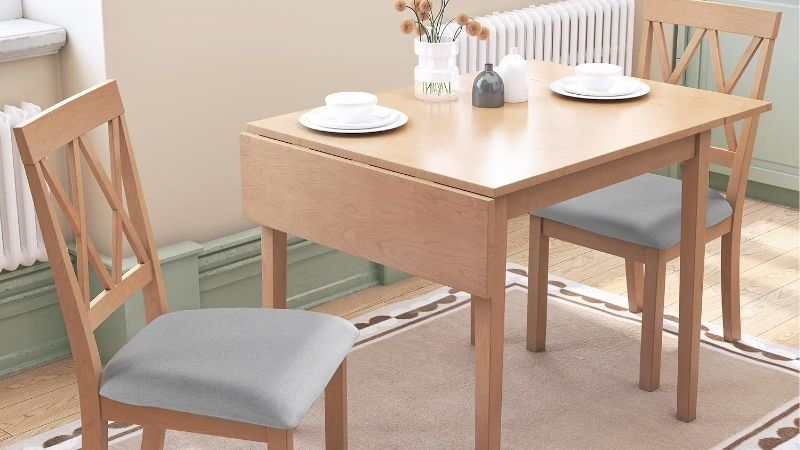
Whether the table is fixed or expandable changes its flexibility, so weigh the two. A fixed table like the VIHALS or LISABO keeps a constant footprint, while IKEA lists the NORDVIKEN as a drop-leaf going from 29.125 inches closed to 41 inches open, seating two to four, which adapts when you host.
A drop-leaf suits a small home that occasionally needs more seating, folding down to a two-seater for daily use and opening for guests. A fixed table is simpler and sturdier but offers no flexibility, so choose based on whether you ever need to seat more than two, which the NORDVIKEN handles and the others do not.
Remember the open footprint of a drop-leaf still needs room when extended, so confirm the 41-inch open size fits when you plan to use it. The closed size governs daily space and the open size governs hosting, so a drop-leaf gives two footprints to plan around rather than one, which is its flexibility and its catch.
Seating Two Confirmation
Confirm the table is actually configured for two, since some tables are two-seaters only in a specific setup. IKEA lists the LISABO in a two-seat configuration and the NORDVIKEN as seating two to four, so check that the footprint you choose matches a genuine two-person layout rather than a larger table scaled down on paper.
A table marketed as small should seat two comfortably with real place settings, not just technically fit two chairs around a tiny top. Read the stated seating for each, since the footprint and the intended seating together confirm it is a true two-seater rather than an oversized or undersized compromise.
For the drop-leaf NORDVIKEN, the two-seat use is the closed configuration, expanding to four when open, so plan which mode is your default. Matching the stated seating to your actual need, whether a dedicated two-seater or an occasional four, ensures the small dining table for 2 you pick suits how you really dine.
Best Small Dining Tables for Two
Each pick below leads with its tabletop footprint and function, the specs that decide fit in a small room. These four are all IKEA models, so the comparison is within one brand’s lineup rather than across the market; check the current price and measure your space before you buy any of these tables.
| Product | Best For | Key Spec | Watch Out For |
|---|---|---|---|
| IKEA NÄSINGE | Best for the tightest space | 31.5×23.625 in; seats 2; fixed | Shallow depth limits place settings |
| IKEA VIHALS | Best square two-seater | 29.125×29.125×29.5 in; seats 2; fixed | Square top suits a corner more than a wall |
| IKEA NORDVIKEN | Best expandable | 29.125 closed / 41 open ×29.125 in; seats 2–4; drop-leaf | Open size needs room when hosting |
| IKEA LISABO | Best roomier two-seater | 34.625×30.75 in; 2-seat config; fixed | Largest footprint of the four |
IKEA NÄSINGE
The IKEA NÄSINGE is the pick for the tightest space, at 31.5 by 23.625 inches seating two. Its shallow 23.625-inch depth makes it the easiest to place against a wall or in a galley kitchen, where a deeper table would intrude, so it suits the smallest kitchens and nooks this category is really meant for.
The narrow depth lets it sit flush to a wall with chairs pulling out into the open side, which is ideal for a one-sided layout in a cramped kitchen. For a studio or small apartment where floor space is scarce, its compact footprint delivers a real two-seater without claiming much of the room.
The trade-off is that the shallow depth gives modest place settings, so two full dinner plates plus serving dishes can feel tight. Confirm the depth suits how you dine, plan the chair pull-out room on the open side, and check the current price at IKEA before buying this compact table.
IKEA VIHALS
The IKEA VIHALS is the square two-seater, at 29.125 by 29.125 by 29.5 inches seating two. Its even square top gives balanced place settings for two people facing each other and suits a corner or the center of a small room, where a square footprint often sits more naturally than a rectangular one.
The square shape makes it easy to place two chairs opposite or adjacent, and the modest footprint fits small kitchens and dining nooks. For a layout where the table sits away from a wall, the symmetry of a square top is both practical for two diners and tidy in a genuinely compact space.
The consideration is that a square top suits a corner or open placement more than sitting flush against a long wall, where a rectangular table fits better. Decide how you will place it, confirm the footprint fits with chair clearance, and check the current price at IKEA before buying this square two-seater.
IKEA NORDVIKEN
The IKEA NORDVIKEN is the expandable pick, a drop-leaf going from 29.125 inches closed to 41 inches open, seating two to four. For a small home that occasionally hosts, it works as a compact two-seater day to day and opens to seat four when guests arrive, which the fixed tables here cannot do.
That flexibility is its standout, letting a tight space stay open most of the time and expand only when needed. The closed footprint matches the compact VIHALS for daily use, so you get a genuine small two-seater that doubles its capacity without buying a second table or living with a larger footprint full-time.
The catch is that the open 41-inch size still needs room when extended, so confirm your space fits it when hosting four. Plan around both the closed and open footprints, check that the drop-leaf mechanism suits how often you expand it, and check the current price at IKEA before buying this expandable table.
IKEA LISABO
The IKEA LISABO is the roomier two-seater, at 34.625 by 30.75 inches in a two-seat configuration. It offers the most tabletop of the four, giving two diners generous place-setting and serving space, which suits a small room that can spare a bit more floor area for a more comfortable meal.
The larger top is the appeal for anyone who finds the tightest tables cramped at mealtime, trading a slightly bigger footprint for real elbow and plate room. For a dining nook or small kitchen with a little space to give, the LISABO balances compactness with a more comfortable surface for two.
The trade-off is simply that it is the largest footprint here, so it needs more floor and chair clearance than the others. Confirm the 34.625-by-30.75-inch top fits your space with room to pull chairs out, and check the current price at IKEA before buying this roomier two-seater table.
Fit It in a Small Room
Getting a two-seater into a small room is about more than the tabletop, so plan the placement. Thinking through the footprint, chair pull-out, wall placement, and any drop-leaf expansion turns a well-sized table into one that actually works in a tight kitchen or apartment without blocking the space.
Footprint
Start by marking the table’s footprint on the floor and checking it against your space, since the tabletop plus a little overhang is the core area it claims. A 31.5-by-23.625-inch NÄSINGE and a 34.625-by-30.75-inch LISABO claim quite different areas, so the footprint you choose should match the floor you can give it.
Measure the available area honestly, including where it narrows near doorways or appliances, because a small kitchen often has less usable floor than it appears. The footprint is the first filter: a table that does not fit the floor area with room around it is the wrong pick no matter how well it seats two.
Leave room beyond the tabletop for chairs and movement, which the next steps cover, so treat the footprint as the minimum rather than the total. Getting the core footprint right against your measured space is the foundation, since every other placement decision builds on the area the table itself occupies.
Chair Pull-Out
Plan the space to pull chairs out and sit down, which a small room can easily lack. Leave roughly two feet behind each chair for getting in and out, and confirm that space is clear of walls, counters, or walkways, since a table that fits but traps the chairs against a wall is frustrating to use daily.
In the tightest rooms, place the table so chairs pull out toward the open side, as a shallow NÄSINGE against a wall allows, rather than needing clearance on all sides. Matching the pull-out direction to where you have room is often what makes a two-seater work in a kitchen that cannot spare clearance everywhere.
Chairs that tuck fully under the table reduce the footprint when not in use, which helps keep a walkway clear. Consider the chairs together with the table, since the pull-out room is part of the real space a small dining table claims, and planning it avoids a setup that looks fine but is awkward in practice.
Wall Placement
Placing a small table against a wall saves space, but the table shape affects how well it works there. A rectangular, shallower table like the NÄSINGE sits flush to a wall efficiently, while a square VIHALS can look and function better in a corner or freestanding, so match the shape to the placement you have in mind.
Against a wall, only the outer side needs chair clearance, which stretches a small room’s usable space, so a wall-friendly shape is an advantage in a galley kitchen. Confirm the table’s depth suits sitting comfortably when one side is against the wall, since too shallow a top can feel cramped in that layout.
A corner placement can tuck a square table out of the main path while still seating two, which suits an open-plan nook. Decide whether a wall or corner placement fits your room, and choose the table shape that works best there, since placement and shape together determine how little space the table ends up claiming.
Drop-Leaf Flexibility
If you sometimes need to seat more than two, a drop-leaf like the NORDVIKEN gives flexibility that a fixed table cannot. Keeping it closed at 29.125 inches for daily two-person use and opening to 41 inches for guests lets a small room stay open most of the time and expand only when hosting four.
Plan for both footprints, since the open size needs clearance and chair room for four, which a tight space may only manage occasionally. The drop-leaf works best where you have the floor to expand into when needed but prefer the compact footprint day to day, so confirm both configurations fit your room.
A drop-leaf adds a mechanism and a little complexity over a fixed table, so weigh whether you will actually use the expansion. For a small home that regularly shifts between two diners and a few guests, it is the flexible answer; for a dedicated two-seater, a simpler fixed table may suit better.
Final Thoughts
The best small dining table for 2 is the one whose tabletop footprint fits your room with space to pull chairs out, in a fixed or drop-leaf form that matches how you dine. Compare the NÄSINGE, VIHALS, NORDVIKEN, and LISABO on footprint and function, remember this shortlist sits within one brand, measure your space and chairs, and check the price.