
Key takeaways
- Shopping for a twin bed frame with headboard and footboard sounds simple until two panels and a mattress have to share a small room. The catch is footprint: the outer frame runs wider and longer than the 38-by-75-inch mattress, so…
Shopping for a twin bed frame with headboard and footboard sounds simple until two panels and a mattress have to share a small room. The catch is footprint: the outer frame runs wider and longer than the 38-by-75-inch mattress, so this guide compares real assembled sizes, clearance and support.
As an Amazon Associate we earn from qualifying purchases.
By KK Home Furnishings Editorial Team
How to Choose a Twin Bed Frame with Headboard and Footboard
A twin frame is judged less by its mattress size than by the space its end panels claim. A headboard adds length a wall has to absorb; a footboard adds length at the foot. Before any model earns a spot, four things decide the fit: outer footprint, under-bed clearance, the panels themselves, and how the deck is supported.
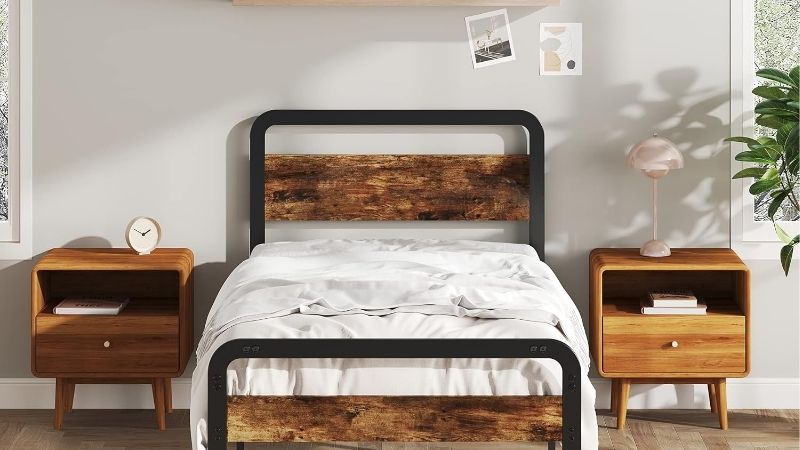
Measure the Outer Footprint, Not the Mattress
Nominal Twin mattresses measure 38 by 75 inches, but these frames sit larger: IKEA STJÄRNÖ assembles to 41⅜ by 78⅜ inches, while a VECELO twin lists a 75-by-39-inch footprint. Those extra inches of overhang on each side are what a wall, a nightstand or a door swing has to absorb, so compare the assembled figure, not the mattress label.
Map the wall before you order. Measure from corner to corner where the head will sit, then subtract a few inches for a nightstand or a radiator. An August Grove twin lists 41 inches wide and 78 inches long, so in a narrow room the footboard can push the usable walkway tighter than the mattress number suggests.
Overhang also sets how the frame ages in a tight space. A footboard that overshoots the walkway invites knocks and loosened joints over time, and metal corner welds take the worst of repeated bumps. If the room is tight, a model whose outer length stays closest to 78 inches leaves the most room to move.
Check Under-Bed Clearance for Storage
Clearance is the gap from floor to frame, and it decides whether storage bins slide under. STJÄRNÖ lists 8⅝ inches of clearance, enough for shallow underbed boxes, while a Gianna twin lists 12.8 inches, which clears taller totes. Neither number is the mattress height, so read the spec sheet’s own label.
Match the gap to what you actually store. Flat gift-wrap and off-season bedding fit under 8 inches; wheeled under-bed drawers and tall bins usually want 10 inches or more. Measure your bins first, then compare, because clearance on a twin is one of the few specs makers publish consistently for this category.
Higher clearance has a trade-off worth noting. A taller deck can mean a higher sleep surface once the mattress is on, which matters for a child climbing in or an older sleeper. It also leaves legs and center support more exposed, so check that the support bar is rated for the deck, not just added as a prop.
Confirm the Headboard and Footboard Are Included
This keyword is specific, yet many listings pair a headboard with an open foot or sell the panels separately. Confirm both end panels ship in the box and note their height: an August Grove twin lists an overall height of 42.5 inches, driven mostly by its headboard, which changes how the bed reads against a wall.
Panel height is a styling and clearance call at once. A tall headboard suits a bare wall but can block a low window sill or a wall outlet; a low footboard keeps sightlines open in a shared kids’ room. Measure the wall height behind the bed and the window line before committing to a tall-panel twin frame.
End panels are also where cheaper builds flex. Particleboard or thin MDF panels sold in the US must meet formaldehyde limits under TSCA Title VI [EPA], but thin panels can still work loose at the bolts after a few moves. Solid-metal or thick-panel headboards hold their fasteners better over repeated disassembly.
Look at the Support System and Foundation Rule
Under the mattress, support is slats, a wire deck or a center rail. A twin is narrow enough that many frames skip a center leg, but a weak deck still sags. Capacity numbers help here only loosely: a Gianna twin lists 700 pounds, but that figure is listing-stated and not measured to a shared test standard.
Foundation rules matter most if a foam mattress is going on top. Several foam-mattress makers tie warranty coverage to a maximum slat gap, often around 2.5 to 3 inches, but the exact figure is set by the mattress brand, so check the warranty for the bed you own before buying a wide-slat twin frame.
The quiet failure point is noise and movement, not collapse. Metal decks can creak where the slats meet the rail as the joints loosen, and felt pads or re-tightened bolts fix most of it. Favor a frame that sells replacement slats and hardware, because a single bent slat should never retire an otherwise sound bed.
Top Picks
Four twin frames cover the common trade-offs. Outer length clusters near 78 inches across all of them, so the real separation is clearance and panel height. Each entry leans on manufacturer-stated specs and a tier, not a fixed price, because listings in this category move week to week — confirm the current price before you buy.
| Product | Best For | Key Spec | Watch Out For |
|---|---|---|---|
| IKEA STJÄRNÖ Twin | Best overall for fit and storage | 41⅜×78⅜ in; 8⅝ in clearance | Shallow clearance limits tall bins |
| VECELO Twin | Best for a tight footprint | 39 in wide; 75 in long | Capacity not published to a standard |
| Gianna Twin | Best for high under-bed clearance | 12.8 in clearance; 700 lb listing-stated | Capacity is listing-stated, not verified |
| August Grove Twin | Best for a tall headboard | 42.5 in tall; 41 in wide | Tall panel can block low windows |
IKEA STJÄRNÖ Twin: Best Overall for Fit and Storage
For most small rooms, STJÄRNÖ is the safe call because IKEA publishes what matters: an assembled 41⅜ by 78⅜ inch footprint and 8⅝ inches of under-bed clearance. It sits in the budget-to-mid tier for twin frames, though prices move, so check the current price at IKEA before you order anything.
Its strength is predictability. Because the outer dimensions are stated by the maker, you can map the wall and the walkway before the box arrives, which is exactly what a headboard-and-footboard set makes hard to eyeball. The low clearance still swallows flat storage boxes and seasonal bedding with ease.
The limitation is that 8⅝ inches of clearance rules out tall wheeled drawers, so heavy-storage shoppers should look higher. IKEA frames assemble with cam locks that can loosen after repeated moves; keep the hardware sheet and re-torque the joints when you relocate, since replacement parts are easy to source.
VECELO Twin: Best for a Tight Footprint
When floor space is the constraint, the VECELO twin keeps a slim profile at 39 inches wide and 75 inches long, close to the mattress itself. That makes it the easiest of these to slot beside a desk or under a sloped ceiling. It lands in the budget tier; confirm the current price and the exact variant first.
The narrow footprint is the whole point for a box room or a shared kids’ space, and the included panels keep bedding from sliding off the ends. Its short 75-inch length leaves a little more walkway at the foot than the longer frames here, which helps when a door swings into the room behind it.
What VECELO does not publish is a capacity figure tested to a shared standard, so treat any load claim as manufacturer-stated. Metal platform frames in this tier can creak at the slat-to-rail joints as they age; felt tape and periodic re-tightening keep it quiet, and single slats are cheap to replace when one bends.
Gianna Twin: Best for High Under-Bed Clearance
Storage-first shoppers get the most room under the Gianna twin, which lists 12.8 inches of clearance — enough for tall totes and wheeled drawers that the lower frames block. Its listing also states a 700-pound capacity. Expect a budget-to-mid tier; verify the current price and that both panels actually ship.
That clearance is the reason to pick it: a child’s out-of-season clothes, bulk paper goods or spare bedding all fit underneath without a separate storage bed. The extra height does raise the sleep surface, so it suits older children and adults more than a toddler just moving out of a crib, where a lower deck is kinder.
Read the 700-pound figure with care: it is listing-stated, not measured to a published test, so it is a rough ceiling rather than a guarantee. Count the mattress and sleeper against it, not body weight alone. As with most metal twins, a sold-separately slat or center bar keeps a sagging deck from becoming a replacement.
August Grove Twin: Best for a Tall Headboard
If the bed anchors a wall, the August Grove twin leads on presence with a 42.5-inch overall height and a 41-inch width, the headboard doing most of that work. The footboard frames the end for a finished look. It reads mid tier for a paneled metal frame; check the current price and the finish options before buying.
A tall headboard suits a grown-up guest room or a teen’s room against a bare wall, and it hides the pillow gap that low panels leave open. Before buying, measure the wall: a 42.5-inch panel can cross a low window sill or sit in front of a mid-height outlet, which is awkward to reach once the bed is in place.
Taller panels put more leverage on the head-end bolts, so this is a frame to re-tighten after the first few weeks and after any move. Powder-coated steel resists rust indoors but chips at the welds; touch up bare spots to stop corrosion creeping where the coating breaks, and keep the seller’s hardware list handy.
Frequently Asked Questions
A few questions come up for almost every shopper weighing a paneled twin, from whether a box spring is needed to how much bigger the frame runs than the mattress. The answers below lean on published dimensions and the support rules makers actually write into their warranties, not on rules of thumb.
Does a Twin Frame With a Headboard and Footboard Need a Box Spring?
Usually not, if the frame has slats or a solid deck. Most platform-style twin frames with headboard and footboard are built to hold the mattress directly, so a box spring is optional rather than required. Check the product page for the words “no box spring needed” to be certain before ordering.
Whether you want one anyway depends on height and feel. A box spring or foundation raises the sleep surface and can add a little give under an innerspring mattress; a foam or hybrid usually wants a firm, even base instead. The frame’s clearance and your mattress type decide which route makes the most sense.
The exception is a warranty rule. Several foam-mattress brands require a foundation or a maximum slat gap to keep coverage valid, so read the mattress warranty, not just the frame listing. If the slats sit wider than the brand allows, add a bunkie board rather than risk voiding the guarantee outright.
How Much Bigger Than the Mattress Is the Frame?
Plan for roughly three to four inches of overhang in width and a few inches in length. A 38-by-75-inch twin mattress sits inside frames that run about 39 to 41 inches wide and 78 inches long here, with the footboard adding most of the extra length. Always check the overall figure, not the mattress size.
That gap is why a twin can feel tight in a box room even when the mattress fits on paper. The headboard presses against the wall and the footboard eats walkway at the foot. Measure the floor space corner to corner, then subtract the overall length and width, not the nominal size, before you commit.
Delivery is the other place overhang bites. Bulky paneled frames ship in long boxes; measure the doorway, hallway turns and stair width before ordering, because a 78-inch carton is harder to route than the assembled bed. Flat-pack models are easier to carry in but ask for more assembly time once inside.
Can I Add Under-Bed Storage?
Yes, if the clearance matches your bins. The frames here range from about 8⅝ inches to 12.8 inches of floor-to-frame gap, so measure the bin height first. Shallow boxes fit the lower frames; tall wheeled drawers need the higher-clearance models, or they simply will not roll under the rail at all.
Clearance also changes with the mattress and any foundation you add, since those raise the deck but not the gap underneath. If you plan heavy storage, a frame listing 12 inches or more gives working room; under 9 inches is best for flat, seasonal items rather than everyday-access drawers you open daily.
Keep weight sensible under there, too. Loading heavy totes against the center support can stress a lightweight deck over time, so spread the load and keep the heaviest items near the legs. On a twin shared with a child, lidded bins beat open baskets for dust and for keeping small parts out of reach.
Will a Tall Headboard Fit a Small Room?
It can, but height is the variable to watch. A headboard in this group reaches about 42 inches tall, which clears most wall art but can cross a low window or a mid-wall outlet. Measure wall height behind the bed and the sill line before choosing a tall-panel frame for a compact room with a window.
In a small room, a lower footboard often reads better than a tall one because it keeps the foot of the bed open and the sightline long. A tall headboard against the only free wall can make a box room feel shorter, so balance presence against how much visual space you can spare at the foot.
If the wall has a radiator, baseboard heater or low window, a floating or flush headboard style avoids the clash a deep paneled frame creates against it. Whatever the height, bolt a tall, lightweight headboard to the frame as the maker directs and re-check it after a few weeks, so the panel cannot rock away from the wall with daily use.
Final Thoughts
The right twin bed frame with headboard and footboard is the one whose outer length and clearance still fit the room once both panels are on, not the one that matches the mattress on paper. Measure the overall footprint and the floor-to-frame gap against your bins before ordering, since those are the numbers listings bury most.
