Key takeaways
- A black tv stand starts with a verified black finish, but the finish is only the first gate: the stand then has to be wide enough for the TV’s feet and rated for its weight. This roundup compares four verified…
A black tv stand starts with a verified black finish, but the finish is only the first gate: the stand then has to be wide enough for the TV’s feet and rated for its weight. This roundup compares four verified black stands by published TV or top load and usable width, so the one you choose actually holds your TV, not just matches it.
As an Amazon Associate we earn from qualifying purchases.
By KK Home Furnishings Editorial Team
How to Choose a Black TV Stand
A black finish is easy to find; a stand that fits and safely holds your TV is the real test. Black is the starting condition, so once a stand’s finish is confirmed, the job is to measure the TV’s feet against the usable top, check the maximum TV or top weight separately from shelf loads, and plan cable management and ventilation.
Verify Black Finish Instead of Assuming From Photos
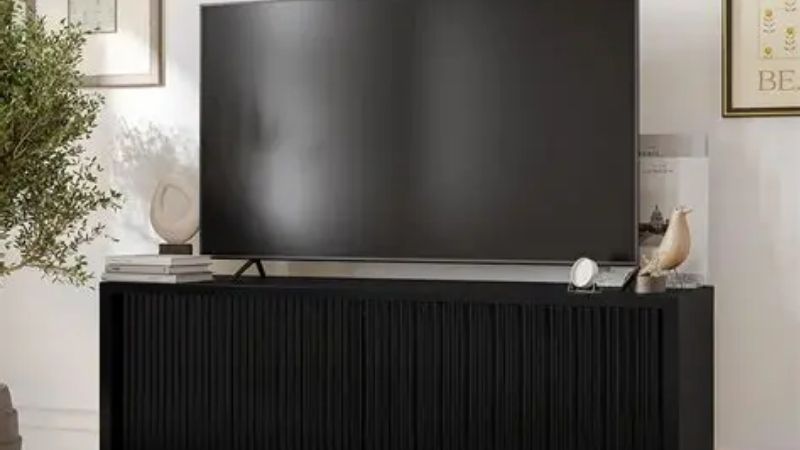
Confirm the exact black variant rather than trusting a photo, since finishes vary by SKU. The picks here are all verified black: the IKEA FJALLBO in black steel and pine, the IKEA BRIMNES in black, the Walker Edison Isla in black solid pine with a glass top, and the Walker Edison HD9724 in black MDF, so each is genuinely the black option.
Match the shade and material of black to the room. A matte black steel frame like the FJALLBO reads industrial, a smooth black cabinet like the BRIMNES reads cleaner, and a black-pine-and-glass build like the Isla reads warmer, so the look of black differs even among verified stands. Confirm the finish on the exact listing you are buying.
Treat black as the entry condition, not the deciding one. Once the finish is verified, the stand still has to fit the TV and the room, so do not let the color settle the choice. Use the confirmed black finish as a filter, then compare the width, the load and the storage, which are what actually determine whether a stand works for you.
Measure the TV Feet Against the Usable Top
The TV’s foot spread, not its screen size, decides whether it sits safely on the top. These stands run from the Isla at 58 inches wide to the BRIMNES at 85.125, with the HD9724 at 80 and the FJALLBO at 78, so measure the distance between your TV’s feet and match it to the usable top width rather than the screen diagonal.
This matters most on legged TVs with a wide stance. If the feet sit wider than the top, the set overhangs and loads the edges, so a large TV can need a wider stand than its screen size implies. A central-pedestal TV needs a top deep and wide enough for the base plate, so check both the width and the depth against the TV.
Marketing screen-size labels can mislead, so rely on measurement. The Isla’s listing, for instance, shows a 65-inch screen figure in one place and 68 inches in another, so its screen size is not a reliable ranking tool; use the 58-inch top width and the TV’s foot spread. Measuring the feet prevents an overhanging, unstable set.
Check Max TV Weight Separately From Shelf Loads
A stand’s maximum TV or top weight is a different figure from its shelf loads, so read the right one. The verified maximums here run from the Walker Edison Isla at 180 pounds down to the HD9724 at 60 pounds, with the FJALLBO at 90 and the BRIMNES at 88, so match your TV’s weight to that top figure with margin to spare.
Confirm your TV’s weight and keep it under the top rating, not just the shelf ratings. A 60-pound top like the HD9724’s suits lighter sets, while the Isla’s 180 pounds gives wide headroom for a heavy large-screen TV. Shelves and cabinets have their own lower limits, so do not load the TV figure onto a shelf or the reverse.
Treat near-equal loads as the same band. The FJALLBO at 90 pounds and the BRIMNES at 88 differ by about 2.3 percent, so neither is meaningfully stronger, and the choice between them turns on width and storage. A higher load does not by itself make a stand the best overall; build, fit and features still decide which one suits you.
Plan Cable Management and Device Ventilation
Cables and airflow are easy to overlook until the setup is a tangle. The FJALLBO offers cable access, the BRIMNES has cable outlets, and the HD9724 adds cabinets and cubbies for devices, so compare how each routes wires and houses a console, soundbar or streamer rather than treating a stand as a flat surface for the TV alone.
Plan the layout around your gear. A stand with cable outlets and open cubbies keeps wires tidy and devices reachable, while closed cabinets hide clutter but need ventilation so a console or receiver does not overheat. Count the devices you will store and the cables they run, then pick a stand whose storage fits them all.
Mind heat in closed storage. Electronics in an enclosed cabinet need airflow, so a stand with vented backs or open shelving suits devices that run warm, while a sealed cabinet can trap heat. Match the storage type to your equipment, and leave a gap for cables and air, so the stand keeps the setup both tidy and cool over time.
Top Picks
Each pick below fills a clear role, with the verified finish, width, load and storage drawn from the makers’ listings, current as of October 2026. Prices and stock move, so confirm before buying. The table pairs the standout figure with the main catch for each stand, and the two IKEA units both require wall anchoring to be safe.
| Product | Best For | Key Spec | Watch Out For |
|---|---|---|---|
| Walker Edison Isla 58 | Best Overall Load Headroom | 180 lb; 58 in W | Listing conflicts on screen-size wording |
| IKEA BRIMNES 85.125 | Best Wide Storage | 85.125 in W; 88 lb | Must be anchored to the wall |
| IKEA FJALLBO 78 | Best Industrial Black | 78 in W; 90 lb | Load almost tied with BRIMNES |
| Walker Edison HD9724 | Best Wide Low Profile | 80 in W; 18 in H | Only 60 lb published top capacity |
Walker Edison Isla 58: Best Overall Load Headroom
The Walker Edison Isla 58 is the pick for the most weight headroom. It measures 58 inches wide by 16 deep by 27 tall in black solid pine with a tempered-glass top, carries a 180-pound published maximum, the highest here, and lists around $429.99 at Target as of October 2026 in the upper tier for a stand of this width.
It suits a heavy large-screen TV where the 180-pound rating gives ample margin, and the solid-pine-and-glass build reads warmer than metal or MDF. At 58 inches it is the narrowest here, so measure your TV’s foot spread against that top, since a wide-stance set could overhang. The glass top also wants care against scratches over time.
The catch is conflicting screen-size wording: the listing shows a 65-inch figure in one place and 68 inches in another, so do not rank it by stated screen size; rely on the 58-inch top width and the 180-pound load and measure your TV’s feet. Its strength is load headroom, so choose it for a heavy TV rather than for maximum width.
IKEA BRIMNES 85.125: Best Wide Storage
The IKEA BRIMNES is the pick for width and storage. At 85.125 inches wide by 16.25 deep by 21.125 tall in black, it is the widest stand here, carries an 88-pound maximum, and adds drawers with cable outlets, listing around $249.99 at IKEA as of October 2026 in the budget-to-mid range for a stand of this generous size.
It suits a long wall and a setup with gear to store, since the 85-inch width spans a large TV and the drawers hide devices while the cable outlets keep wires tidy. Measure your TV’s foot spread against the wide top, and plan for the tempered-glass drawer fronts, which look clean but show fingerprints and need gentle, regular care.
The non-negotiable catch is anchoring: IKEA requires the BRIMNES to be securely anchored to the wall, which is part of using it safely rather than optional. Its 88-pound maximum also sits in the same band as the FJALLBO, so it is not notably stronger; choose it for the width and storage, and secure it to a stud during setup.
IKEA FJALLBO 78: Best Industrial Black
The IKEA FJALLBO is the pick for an industrial black look. At 78 inches wide by 17.75 deep by 21.25 tall in black steel and solid pine with cable access, it carries a 90-pound maximum and lists around $299.99 at IKEA as of October 2026 in the mid tier, offering an open, metal-framed style rather than a closed cabinet.
It suits a room that wants a visible, industrial frame and open shelving for devices, with the steel-and-pine build reading sturdier and more characterful than MDF. Measure your TV’s foot spread against the 78-inch top. Its 90-pound maximum sits level with the BRIMNES, so treat the two as the same load band.
Two conditions apply. IKEA requires the FJALLBO to be securely anchored to the wall, and while the maker notes a TV larger than 75 inches can sit on it if the weight stays within the maximum, it still advises a bench wider than the TV, so that is not a license for any oversized set. Anchor it and measure the TV first.
Walker Edison HD9724: Best Wide Low Profile
The Walker Edison HD9724 is the pick for a wide, low-profile stand at the lowest price. At 80 inches wide by 15.75 deep by just 18 tall in black MDF, it offers two cabinets and four cubbies, carries a 60-pound published top capacity, and lists around $179.99 at Home Depot as of October 2026, the budget option in this group.
It suits a long, low setup with plenty of storage, since the 80-inch width spans a large TV while the 18-inch height keeps the screen low, and the cabinets and cubbies hold consoles and media. Measure your TV’s foot spread against the wide top, and note its width sits within about 2.6 percent of the FJALLBO, so treat them as similar.
The catch is the 60-pound top capacity, the lowest here, so confirm your TV’s weight stays well under it, as heavier large-screen sets may exceed it despite the generous width. The MDF build is lighter-duty than steel or solid pine. Choose it when a wide, low, storage-rich stand for a lighter TV matters more than load headroom.
Frequently Asked Questions
Buyers of TV stands ask the same practical things, mostly about width versus TV size, screen fit, weight and anchoring. Each answer below leads with the direct reply, then adds the condition that changes it, so you can apply it to your exact TV and wall rather than a rule that treats screen size as the only measurement.
Should a TV stand be wider than the TV?
Ideally yes, or at least wide enough for the TV’s feet, which is the real requirement. A stand wider than the TV looks balanced and leaves room for a soundbar, but the non-negotiable is that the feet sit fully on the top, so measure the foot spread against the stand width rather than matching the stand to the screen diagonal.
The deciding figure is foot spread, not screen size. A large TV with a wide stance can need a wider stand than its diagonal suggests, while a central-pedestal set needs a top deep and wide enough for the base plate. Pull both measurements from the TV and compare them to the stand’s usable top before assuming a given width fits.
A stand narrower than the feet is the problem to avoid. If the feet overhang, the set loads the edges and can tip, so err toward a top at least as wide as the foot spread, with margin. A wider stand is safer and tidier, but the minimum is simply that the TV’s feet rest fully and squarely on the surface below it.
Can a 75-inch TV sit on a 70-inch TV stand?
Sometimes, if the TV’s feet fit the top and the weight is within the rating, since screen size is not the measurement that matters. A 75-inch TV with feet spread under 70 inches can sit on a 70-inch stand, while one with a wider stance cannot, so measure the foot spread and the weight rather than comparing the diagonal to the width.
Weight is the second gate. A 75-inch set can be heavy, so the stand’s maximum top rating has to clear it, which the Isla’s 180 pounds does easily and a 60-pound top does not. Confirm both the foot spread against the top width and the TV’s weight against the maximum load before putting a large set on a narrower stand than its diagonal.
Makers may allow a larger TV within limits, but with conditions. IKEA notes the FJALLBO can take a TV over 75 inches if the weight stays within its maximum, yet still advises a bench wider than the TV, so that is not blanket permission. Measure your specific set and respect the maker’s guidance rather than assuming any 75-inch TV fits.
Does maximum TV size matter more than weight?
Weight usually matters more, because it is the figure that determines whether the stand can safely hold the set. A listed maximum screen size is a rough guide, but a TV’s foot spread and weight decide the real fit, so match the weight to the stand’s top rating and the feet to the width rather than trusting a stated screen-size number.
Screen-size labels can also be inconsistent, which makes weight the safer anchor. The Isla’s listing shows two different screen figures, so its stated size is unreliable, while the 180-pound load and 58-inch width are concrete. Use the measured width and the published weight limit, and treat any screen-size claim as secondary.
Check both, but let the hard numbers lead. Confirm the TV’s feet fit the top width and its weight sits under the maximum load, and the screen-size figure becomes a sanity check rather than the deciding factor. A stand that clears the weight and the foot spread holds the TV safely, whatever a marketing screen-size label happens to say.
Do black TV stands need to be anchored?
Tall or top-heavy ones should be, and some makers require it. IKEA requires both the FJALLBO and BRIMNES to be securely anchored to the wall, reflecting the tip-over risk of a loaded stand, so anchor a stand to a wall stud whenever the maker calls for it or the setup is tall, regardless of the finish color on it.
The risk is highest with a heavy TV and in homes with children or pets, who can pull a stand over. Anchoring the stand, and ideally the TV to the wall or the stand, keeps a top-heavy setup from tipping, so use the included or appropriate hardware for your wall type. A low, wide, heavily built stand is more stable but not immune.
Follow each maker’s specific instruction rather than assuming. The IKEA units here explicitly require anchoring, while other stands may advise it, so check the manual for your model and anchor accordingly. Treating wall anchoring as standard, not optional, is the simplest way to keep any TV stand and its screen safely in place.
Final Thoughts
Choosing a black tv stand means treating the finish as the first gate, not the choice: measure the TV’s feet against the top, check the max TV weight apart from shelf loads, and plan cables and anchoring. The high-load Isla, wide BRIMNES, industrial FJALLBO and low HD9724 each suit a TV and wall; the IKEA units must be anchored.