Key takeaways
- Small apartment: Choose a slim two-compartment sorter with removable bags. Measure depth as carefully as width, and skip large wheels if they intrude on the path.
- Busy family: Choose three compartments if they correspond to loads you regularly wash separately. Favor a braced metal frame and bags with reinforced handles.
- Renters or shared laundry: A lightweight rolling frame with locking casters and removable bags is easier to relocate. Check the packed dimensions if it must be carried up stairs or through a tight doorway.
- Pets or snag-prone clothing: Choose sturdier fabric or enclosed bag panels over exposed mesh, and keep the sorter away from areas where pets can pull at loose bags.
- Limited lifting or back discomfort: A stable cart with smooth-rolling wheels can reduce carrying, provided it fits the route and has usable handles. Avoid filling bags so high that lifting them out requires a deep bend or awkward reach.
Best Laundry Sorters for Faster, More Organized Washing
The best laundry sorter is a stable, ventilated frame with enough bag capacity for the time between wash days—and two compartments for most households, or three when separating lights, darks, and towels saves an extra sorting step.
Before comparing layouts, measure where the sorter will stand and how laundry travels to the washer. A roomy three-bag cart is less useful if it blocks a closet door or cannot pass through the laundry-room entrance. The right choice depends on household size, washing frequency, and whether the sorter stays put or needs to move.

ROMOON Laundry Hamper Sorter Cart, 4-Section Organizer with Lockable Wheels
Included for 'Best Laundry Sorters for Faster, More Organized Washing' because the listing specifies 4-Section Organizer with Lockable Wheels, details this guide uses to compare options.
View on Amazon
STORAGE MANIAC 4 Section Laundry Sorter, Laundry Hamper with Wheels, Gray
Included for 'Best Laundry Sorters for Faster, More Organized Washing' because the listing specifies Laundry Hamper with Wheels and Gray, details this guide uses to compare options.
View on Amazon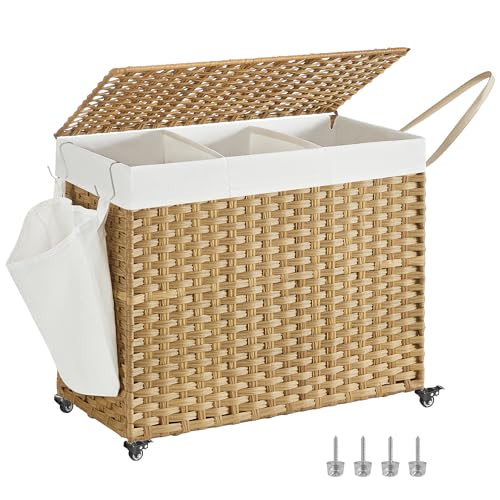
SONGMICS Rolling Laundry Hamper with Lid, 160 L 3-Section Synthetic Rattan
Included for 'Best Laundry Sorters for Faster, More Organized Washing' because the listing specifies 160 L 3-Section Synthetic Rattan, details this guide uses to compare options.
View on Amazon
VASAGLE Laundry Hamper with Shelf, 3 Pull-Out Bags, 3 x 10.6 Gallons (40 L)
Included for 'Best Laundry Sorters for Faster, More Organized Washing' because the listing specifies 3 Pull-Out Bags and 3 x 10.6 Gallons (40 L), details this guide uses to compare options.
View on AmazonChoose the layout that matches your routine
| Household or laundry routine | Best-fit layout | Why it works | Check before buying |
|---|---|---|---|
| One or two people, washing every few days | Two compartments | Separates everyday loads, such as lights and darks, without using extra floor space. | Whether each bag holds enough laundry for your usual load. |
| Family, shared laundry, or weekly wash day | Three compartments | Can separate lights, darks, and towels or delicates before laundry piles up. | Whether the full cart fits with doors, appliances, and walking space clear. |
| Narrow apartment laundry nook | Slim two-compartment sorter | Keeps the footprint compact while still dividing laundry by load. | Frame width and depth, including projecting handles and wheels. |
| Several rooms or a long route to the washer | Rolling sorter with removable bags | Wheels reduce carrying trips; removable bags make it easier to unload. | Wheel locks, doorway clearance, and whether the floor is smooth or uneven. |
Two compartments are not automatically too few for a family: they work if you combine categories that can be washed together and sort again at the machine. Three compartments are useful when they prevent a recurring extra step, not simply because the extra bag is available.
Capacity: compare bag volume with wash frequency
Bag capacity is often given in liters or cubic feet, but the usable amount depends on bag shape and how high it can safely be filled. A wide, shallow bag may be easier to reach into than a narrow, deep one, even if both have similar stated volume. Compare the capacity of each bag—not just the total—because one overloaded compartment can make the whole sorter awkward to move.
As a planning estimate, a typical adult laundry load occupies roughly 2–3 cubic feet when loosely piled. Use that only as a starting point: bulky towels and bedding take more room, while compact clothing takes less. If you wash twice a week, choose capacity around the amount you expect to generate between wash days, rather than buying a large cart that consumes permanent floor space.
Look for removable bags with handles, a reinforced base, or a clear way to lift them out. Check whether a full bag can be carried comfortably to the washer. A cart that rolls well may still be inconvenient if its bags are too heavy or their openings are too small for easy unloading.
Frame, fabric, wheels, and airflow: what matters in daily use
| Feature | Useful specification or design | Trade-off to consider |
|---|---|---|
| Frame | Steel or aluminum tubes with secure joints and a stated load limit | Metal tends to be more stable than a lightweight plastic frame, but can add weight and may corrode if its finish is damaged in a damp room. |
| Bags | Washable polyester or another clearly care-labeled fabric; reinforced seams and handles | Fabric bags are light and removable, but thin material or weak stitching can wear first at the handles and corners. |
| Casters | Four well-attached wheels, ideally with at least two locking brakes | Small wheels suit smooth floors; they can snag on thick rugs, thresholds, or uneven tile. |
| Ventilation | Open mesh, breathable fabric, or gaps around bags | Airflow helps damp clothes dry out sooner, but mesh can catch on zippers or snag-prone items. |
| Footprint | Published assembled width, depth, and height | A compact cart saves floor area but may offer smaller bags or a taller, less stable load. |
For a humid laundry room, avoid leaving wet towels or swimwear sealed in a solid, non-breathable bag. Ventilation is not a substitute for drying wet items promptly, but breathable panels reduce the chance that moisture stays trapped. If odors are a concern, choose bags that can be removed and washed, and confirm their care instructions before purchase.
Frame durability depends on joints as much as material. Check whether rails are braced, bags attach securely, and the manufacturer gives a load limit. A tall, narrow cart can tip if a heavy bag is pulled sharply or the load sits unevenly. Lock the wheels while loading and avoid exceeding the stated limit.
Fit the sorter to the room—not just the available corner
Measure the assembled cart, then add working clearance. As a practical planning target, leave about 24 inches (61 cm) in front of the sorter to remove bags and reach into compartments. Keep at least 30 inches (76 cm) of clear passage where people regularly walk; more is preferable in a shared route. These are layout targets, not universal building-code requirements, so account for appliance doors and household mobility needs.
| Laundry area | Planning example | Sorter direction |
|---|---|---|
| Narrow closet or apartment nook | About 24–30 in. (61–76 cm) of usable width | Measure a slim two-bag frame carefully; confirm it does not obstruct the washer door or closet access. |
| Compact laundry room | About 5 × 6 ft (1.5 × 1.8 m) | A compact cart can fit if the route to the machines remains clear and bags can be removed without moving the cart. |
| Dedicated family laundry room | About 8 × 10 ft (2.4 × 3 m) or larger | A wider three-compartment sorter is easier to accommodate, but preserve a clear path around appliances and storage. |
Room dimensions alone do not guarantee a fit. Sketch the washer and dryer doors in their open positions, then include the sorter and the clearance needed to pull out its bags. In a narrow room, a fixed-position sorter may be better than one on casters if the wheels would drift into the walking path.
Best choice by situation
- Small apartment: Choose a slim two-compartment sorter with removable bags. Measure depth as carefully as width, and skip large wheels if they intrude on the path.
- Busy family: Choose three compartments if they correspond to loads you regularly wash separately. Favor a braced metal frame and bags with reinforced handles.
- Renters or shared laundry: A lightweight rolling frame with locking casters and removable bags is easier to relocate. Check the packed dimensions if it must be carried up stairs or through a tight doorway.
- Pets or snag-prone clothing: Choose sturdier fabric or enclosed bag panels over exposed mesh, and keep the sorter away from areas where pets can pull at loose bags.
- Limited lifting or back discomfort: A stable cart with smooth-rolling wheels can reduce carrying, provided it fits the route and has usable handles. Avoid filling bags so high that lifting them out requires a deep bend or awkward reach.
Assembly and moving: small checks that prevent frustration
Many fabric-and-frame sorters assemble from tubes, connectors, bags, and casters. Before tightening everything, check that the parts match the instructions and orient the bag openings toward the side you can reach. Tighten joints evenly and test the cart unloaded before adding laundry. If the product ships in one box, check its listed package dimensions and weight: a bulky carton may be harder to carry through a stairwell than the assembled sorter is to roll through the home.
Measure the narrowest doorway, hall turn, or stair landing on the route from the delivery point to the laundry area. For moving the assembled cart, compare its overall width—including handles and wheels—with that clearance. When taking it apart, keep small connectors together; loose fittings are easy to lose and can make a stable frame wobble after reassembly.
Bottom line
For most homes, a two-compartment sorter is the practical starting point: it separates common loads while keeping capacity and footprint in check. Choose three compartments when distinct categories genuinely streamline your wash routine. Prioritize a sturdy frame, washable breathable bags, suitable wheel size, and a measured path to the machines; those details determine whether the sorter speeds up laundry or becomes another obstacle in the room.