Key takeaways
- Measure the door thickness, frame clearance, hinge-side clearance, and available walking space.
- Confirm that the hooks fit over the door without blocking the latch or damaging the weather seal.
- Attach every stabilizing screw or bracket only where the door construction permits it; do not drill blindly into a hollow-core door.
- Load the organizer gradually, putting the heaviest items in lower compartments and spreading weight from side to side.
- Open and close the door several times before filling every pocket. Listen for rubbing, bending hooks, or a latch that no longer aligns.
- When moving, empty the organizer rather than carrying it loaded. A filled rack can twist the door, tear its top seam, or catch on a narrow doorway.
Best Over-the-Door Organizers for Every Room
The best over-the-door organizer depends on what you are storing: choose a deep, reinforced pocket system for closets and pantries, a moisture-resistant narrow model for bathrooms, and a shallow file or supply organizer for offices.
Quick picks by room and situation
| Situation | Best organizer type | Useful specifications | Why it fits |
|---|---|---|---|
| Small apartment or bedroom with little floor space | Fabric shoe-and-accessory organizer | 12–24 pockets; 10–18 lb total capacity; 5–7 in. door clearance | Adds storage without using a dresser, shelf, or closet floor. |
| Children’s room or family mudroom | Reinforced fabric bin organizer | 6–12 large pockets; 15–25 lb total capacity; rounded or covered hardware | Holds hats, gloves, small toys, and daily items without sharp wire edges. |
| Renter who cannot drill | Hook-over-door model with padded brackets | 1¾–2¼ in. hook opening; 2–4 in. bracket depth; 10–20 lb capacity | Installs without holes, although the door must close with the brackets in place. |
| Bathroom with humidity and limited wall space | Plastic or coated-metal pocket rack | Water-resistant surface; 3–5 in. depth; 8–15 lb capacity | Handles toiletries better than untreated cardboard or absorbent fabric. |
| Back pain or limited bending | Shallow organizer mounted at hand and shoulder height | Top pockets no higher than 70 in.; bottom pockets at least 30 in. above the floor | Keeps frequently used items between approximately waist and eye level. |
What separates the best over the door organizers
Pocket size and usable depth
Count pocket dimensions, not just the number of pockets. A pocket measuring 5 inches wide by 7 inches high may hold sunglasses, cables, or cosmetics, but not folded towels or adult shoes. For shoes, look for openings at least 8–10 inches wide and 12–16 inches high. For pantry goods, pockets 4–6 inches deep are usually more useful than very shallow compartments, while bathroom storage is safer at roughly 3–5 inches deep so bottles do not project into the doorway.

JARLINK Over the Door Organizer for Bedroom, Pantry, Bathroom, 5 Shelf Grey
Included for 'Best Over-the-Door Organizers for Every Room' because the listing specifies Pantry and Bathroom, details this guide uses to compare options.
View on Amazon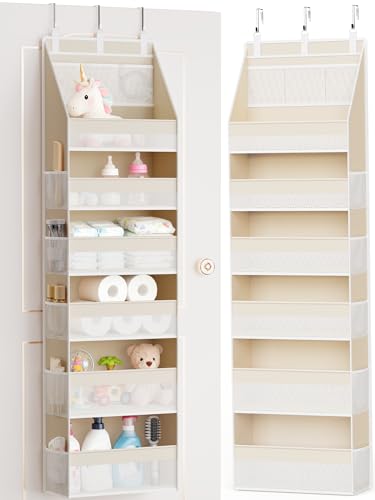
Criusia Over the Door Organizer, 6-Shelf Closet Hanging Storage with 13 Mesh Pockets, 55lbs Capacity Behind the Door Storage for Baby Nursery, Bathroom, Bedroom, and Dorm, Beige
Included for 'Best Over-the-Door Organizers for Every Room' because the listing specifies 6-Shelf Closet Hanging Storage with 13 Mesh Pockets and 55lbs Capacity Behind the Door Storage for Baby Nursery, details this guide uses to compare options.
View on Amazon
ULG 1 Pack Over Door Organizer with 5 Large and 10 Mesh Side Pockets, 44 lbs Weight Capacity Hanging Storage with Clear Window Kids Toys, Shoes, Diapers, Dark Grey, 5 Layers
Included for 'Best Over-the-Door Organizers for Every Room' because the listing specifies Shoes and Diapers, details this guide uses to compare options.
View on Amazon
Lifewit 1 Pack Over the Door Organizer 5 Section Hanging Storage, Dark Gray
Included for 'Best Over-the-Door Organizers for Every Room' because the listing specifies Dark Gray, details this guide uses to compare options.
View on AmazonDeep pockets increase capacity but also move the center of gravity away from the door. A fully loaded 7-inch-deep organizer can pull on the top hooks and make a lightweight hollow-core door flex. If the organizer will carry cans, cleaning products, or books, choose fewer reinforced compartments rather than the maximum pocket count.
Total load capacity versus pocket capacity
A product may list a total capacity of 20 pounds while recommending only 2 pounds per pocket. That distinction matters. Distribute heavier objects across the organizer, keep dense items in the lowest pockets, and avoid placing all the weight on one side.
For ordinary fabric models, a practical target is 10–15 pounds total. Reinforced models with stitched webbing, a rigid back panel, and metal or substantial plastic hooks may support 15–25 pounds. Those figures describe the organizer, not necessarily the door. A hollow-core interior door may not be suitable for concentrated loads above about 15–20 pounds without additional support.
Door clearance and hardware
Measure the gap between the closed door and the frame, trim, adjacent wall, or furniture before buying. Hook-over brackets commonly add 2–4 inches to the door face, while the loaded pockets may extend another 3–7 inches into the room. A narrow hallway door can become difficult to pass if a deep organizer faces a wall or coat rack.
Allow at least 24 inches of clear walking space in front of the door after loading the organizer. In a compact 10-by-12-foot bedroom, place the organizer on a closet or bathroom door rather than the door that opens toward the bed or desk. If the door swings close to a table, leave roughly 6 inches between the organizer’s deepest point and the table edge so the door can open fully without crushing the contents.
Check the hinge side as well. A door may close normally when empty but scrape the frame once the fabric sags or the hooks shift. Padded, low-profile brackets are gentler on paint; adjustable brackets are useful when the door thickness is unusual. Adhesive strips should be treated as supplemental stabilization, not the main support for heavy items.
Head-to-head comparison by room
Closets and bedrooms: fabric pockets versus rigid racks
Fabric pocket organizers are usually the most space-efficient choice for shoes, scarves, belts, small handbags, and folded accessories. They are lightweight, quiet, and compress slightly when the door moves. Look for polyester or canvas fabric with stitched seams, a reinforced top hem, and a rigid insert that prevents the organizer from bowing.
Rigid metal or plastic racks are better for bottles, brushes, and items that need to be visible at a glance. They ventilate more effectively and are easier to wipe clean, but they can rattle against the door and may require more clearance. For a bedroom door, fabric is generally the better choice unless the contents are unusually heavy or damp.
Bathrooms: water resistance matters more than pocket count
Choose polypropylene, powder-coated metal, or quick-drying synthetic fabric for bathroom storage. Avoid uncoated fiberboard and thick cotton canvas near a shower or sink. The best bathroom layout often has six to eight medium pockets rather than 20 tiny ones: reserve the upper sections for spare toiletries and the lower sections for hair tools, toilet paper rolls, or cleaning supplies.
Keep the organizer away from direct spray. Even water-resistant materials can develop mildew if bottles leak into a pocket with no ventilation. Open mesh improves drying, while solid plastic protects against drips but can trap condensation. A rack with drainage holes is useful for shower accessories, provided the water cannot run onto the floor or electrical outlets.
Pantries and utility areas: use load distribution as the deciding factor
Over-the-door pantry organizers are convenient for packets, spices, wraps, and lightweight cleaning supplies, but they are not a substitute for a structural shelf. Cans, glass jars, and large detergent bottles become heavy quickly. A useful calculation is simple: ten 1-pound items already create a 10-pound load before adding the organizer itself.
For pantry use, select a rack with a rigid frame, a bottom support surface, and a stated capacity of at least 20 pounds if you intend to store dense goods. Keep glass and liquid containers low, and use the upper pockets for snacks, packets, and paper goods. Confirm that the pantry door has enough room for the rack’s frame and that the shelves inside will not collide with it.
Home offices: shallow compartments prevent door damage
Office organizers work best when they are 2–4 inches deep. Use them for notebooks, envelopes, charging cables, calculators, scissors, and folders—not stacks of textbooks. A hanging file organizer can hold more paper, but its load can quickly exceed the safe capacity of a hollow door.
For a desk positioned behind the door, keep the organizer shallower than the distance from the door face to the desk edge. A 30-inch-deep desk typically leaves insufficient clearance if the door opens directly into it. Moving the desk 6–12 inches away or choosing a nearby closet door may prevent repeated impacts and preserve the organizer’s stitching.
Material and construction trade-offs
| Construction | Strength and capacity | Advantages | Limitations |
|---|---|---|---|
| Polyester or canvas fabric | Usually 10–20 lb total | Lightweight, quiet, folds for moving, many pocket layouts | Seams can stretch; absorbs spills unless coated |
| Plastic pocket rack | Usually 8–20 lb total | Easy to wipe, moisture-resistant, does not sag as quickly | Can crack under impact; often has less flexible storage |
| Powder-coated metal rack | Often 15–30 lb total | Strong ventilation and good support for bottles or bins | Heavier, noisier, and more likely to mark a door without padding |
| Wire frame with fabric bins | Usually 12–25 lb total | Combines structure with soft, accessible compartments | Wires may bend if overloaded; bins can hide small items |
Installation and moving checklist
- Measure the door thickness, frame clearance, hinge-side clearance, and available walking space.
- Confirm that the hooks fit over the door without blocking the latch or damaging the weather seal.
- Attach every stabilizing screw or bracket only where the door construction permits it; do not drill blindly into a hollow-core door.
- Load the organizer gradually, putting the heaviest items in lower compartments and spreading weight from side to side.
- Open and close the door several times before filling every pocket. Listen for rubbing, bending hooks, or a latch that no longer aligns.
- When moving, empty the organizer rather than carrying it loaded. A filled rack can twist the door, tear its top seam, or catch on a narrow doorway.
The parts that usually wear first are the top hanging loops, hook seams, pocket corners, and plastic clips. Reinforced stitching and a rigid back panel matter more for long-term durability than an impressive pocket count. For most homes, a medium-depth organizer with a realistic 10–20-pound capacity, secure padding, and room-specific pocket dimensions is a better choice than the largest model available.