
Key takeaways
- An expandable couch can mean a sofa that gains seating modules, pulls out into a bed, or extends a lounge seat. Those are different functions, not interchangeable descriptions. Choose modular expansion if you expect to need more seats later; choose…
An expandable couch can mean a sofa that gains seating modules, pulls out into a bed, or extends a lounge seat. Those are different functions, not interchangeable descriptions. Choose modular expansion if you expect to need more seats later; choose a sleeper if the missing function is guest sleeping space. Before buying, confirm both the compact and extended dimensions and exactly how the mechanism works.
As an Amazon Associate we earn from qualifying purchases.
By KK Home Furnishings Editorial Team
What Does an Expandable Couch Actually Do?
The word expandable tells you that something changes, but not what changes. An extra seat, a longer leg rest, and a sleeping platform solve separate problems. The most useful first question is whether you need more people to sit upright, more room to recline, or a place for overnight guests. A sofa that does one may not do the others.
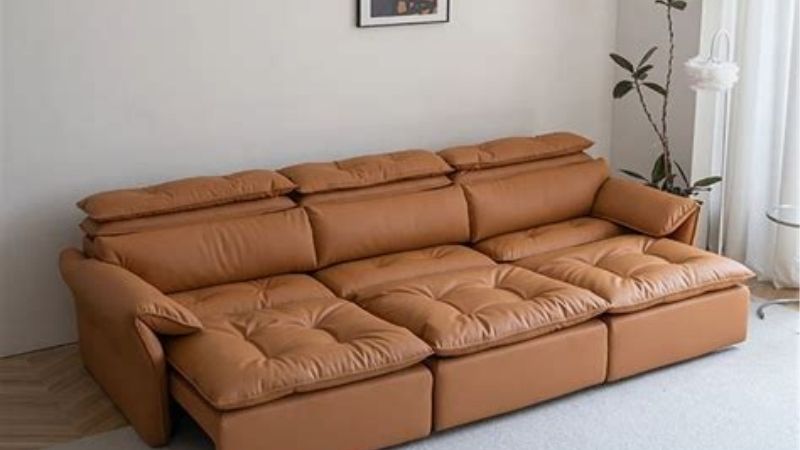
This guide compares published product descriptions, dimension diagrams, and compatibility notes from manufacturers as of October 2026. It does not claim hands-on comfort testing or assume every configuration remains available in every location. The examples below illustrate mechanisms and buying checks rather than forming a ranked product roundup.
Modular Sofas Grow by Adding Compatible Sections
A genuinely expandable modular sofa lets you attach a matching armless chair, corner, chaise, or other section to the existing assembly. This can create a longer straight couch or reshape a layout around a corner. The added piece must belong to the compatible product system; a similar-looking seat from another series is not automatically interchangeable.
IKEA describes both FINNALA and SÖDERHAMN as systems that can grow by adding sections. Burrow likewise describes its Nomad collection as modular and reconfigurable. These are manufacturer-stated capabilities, not a promise that every accessory or color is stocked indefinitely. The first purchase should be planned with future pieces and finishes in mind.
Sleeper Sofas Expand Into a Sleeping Surface
A pull-out sleeper changes function rather than increasing the number of normal back-supported seats. The sleeping area may slide from under the cushions, fold down from the back, or deploy through a separate mattress mechanism. A wider open surface is useful for guests, but it is misleading to treat the expanded bed footprint as extra everyday seating.
IKEA identifies its FRIHETEN sleeper sofa as converting into a bed. The Faringe light gray version is published at 88 5/8 inches wide as a sofa, while the bed surface measures 56 3/4 inches wide and 78 3/8 inches long. Those figures describe that exact variant and separate furniture width from usable sleeping area.
Extendable Loungers Change Depth Without Adding Seats
Some listings use expandable to describe a seat or footrest that slides forward, creating deeper lounging space. This may be convenient for watching a movie, but the mechanism can consume valuable floor space in front of the couch. The expanded section does not necessarily have the backrest, cushion support, or manufacturer-rated capacity of a regular seat.
Inspect a product demonstration and its assembly document to see what moves: a full seat frame, an ottoman, a footrest, or a bed deck. A chaise is not inherently extendable merely because it is long. When the retailer does not publish a clear open-position dimension, request it before ordering, especially for a narrow room.
Use this comparison to identify the mechanism before examining fabric choices. It shows what each type changes, not an inventory-checked list of sofas for sale.
| Expansion Type | What Changes | Measurement That Matters | Main Trade-Off |
|---|---|---|---|
| Add-on modular seating | Adds a compatible seat or corner unit | Assembled width and return after expansion | Extra pieces may be unavailable later |
| Reconfigurable sectional | Moves existing modules into a different shape | Outside dimensions of each supported layout | Rearranging alone may not add seats |
| Pull-out sleeper | Creates a sleeping platform | Bed width, bed length, and floor depth when open | Sleep surface can block access through the room |
| Sliding lounge extension | Projects the seat or footrest forward | Fully extended projection from sofa back | More lounging depth without a full new seat |
| Chaise or ottoman add-on | Creates an extra lounging position | Chaise depth, ottoman size, and connector fit | May not provide another upright seat |
How to Tell Whether a Sofa Can Really Expand
Modular branding alone does not guarantee that a specific sofa can be enlarged after purchase. Some sets are sold as fixed packages; others offer individual modules but restrict which versions work together. Check the intended next configuration now, not after you have moved into a bigger home or discovered that guest seating is short.
Confirm Series, Generation, and Connector Compatibility
Find the assembly guide for your current model and the exact add-on part number. Ask whether the new piece attaches directly, requires another armrest, or needs special hardware. A matching upholstery name is not evidence of matching connectors. If a retailer sells replacement covers separately, confirm whether old and new pieces use the same cover pattern.
IKEA gives a particularly clear compatibility warning for its VIMLE one-seat section in Gunnared beige: that listed section works only with VIMLE sofas and sections purchased from April 2021 onward. The published one-seat unit is 28 inches wide. That generation restriction is far more actionable than a generic claim that a range is modular.
FINNALA provides another concrete add-on example: its Gunnared beige one-seat section also measures 28 inches wide, with a listed depth of 38 5/8 inches and a seat depth of 21 5/8 inches. These are module dimensions, not a guaranteed increase to the finished sofa width. Final assembled size depends on how arms and neighboring parts connect.
Measure Both the Everyday and Fully Open Layout
Draw the room and mark doors, a coffee table, and the path people use most often. Then obtain two manufacturer diagrams: one for the compact seating position and one for the expanded arrangement. For a modular sofa, ask for the overall width and any corner return after the new section is attached. For a sleeper, measure the front edge of the fully deployed bed.
IKEA publishes its FINNALA three-seat sofa in Gunnared medium gray at 94 7/8 inches wide and 38 5/8 inches deep. Its separate one-seat add-on is not the same thing as simply adding an arbitrary number to that width. Instead, obtain the diagram for the exact finished combination. This avoids including arm widths or joinery gaps incorrectly.
A sleeper illustrates a different clearance problem. The FRIHETEN Faringe light gray couch has an ordinary depth of 41 3/8 inches, yet the extended bed needs room for a sleeping area 78 3/8 inches long. The product page does not substitute for a fully open floor-plan check; account for the direction in which the platform deploys and where someone will walk around it.
Check How Parts Stay Together and How Covers Are Cleaned
Expansion can create maintenance work at every joint. Inspect the locking hardware, leg alignment, and access needed to release connectors. Loose pieces may drift on smooth flooring, while mechanisms that are difficult to disengage can make frequent rearrangement frustrating. Check whether individual modules or cushions can be serviced without dismantling the entire sofa.
Burrow describes latches and thumbscrews for Nomad modules and markets the system as rearrangeable. Those are construction claims from the maker, not an independent result for connector longevity. When comparing alternatives, favor accessible instructions, replaceable connection hardware, and a method you can use without specialized tools.
Care varies by part even within one model. IKEA describes the removable FINNALA Gunnared cover as machine washable, while its inner cushions are labeled not washable. A cover zipper does not authorize laundering the cushion core. For a sleeper with a hidden frame, also ask how to clean under the mechanism and whether spare parts are available.
Choose the Expansion Style for Your Actual Routine
The strongest choice depends on the change you expect. Hosting a growing group, making a guest bed, and moving furniture weekly create different demands on the frame. Each scenario below uses a manufacturer example to illustrate what to look for, without assuming that a product available in one city is ready to ship to another.
Growing Households: Favor a Repeatable Seating System
If you expect another regular sitter in a year or two, the practical benefit is a matching full seat with a real backrest. An ottoman is less convincing as a substitute. Select a series where the manufacturer publishes stand-alone units and connection diagrams. Keep a copy of the exact product family and fabric code before finishes or frame versions change.
IKEA FINNALA one-seat sections show how a system can be extended in a controlled way. The maker identifies a matching seat module and describes combining pieces as the household changes. Its pocket-spring cushions and high-resilience foam are published construction details, but they do not prove a particular feel or long-term lifespan. Try a similar configuration in person if seat firmness matters.
For families with frequent spills, consider the cost and effort of care across the eventual larger sofa. Removable covers may be helpful, but replacement panels should match both the textile batch and section pattern. Confirm fabric availability, not merely whether a full replacement sofa is still sold.
Small Apartments With Guests: Prioritize the Sleep Conversion
If most days require a normal sofa and only occasional nights require a bed, a sleeper is often more useful than buying extra modules. The key question becomes where furniture moves when the platform opens. A coffee table that must be relocated every night can make an otherwise compact solution much less convenient.
The IKEA FRIHETEN Faringe light gray is an illustrative sleeper with a published 56 3/4-inch-wide sleeping surface and a 78 3/8-inch length. IKEA also lists storage under the seating area. The model converts into a bed, but it is not described as a modular sofa you can keep lengthening with extra upright seats. This distinction prevents buying the wrong kind of expansion.
Check sleeping comfort separately from sofa comfort. A retailer may specify bed size without giving measured pressure support or testing the platform for nightly use. Ask about frame noise, transitions between cushion sections, cleaning restrictions, and replacement mechanism parts if guests will use the bed regularly.
Flexible Living Rooms: Choose True Rearrangement Over Size Alone
For people who repeatedly change the living-room layout, modules that separate and reconnect may matter more than maximum seating capacity. A sectional can move from an open L-shape to a different conversation arrangement without buying an entirely new couch. Still, not every apparent rearrangement is supported by the original arm and corner components.
IKEA says SÖDERHAMN sections can be used separately or combined, and its Tonerud gray three-seat chaise version is listed at 73 1/4 inches wide with a chaise depth of 59 1/2 inches. That model also lists removable, machine-washable covers. The specific assembled configuration determines which edges can be left exposed, so follow the maker’s planning tool and assembly documents.
Burrow Nomad is another example of a range marketed for expansion and reconfiguration. Its option to rearrange modules is distinct from a FRIHETEN-style pull-out bed. For either system, confirm that the desired layout uses the correct backs, arms, and connectors; otherwise flexibility in a marketing photograph may exceed what your purchased parts can achieve.
Frequently Asked Questions
Is an Expandable Couch the Same as a Modular Sectional?
Not necessarily. A modular sectional can be an expandable couch when compatible add-on seating can be purchased and installed. Some modular pieces only rearrange the seats you already own, so the available seating count remains unchanged. A pull-out sleeper can also be called expandable even though it provides a bed rather than more seats.
Ask the seller to name the proposed add-on part, show the finished layout, and confirm compatibility. If the only transformation is turning the backrest into a mattress, classify it as a sleeper for your shopping decision, not as expandable family seating.
Can You Add a Seat to an Existing Sofa Later?
Only if the maker designed the series for compatible additional sections, and those parts still exist for your generation of sofa. Similar color, height, and fabric do not establish a safe fit. A nonmodular upholstered frame generally cannot accept another seat as if it were a snap-in accessory.
Save the purchase model number, component numbers, fabric name, and assembly manual. IKEA VIMLE demonstrates why this matters: the manufacturer restricts its listed one-seat extension to VIMLE sections bought from April 2021 onward. A model-family match without the correct generation can still be insufficient.
Does an Expandable Couch Need Extra Floor Space?
Usually, yes while it is actually expanded. A new seating module makes the assembled footprint longer or changes a corner return, and a deployed sleeper occupies space in front of the sofa. Rearranging the same modules can move the occupied area rather than increase it, but the new shape may still obstruct a doorway.
Measure the footprint you intend to use most often, then check the alternative position you will need on guest nights or during gatherings. The compact measurement alone does not tell you whether the expansion is practical. Keep access to exits and common walking paths clear in either arrangement.
Are Expandable Couches Harder to Maintain?
They can involve more hardware and more surfaces to clean, but there is no universal maintenance penalty. Modular units introduce joints and removable covers; sleepers introduce hinges or slides. The relevant issue is how accessible those parts are and whether manufacturer instructions explain inspection, cleaning, and replacement.
For US upholstered furniture, look for applicable TB 117-2013 smolder-resistance labeling; the standard is not a promise that a couch is fireproof. When regulated composite wood appears in the frame, TSCA Title VI requirements may also apply. Neither label measures comfort or predicts whether a connection mechanism will last through years of rearranging.
Final Thoughts
Choose an expandable couch according to the future change you want, not the marketing label. For added regular seating, secure the matching module and generation information before buying the base sofa. For guest nights, test the fully opened floor plan first. One final buying check can change the answer: ask whether the expansion part can be ordered separately today and whether the manufacturer commits to supplying replacement hardware. A couch that expands only on paper is not a useful long-term plan.
