
Key takeaways
- Wondering, “can you wash an electric blanket?” Often yes, but only when its sewn-in label or owner’s manual permits it. Unplug it, remove every detachable control, use the specified wash method, and wait until the entire blanket and connector are…
Wondering, “can you wash an electric blanket?” Often yes, but only when its sewn-in label or owner’s manual permits it. Unplug it, remove every detachable control, use the specified wash method, and wait until the entire blanket and connector are completely dry before reconnecting power.
As an Amazon Associate we earn from qualifying purchases.
By KK Home Furnishings Editorial Team
Can You Wash an Electric Blanket? Check the Label First
The answer depends on the specific blanket, not simply its fabric. Modern heated bedding can contain washable insulated heating elements, while some older or differently built products are unsuitable for immersion. A detachable controller is a helpful sign, not permission on its own. Follow the instructions for the exact model rather than a generic laundry tip.
The care guidance below draws on manufacturer instructions from Sunbeam and consumer electrical-safety advice, reviewed in October 2026. It is not based on hands-on wash testing. The label and manual supplied with your blanket take priority whenever they differ from an example given here.
| What your blanket says or shows | What to do | Why it matters |
|---|---|---|
| Machine washable; controls removable | Disconnect controls, then follow the specified machine cycle | Some heated fabric assemblies are designed for laundering |
| Hand wash only | Use only the hand-washing method described in the manual | Machine agitation may exceed that model’s limits |
| Spot clean only | Clean the permitted surface area without immersing the blanket | Water immersion is not approved for this model |
| Do not wash or missing care directions | Do not put it in a washer; obtain the exact manual | Washability cannot be inferred from the outer fabric |
| Dryer permitted at low or delicate heat | Use only the permitted dryer process and finish drying completely | Excess heat can damage wiring or change fabric dimensions |
| Air dry only | Spread or drape as directed and wait until fully dry | A dryer cycle is not authorized |
| Frayed wiring, scorch marks, or a recall match | Stop use; follow official manufacturer or recall instructions | Cleaning cannot correct an electrical defect |
Read the sewn-in tag and the manual together
Look for the laundry symbols and the instructions printed beside them, then locate the product’s brand and model number. The tag may specify a gentle cycle, cold water, hand washing, or no immersion. If it refers you to a manual, look up the version for that exact model. Similar-looking throws from one brand may have different care rules.
For example, Sunbeam states that its heated bedding with detachable controls is machine washable and dryer safe, with care directions that specify a cold gentle wash for certain products. That is manufacturer guidance for its own bedding, not a universal rule for every heated blanket. The safest default for an unidentified unit is to delay washing until its instructions are found.
Inspect the fabric, connector, and power cord before cleaning
Lay the unplugged blanket flat and look across the fabric for scorch marks, dark spots, exposed heating wires, tears, stiff or unusual hot spots, and obvious bunching around the internal elements. Check the controller cable, plug, and blanket-side socket for cracks, bent parts, or looseness. Stop using a damaged blanket; laundering is not a repair.
Electrical Safety Foundation International warns against continued use of electric blankets with frayed or charred areas or damaged cords. Also check the US Consumer Product Safety Commission database using the complete model number. A recalled product must be handled according to its recall remedy even if its tag advertises machine washing.
Know what must be disconnected and what stays attached
Unplug the power cord from the wall before disconnecting anything at the blanket. Remove detachable controllers and control cords by the release mechanism shown in the manual, without yanking wires. On some designs a sealed fabric-side connector remains part of the washable blanket. Do not pry out that connector or detach an internal heating element.
Never put a controller, power adapter, wall plug, or a cord that the instructions say to remove into wash water. If a blanket has built-in electronics or a control that cannot be removed, rely on its own care directions instead of assuming it can be submerged. If the socket is loose or damaged, contact the maker rather than trying to tape or seal it.
How to Wash and Dry a Washable Electric Blanket Safely
Once the manufacturer has authorized washing, choose the method that fits the care label. A washing machine and a dryer are optional, not mandatory: some products allow hand washing or line drying instead. The aim is to clean the textile without stressing the built-in heating assembly, and to return it to service only when it is undamaged and fully dry.
Prepare the blanket without pulling or twisting the wiring
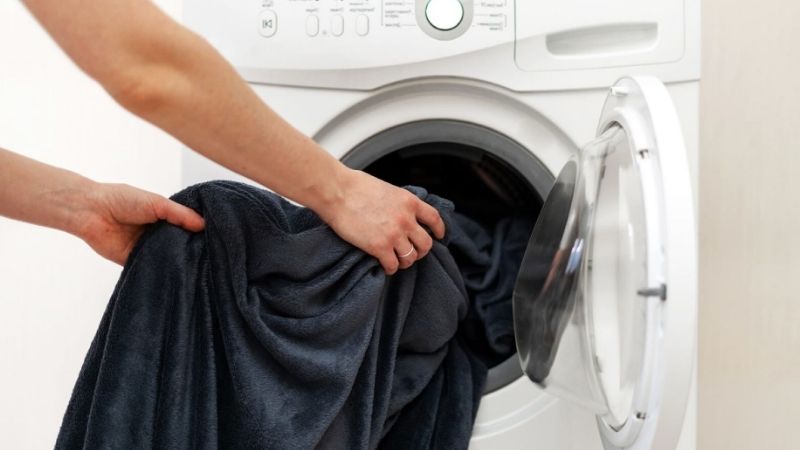
Turn the heat off, disconnect from the outlet, detach the approved removable controls, and verify that no power cord remains connected. Let the blanket cool if it was recently used. Gently shake away loose lint or crumbs, inspect the fabric again, and place it into a washing machine with enough room to move freely without being compressed.
A heavy queen or king electric blanket may be too bulky for a small home washer. If it must be forced into the drum, do not proceed; avoid a laundromat’s commercial equipment unless the manufacturer explicitly approves that equipment. Do not twist the blanket to fit, tie it tightly, or fold it around an agitator. Those actions can stress its heating elements.
Use the precise washer settings the manufacturer allows
For models whose instructions match Sunbeam’s published care guidance, a cold-water gentle cycle is an approved example. Choose a mild laundry product compatible with the fabric if the label allows detergent. Follow any maker-specific directions about loading, soaking, cycle length, and rinsing rather than transferring those settings to an unrelated brand.
Avoid adding bleach, fabric softener, stain removers, or other laundry chemicals when they are restricted by your blanket’s care label. Do not use vigorous scrubbing or repeated spin cycles as a shortcut for heavy soiling. If the blanket emerges tightly twisted or snagged, stop and inspect it before considering another cleaning pass.
Hand wash only when the blanket permits immersion
Hand washing is not automatically safer for a blanket labeled “do not wash.” If the manual explicitly permits it, use the specified water temperature and a suitably large basin so the blanket can rest without sharp folds. Gently move the fabric through the water instead of wringing, scrubbing, or pulling at the connector housing. Follow the manual’s rinse directions.
Lift and support a wet electric blanket carefully; saturated fabric is heavy, and the added weight can strain stitched channels and cable junctions. Do not twist the blanket to expel water or use a mechanical wringer. If the maker approves only surface cleaning, skip immersion completely and use the limited spot-cleaning method it describes.
Dry the whole blanket, including the connector area
The safe drying method varies by model. Sunbeam’s detailed instructions for certain heated bedding permit a low, delicate tumble-dry stage followed by hanging the item to finish drying. They warn against hot commercial dryers and say not to reconnect the product until it is completely dry. A blanket labeled air dry only must not go into a tumble dryer.
Support the fabric evenly while drying and avoid sharp creases or a direct heat source such as a radiator. Some Sunbeam guidance says to drape the product over a clothesline or shower rod without clothespins, which can create pressure points. Check the edges, folds, and connector area for residual moisture; a dry-feeling outer fleece is not proof that everything inside is dry.
Inspect the blanket again before reconnecting power
After the blanket has dried completely, check the cord entry point, plug contacts, seams, and entire fabric surface. Look for a persistent kink, exposed wire, damaged insulation, burn discoloration, or a connector that no longer fits securely. If anything appears wrong, do not perform a trial heating run. Follow the manual’s troubleshooting steps or contact the manufacturer.
Only reconnect the original, manufacturer-approved controller when the blanket and connector are dry and the product passes a visual check. Set it up flat in the position required by the manual, then operate it according to those instructions. Never plug it in merely to “dry the last bit out”; electrical-safety advice specifically warns against energizing damp bedding.
Handle isolated stains and accidental spills differently
A small mark does not always call for a full wash. When the care label allows spot cleaning, use the maker’s approved approach and limit moisture around the controller socket. Rubbing in a strong stain treatment or soaking one corner can be more aggressive than it sounds, particularly when the maker has not approved those chemicals.
If a drink spills onto a powered electric blanket, turn the power off and disconnect it safely without touching wet electrical components. Do not use it again until you have consulted the manufacturer’s guidance about liquid exposure and confirmed that the unit is undamaged and fully dry. If liquid entered a controller or connection, seek manufacturer advice rather than assuming that drying alone resolves the hazard.
Store it dry and loosely arranged after laundering
Storage matters because the internal conductors remain in the fabric after washing. Make sure the entire blanket is dry, then follow the manufacturer’s folding or rolling guidance. Avoid pressing it under heavy boxes, creating tight creases, or wrapping the cord sharply around the controller. Keep the appliance in a clean, dry place out of reach of pets that might chew cables.
Before the next cold season, perform another cord and fabric inspection and check for new model-specific safety notices. Wash cycles do not make a recalled or damaged blanket safe. If you cannot obtain correct controls or the maker’s approved care directions, replace the uncertain product rather than improvising a new wiring arrangement.
Frequently Asked Questions
These are the details most likely to change the cleaning decision after you have checked the care label. None of the answers overrides the instructions for your own model.
Can an electric blanket go in the dryer?
Only if the manufacturer expressly permits it. Certain Sunbeam heated bedding instructions allow a low, delicate tumble-dry step, then recommend taking the item out while still damp to complete drying on a line. That does not make higher-temperature cycles, commercial dryers, or the same method acceptable for other brands.
If the tag says air dry only, follow it. Regardless of method, the blanket, fabric-side connector, and any area near the heating elements must be fully dry before the controller or plug is reattached. Never switch on an electric blanket to speed drying, even briefly.
Can you wash an electric blanket without removing the wires?
Yes, for models whose manufacturer approves washing the complete fabric assembly. Their heating wires are integrated into the blanket and are not intended to be extracted. What normally comes off is the detachable controller or power lead, if the manual tells you to remove it. Never open seams or pull out conductors to make an unapproved blanket washable.
If your model has no detachable controls, that alone does not prove it is either washable or un-washable. Check its manual for specific construction and cleaning directions. A damaged connector, exposed wire, or unidentified model is a reason to stop rather than experiment with immersion.
Should you dry-clean an electric blanket instead?
Not unless its own care label explicitly authorizes dry cleaning. Electrical Safety First cautions that harsh dry-cleaning chemicals can affect internal heating components, and Sunbeam’s published instructions say not to dry-clean its heated bedding. A cleaner’s willingness to accept the item is not a substitute for a maker’s approval.
For a blanket marked spot clean only, use the method allowed by the manufacturer. If both machine washing and dry cleaning are prohibited, the answer is not to search for a stronger cleaning process; it is to preserve the wiring system by respecting those limits or replace the blanket when it cannot be cleaned adequately.
What if your electric blanket is recalled or stops working after washing?
Unplug it and stop using it. Do not attempt to splice an internal wire, swap in an incompatible controller, or repeatedly reset a suspicious unit. Search the CPSC recall database by brand and exact model. For example, the September 2026 JKMAX recall identifies particular heated products, and its instructions call for stopping use and pursuing the listed remedy.
If there is no recall match, contact the manufacturer with the model number, purchase details, and a description of the issue. Sunbeam’s troubleshooting guidance directs customers to disconnect and contact support when a control fault persists. A blanket that no longer heats correctly is not made safe by another wash cycle.
Final Thoughts
So, can you wash an electric blanket? Yes, when the exact product instructions allow it. Read the label first, disconnect every removable control, choose the approved wash and drying method, and reconnect only after complete drying and inspection. If the blanket is damaged, unidentified, or recalled, do not wash it back into service.
