Key takeaways
- Wondering is it safe to sleep with an electric blanket all night? The safest general advice is no: switch it off before going to sleep. An automatic shutoff or low setting does not remove burn and fire risks. Warm your…
Wondering is it safe to sleep with an electric blanket all night? The safest general advice is no: switch it off before going to sleep. An automatic shutoff or low setting does not remove burn and fire risks. Warm your bed while awake, then turn the blanket off and unplug it before sleeping.
As an Amazon Associate we earn from qualifying purchases.
By KK Home Furnishings Editorial Team
Is It Safe to Sleep With an Electric Blanket All Night?
Electrical Safety Foundation International (ESFI) advises that heating appliances should not be used while sleeping. Its guidance also warns against folded, covered, damaged, or old electric blankets. Some heated bedding has features intended to manage heat, but there is no universal overnight permission: the exact product instructions and the user’s ability to detect excessive heat still matter.
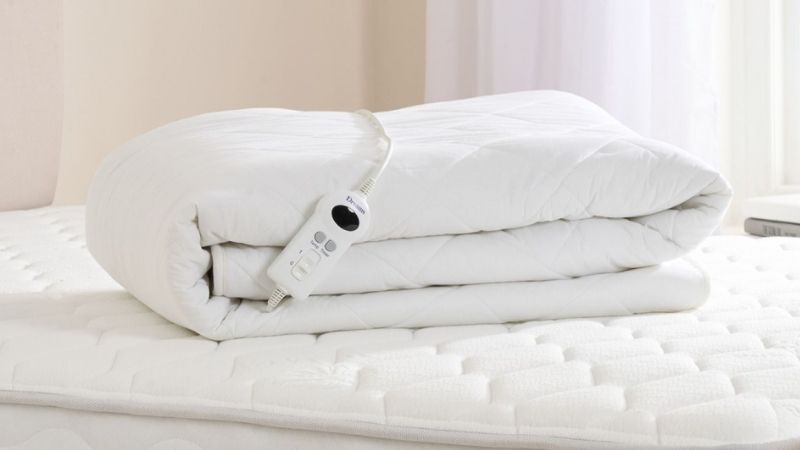
This safety explanation uses ESFI guidance, the published scope of UL 964, U.S. Consumer Product Safety Commission (CPSC) recall notices, and American Diabetes Association and MedlinePlus advice, reviewed in October 2026. It is not an independent electrical test of a specific blanket, and it does not replace that product’s safety instructions.
| Question or Condition | What It Means | Practical Decision |
|---|---|---|
| Sleeping while heat stays on | A sleeping person may not notice excessive heat or electrical trouble promptly | Turn off and unplug before sleeping; use passive bedding for the night |
| Automatic shutoff or a timer | A cutoff limits the programmed operating period; it is not a guarantee against faults or burns | Check the manual, and do not treat the timer as overnight approval |
| UL or ETL mark | A model-specific safety certification is useful but not a permission to ignore its instructions | Confirm the exact model and follow its stated use restrictions |
| Folds, tight tucking, or other coverings | Compressed and covered areas may hold heat in the blanket | Keep the heated textile flat and uncovered during permitted use |
| Reduced heat sensation or limited mobility | A person may not sense heat or move away before a burn develops | Avoid direct electric bedding heat and ask a clinician about safer options |
| Children, sleeping infants, or pets | The user may not control heat exposure or move the textile safely | Use ordinary blankets and a comfortably heated room |
| Scorch marks, frayed wiring, damaged controller | Physical deterioration can precede overheating or failure | Stop using the unit rather than attempting a home repair |
| Recalled model | A safety-related defect applies to specific models or product groups | Stop use immediately and follow the CPSC remedy |
The main distinction is between keeping a sleeping space comfortable and maintaining active heat against bedding for hours when nobody is checking it. Preheating can serve the first goal without requiring the second. Where the manufacturer expressly prohibits use while sleeping, neither a lower setting nor a separate timer overrides that warning.
What Fire-Safety Guidance Actually Says
ESFI’s electric-blanket fire-prevention guidance says not to use heating appliances while sleeping. It also advises plugging blankets directly into a wall outlet, not an extension cord or power strip, and replacing products with scorched fabric, frayed cords, or other wear. These precautions address both the electrical supply and heat buildup inside the bedding.
That advice is broader than the manual for any single blanket. A modern controller may manage temperature, but the user still needs to follow restrictions on tucking, folding, coverings, and who can use the product. Keeping the blanket flat for permitted preheating is a better approach than assuming a new blanket has no risk of overheating.
Why Auto Shutoff and a Safety Mark Are Not Overnight Approval
Auto shutoff means a controller is designed to stop powering the heating circuit after a stated interval or condition. It does not promise that the blanket stays harmless until that time, that the controller cannot fail, or that the sleeper will notice discomfort. Likewise, a low setting changes intended heat delivery, not the need for supervision while awake.
UL 964 is the U.S. safety standard covering electrically heated blankets and related bedding. A UL or ETL mark should be associated with the exact product, not presumed from the brand name alone. UL Solutions provides its Product iQ certification database for checking UL claims. Compliance with a standard is not permission to disregard model-specific warnings.
Why Damage, Trapped Heat, and Heat Sensitivity Change the Risk
Folding a powered blanket concentrates wires and fabric into a smaller area; placing pillows, pets, or extra heavy bedding over it can also retain heat. ESFI specifically warns against folding and putting objects on heated textiles. A blanket that is bunched under someone who shifts during sleep may no longer have the placement it had when switched on.
A person who cannot reliably sense heat or move away from it faces a separate burn risk even without an electrical fault. The American Diabetes Association describes how nerve damage can reduce temperature sensation, while MedlinePlus advises people with diabetes to avoid heating pads or electric blankets when warming their feet. This is a reason to choose unpowered warmth, not a temperature setting.
Seven Situations That Change the Safer Overnight Choice
Your sleeping situation determines which precaution matters most, but it cannot convert an unsafe appliance into one approved for sleeping. The following cases focus on the person using the blanket, how it lies on the bed, and whether anyone is likely to notice a problem. For overnight warmth, start with the option that requires no active heating element.
You Are a Healthy Adult in a Cold Bedroom
A healthy adult who can feel heat and reposition the blanket still should not assume it is safe to leave electric bedding running all night. ESFI’s advice is to avoid heating appliances while sleeping. If the model permits preheating, use it while awake to take the chill off the bedding, then switch it off and unplug it before getting under the covers.
For sustained warmth, try an appropriately insulated comforter, an extra non-electric layer, or a modest increase in room heat instead. The right alternative depends on whether you need warmth across the whole room or only in the bed. None requires you to rely on a sleeping person to detect a damaged cord or a hot spot overnight.
Your Blanket Has a Long Auto-Off Timer
A timer that lasts for much of the night does not mean a manufacturer or independent safety organization recommends leaving the blanket on during sleep. The setting may be useful for planned, awake use, but it cannot detect every hazard. Check whether the instruction sheet allows the intended use and whether its controller resets after interruption.
Treat any advertised shutoff interval as a feature of that particular model, not a blanket-wide standard. If the only reason you plan to sleep with it energized is that the controller eventually switches itself off, choose the safer approach of preheating and manual power-off instead. A third-party smart plug is not a substitute for the maker’s controller.
A Child, Infant, or Person Who Cannot Move Easily Shares the Bed
Do not place an operating electric blanket on a sleeping infant or someone unable to move it away quickly. A child may also change the setting, trap a cord, or pull the heated fabric into a fold. Adult supervision when awake does not eliminate those problems once everyone goes to sleep. Check the manufacturer’s age and assistance restrictions.
Use age-appropriate unpowered bedding, suitable room heating, and a safe sleep environment instead. For infants, follow pediatric safe-sleep guidance on bedding and room temperature rather than adding a heated blanket or extra loose covers. Someone with restricted movement may need help adjusting ordinary blankets or room temperature without direct electrical heat.
You Have Reduced Heat Sensation or Circulation Concerns
Avoid using electric bedding as an overnight heat source if you have diminished temperature sensation, neuropathy, or trouble responding promptly to discomfort. The danger is not necessarily an unusually high controller setting: skin can remain against unwanted heat without the warning sensation that would make someone move the blanket away.
MedlinePlus and the American Diabetes Association warn that reduced sensation associated with diabetes can increase burn risk from direct heat. They recommend practical alternatives such as socks for cold feet, rather than heating pads or blankets against the feet. People with relevant medical or mobility limitations can ask a clinician for individualized warming advice.
You Share a Bed With a Partner Who Sleeps at a Different Temperature
Separate heat preferences do not justify keeping one side of a powered blanket on overnight. Dual-control designs can provide different settings while awake, but each side still uses powered heating elements. The bedding can also migrate across the bed, fold at the center, or become covered when one person rearranges the other covers.
For a mixed-temperature couple, consider separate ordinary comforters or a breathable layer for the warmer sleeper and an extra unpowered blanket for the cooler one. If using dual-control electric bedding to preheat a shared bed, follow that exact manual and check that both controllers are off before either person goes to sleep.
Pets Lie on the Blanket, or You Use It for a Couch Nap
Pets can settle on top of a heated blanket, adding weight and trapping heat in one location. ESFI warns against placing objects, including pets, on electric blankets while operating them. A couch creates a similar placement problem when the blanket slips into the gap beside a cushion or is tucked around an armrest during a nap.
Keep the heating element switched off before a nap, whether on a sofa or a bed. Use a regular throw for a pet-friendly couch and avoid allowing pets to rest on powered bedding. Do not use a heated throw as a substitute for a fitted electric mattress pad; electrical bedding products are not automatically interchangeable in placement or intended use.
Your Blanket Is Old, Damaged, or May Be Recalled
Do not use an electric blanket with dark spots, damaged insulation, an overheating connector, a broken control, or frayed wiring. ESFI recommends replacing worn or old blankets rather than continuing to use them. An unfamiliar smell or localized hot patch should prompt you to turn it off, disconnect power when safe, and remove it from service.
Model-specific recalls show why brand reputation alone is not enough. In September 2026, CPSC recalled JKMAX heated blankets and pads, including model JKMAX-7284B, over overheating hazards. July 2026 CPSC notices also addressed OCTROT heated throws and blankets, including OCT-5060. Compare the tag and controller model with the recall notice; stop using a matching unit.
Frequently Asked Questions About Overnight Electric Blankets
The label, heating controls, and manufacturing details are easy to overlook when a blanket feels comfortably warm. These answers separate product certification from permission to sleep with active heat, explain how to check a recall, and cover situations where adding another device or layer creates risks that a temperature setting cannot resolve.
Can I Put Another Comforter Over an Electric Blanket?
Do not add a covering over an operating electric blanket unless the exact product instructions explicitly permit that arrangement. ESFI warns that objects and other blankets placed on top of heated bedding may cause overheating. A thick duvet can make it harder to notice uneven warmth, especially if the electric layer becomes folded underneath it.
If you need more insulation for sleep, switch off and unplug the electric blanket first, then use a suitable non-electric comforter. Do not use extra fabric to mask a blanket that seems too hot at its lowest setting. That is a reason to stop using powered heat, check the instructions, and choose a different warming setup.
Can a Smart Plug or Outlet Timer Make All-Night Use Safe?
No. A separate timer cannot make sleeping with a powered electric blanket universally safe. It may interrupt power at a chosen time, but it does not check fabric temperature, blanket folding, or a controller fault. Some appliances also have instructions about external switches or automatic power restoration that must be respected.
Use only the controls and accessories allowed by the blanket manufacturer. Even when a smart timer is compatible, safety guidance against unattended sleep use still applies. Switch the original controller off while awake and unplug the appliance rather than treating a remote command or future shutoff as proof that it is safe.
How Do I Check Whether My Electric Blanket Was Recalled?
Find the exact brand and model number on the sewn-in product tag, controller, or packaging, then compare it with CPSC recall descriptions. Do not rely solely on a similar-looking product photo. Some notices cover several sizes or model numbers, while others cover a narrowly specified product sold during a particular period.
As of October 2026, published CPSC notices include the September 17, 2026 JKMAX heated-bedding recall, the July 30, 2026 OCTROT heated-blanket recall, and earlier model-specific actions. This is not an exhaustive clearance check for a product in your home. If the identifiers match a notice, stop use and follow the remedy directly.
Can I Leave the Electric Blanket on My Bed After I Turn It Off?
That depends on the product instructions and the condition of the blanket. An unplugged, intact blanket may be allowed to remain on the bed as ordinary fabric, but do not assume it can be tightly tucked, crushed, or machine washed just because power is off. Follow the manufacturer’s bedding placement and storage instructions for that model.
Before the next permitted use, inspect the fabric, connections, controller, and cord. Never pin through a heated blanket, repair broken heating wires yourself, or use a blanket with damaged insulation. If the manufacturer prohibits a particular placement on an adjustable bed, recliner, or mattress, storing it there unplugged does not change that restriction during heating.
Final Thoughts
If you are asking is it safe to sleep with an electric blanket all night, choose the lower-risk routine: warm the bed only while awake, then switch off and unplug before sleep. Check the exact model for recalls and damage; when overnight heat is still needed, use suitable unpowered bedding or room heating instead.