Our Top Picks
A single-sink vanity between 24 and 36 inches wide with a solid-wood or plywood cabinet suits most standard bathrooms, a 48-inch or wider double-sink model suits a primary bath with room to spare, and a floating or slim-depth vanity suits a powder room or tight remodel. The widest selection sits in the middle of the market, where cabinet, top and faucet drilling come as a set, so the decision usually comes down to size, cabinet material, countertop and how much storage you actually use.
Bathroom Vanities at a Glance
| Vanity type | Best for | Typical stated sizes | Main limits |
|---|---|---|---|
| Compact single-sink (18 to 30 in. wide) | Powder rooms, guest baths, narrow walls | Makers commonly list widths from 18 to 30 inches | Little counter space, one drawer or a small cabinet only |
| Standard single-sink (30 to 48 in. wide) | Most family bathrooms and hall baths | Widths of 30, 36, 42 and 48 inches are common | Need to check door swing and drawer clearance next to the toilet |
| Double-sink (60 to 72 in. wide) | Shared primary baths | Often 60, 72 and sometimes 84 inches | Needs wall space, two supply lines and two drains |
| Floating (wall-mounted) | Small rooms, visual openness, easy floor cleaning | Usually 24 to 48 inches | Wall must carry the weight; blocking in the studs is typically required |
| Vanity with vessel sink | Style-led remodels | Counter-only top plus separate bowl | Splash zone, taller faucet needed, less usable counter |
| Freestanding furniture-style | Traditional or transitional looks | Legs raise the cabinet off the floor | Plumbing is more visible, less enclosed storage |
Start With Width, Depth and Rough-In
Measure the wall, then measure what already exists. If you are replacing a vanity, the drain and supply lines are already in the wall, and the easiest swap is a new unit of similar width. Most standard vanities are around 21 inches deep, while slim or narrow-depth models are offered by several makers for tight rooms, often in the range of 16 to 18 inches. Check that the front of the vanity leaves comfortable clearance from the toilet and that doors and drawers open fully.

Marsail 30 Inch Bathroom Vanity with Sink, Wood Bathroom Vanities Modern Fluted Vanity Bathroom Cabinet with Drawer, Freestanding Ceramic Vanity Sinks for Bathrooms, Natural Oak
Chosen because it specifies Freestanding Ceramic Vanity Sinks for Bathrooms and Natural Oak.
View on Amazon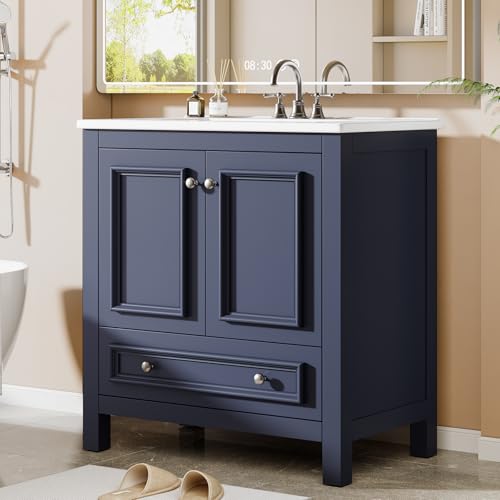
Tribesigns 30" Bathroom Vanity with Sink, Freestanding Bathroom Vanities Cabinet with Ceramic Basin Combo, Bathroom Sink Cabinet with 2 Doors and 1 Drawer, Solid Wooden Frame (Navy Blue, 30 INCH)
Chosen because it specifies Bathroom Sink Cabinet with 2 Doors and 1 Drawer and Solid Wooden Frame (Navy Blue.
View on Amazon
ELEVACHIC 30" Bathroom Vanity with Sink, Sliding Barn Door & 3 Drawers | Farmhouse Bathroom Cabinet Set, Freestanding Bath Vanities, Black
Chosen because it specifies Sliding Barn Door & 3 Drawers and Farmhouse Bathroom Cabinet Set.
View on AmazonPlumbing is the second constraint. A vanity with a back panel needs cutouts, and a drawer base has to be designed around the trap. Drawer-over-drain designs use notched drawers, which lowers usable depth. If the supply lines come out of the floor rather than the wall, look for open-back designs or confirm the cutout location with the maker. When in doubt, a licensed plumber can confirm rough-in positions before you buy.
Cabinet Materials and What They Mean
Solid wood and plywood
Makers of higher-priced vanities typically list solid hardwood frames, plywood boxes or both. Plywood and solid wood generally hold fasteners well and tolerate humidity better than low-density board when the finish is intact. Look for water-resistant finishes and sealed edges, especially around the sink cutout.
MDF and engineered wood
Many budget and mid-range vanities use MDF or particleboard with a laminate, thermofoil or painted surface. These can look clean and are easy to wipe, but if water gets under a chipped edge or around a leaking trap the board can swell. Check that the sink area and the bottom shelf are sealed, and fix drips promptly.
Metal and composite
Some lines use powder-coated metal or PVC-type composites for moisture resistance. These suit damp rooms or basements but offer fewer style options.
Countertop Options
- Cultured marble or integrated resin tops: the sink and top are one piece, so there is no seam to leak. Common at budget and mid-range tiers.
- Quartz (engineered stone): a non-porous surface that makers describe as stain resistant and low maintenance. Usually mid-range to premium.
- Natural marble or granite: attractive and durable but needs periodic sealing; marble can etch from acidic products.
- Ceramic or porcelain tops: easy to wipe, with an integrated bowl in many sets.
- Solid surface: seamless and repairable, a good fit for modern looks.
Confirm whether the top is included. Many packages list a cabinet only, so the top, sink, faucet and mirror are bought separately. Check the faucet hole spacing: single-hole, 4-inch centerset and 8-inch widespread tops need matching faucets.
Storage Layout Trade-offs
Doors are simple and suit tall items such as bottles and cleaning supplies. Drawers keep small items visible and reachable, but a sink drain reduces drawer depth. Many shoppers pair one drawer bank with a door cabinet. For shared baths, a double vanity with a center drawer stack can keep each person’s items separate. A tall linen tower or wall cabinet adds storage without a bigger vanity footprint.
Budget Tiers
| Tier | What buyers typically get | Watch for |
|---|---|---|
| Budget | MDF or particleboard box, laminate or resin top, basic hardware, flat-pack assembly | Moisture exposure at edges, thinner drawer slides, limited finish options |
| Mid-range | Plywood or solid-wood frame, soft-close hinges, quartz or ceramic top options | Confirm what is included: top, backsplash, faucet, mirror |
| Premium | Solid hardwood, dovetail drawers, stone tops, brand support | Longer lead times, heavier units that need solid wall and floor support |
Brands and Lines Shoppers Commonly Compare
Home-improvement and furniture-style bathroom lines such as Kohler, Delta, Glacier Bay, Home Decorators Collection, Ove Decors and Allen + Roth appear frequently in buying guides. Product lines rotate, so check the maker’s own product page for the current model name, dimensions and what the carton contains before ordering. Where a maker states a feature such as soft-close drawers or a plywood box, treat it as the maker’s claim and read the spec sheet for the details.
Installation, Care and Safety Notes
- Shut off water before disconnecting supply lines, and have a licensed plumber handle any rerouting of pipes.
- Wall-hung vanities need blocking or a rated mounting rail in the studs; follow the installation manual for the weight limits.
- Use silicone sealant where the top meets the wall and around the sink rim, and wipe splashes promptly.
- Clean with mild soap and a soft cloth; abrasive cleaners can dull painted and laminate surfaces.
- Any new outlet or light near the sink should be installed by a licensed electrician and be GFCI-protected, following local code.
Pick X If You Want…
| Pick this | If you… |
|---|---|
| Compact 18 to 24 inch vanity | Have a powder room or a very narrow wall |
| 30 to 36 inch single-sink with drawers | Need everyday storage in a hall or kids’ bath |
| 60 to 72 inch double-sink | Share a primary bath and have the wall length |
| Floating vanity | Want an open floor and are ready to confirm wall support |
| Plywood or solid-wood cabinet | Plan to keep the vanity for many years in a humid room |
| Integrated resin or ceramic top | Want the fewest seams and an easy-wipe surface |
| Quartz top | Want a hard-wearing, low-maintenance surface and a mid-range or higher budget |
Alternatives to a Standard Vanity
- Pedestal or console sink: frees visual space in a half bath but gives almost no storage, so pair it with a wall cabinet.
- Repurposed furniture: a dresser or console turned into a vanity can look distinctive. It needs a cutout, a waterproof finish and careful plumbing work.
- Refacing the existing cabinet: new doors, hardware and a new top can refresh the room without changing plumbing.
Frequently Asked Questions
What size bathroom vanity is most common?
Single-sink vanities in the 30 to 36 inch range are among the most widely sold, because they fit a typical hall or guest bathroom. Double-sink models usually start around 60 inches. Always measure your own wall and the clearance on each side before choosing.
Is a plywood vanity better than MDF?
Plywood and solid wood are generally considered more tolerant of humidity and fasteners than MDF, though a well-sealed MDF cabinet can last in a lightly used bath. The finish and edge sealing matter as much as the core material. Keep leaks and standing water away from any engineered board.
Does a vanity come with the faucet and countertop?
It varies by maker. Many listings sell the cabinet alone, others include the top and sink, and few include the faucet. Read the product page to see exactly what is in the carton and confirm faucet hole spacing.
Can I install a bathroom vanity myself?
Many homeowners handle a like-for-like swap with basic tools, following the maker’s instructions. Plumbing changes, new electrical work or wall-mounted installs are better left to a licensed plumber or electrician. Local code may require permits for some changes.
How do I choose between a floating and a freestanding vanity?
Floating vanities make small rooms feel larger and make floor cleaning easier, but they depend on strong wall blocking. Freestanding units carry their weight on the floor and are simpler to install in older walls. Decide based on wall construction and the look you want.
How long should a bathroom vanity last?
Lifespan depends on materials, humidity control and how quickly leaks are addressed. Solid wood and plywood units with sealed finishes and a well-ventilated room tend to last longest. Using an exhaust fan and wiping splashes helps any vanity last longer.
More from Amazon
Programs that pair well with the guide above. Offers and eligibility are set by Amazon and may change.
Collect the home and kitchen items you want in one registry that guests can shop from.
Create a wedding registrySet up recurring deliveries of everyday items on eligible products. Terms and savings are set by Amazon.
Explore Subscribe & SaveFree shipping on eligible items, Prime Video and more. Eligible new members can start with a free trial.
Start a Prime free trialAudiobooks and podcasts to listen to on the go. Eligible new members can start with a free trial.
Try Audible freeAs an Amazon Associate we earn from qualifying purchases.