
Key takeaways
- The best home gym cycle is the one whose riding position, adjustments and ownership requirements fit your household. Before comparing screens or...
What's inside
- Product listings to compare
- Compare riding positions before features
- Understand what changes between users
- Place the bike beside existing furniture
- Separate entertainment from operating requirements
- Check placement and care information
- Decide whether it will move
- Make the final comparison specific
- Additional product links
- Related reading
The best home gym cycle is the one whose riding position, adjustments and ownership requirements fit your household. Before comparing screens or styling, decide how you want to sit, which users need adjustment and where the complete bike can operate without interfering with furniture.
This guide provides practical selection and use considerations. It does not report hands-on product testing.
A home cycle becomes part of the room even when nobody is riding. Its placement should allow access to storage, doors and seating, while leaving the space required by the manufacturer’s instructions. Start with those practical requirements and use appearance to narrow an already suitable shortlist.
Product listings to compare
As an Amazon Associate we earn from qualifying purchases at no extra cost to you. Product prices and availability are accurate as of the date shown and are subject to change. Compare the selected variant and its current description with the requirements above.
As an Amazon Associate we earn from qualifying purchases at no extra cost to you. Product prices and availability are accurate as of the date shown and are subject to change.


Compare riding positions before features
Upright and recumbent designs arrange the seat, pedals and controls differently. Assess the exact model rather than assuming either category suits everyone. A product described as comfortable may still place its controls out of convenient reach or offer an adjustment range that does not match the intended user.
If possible, try the relevant seating arrangement before buying. Note how the seat is adjusted and whether the settings are clearly identified. If an individual has mobility concerns or requires a particular exercise setup, obtain qualified advice instead of using a category label as a medical recommendation.
Understand what changes between users
For a shared bike, list the adjustments each rider would need to make. Check the instructions for securing those settings and do not assume another model’s method applies. A useful adjustment system is one the household can understand and use consistently.
Consider whether preferences are saved or must be entered again, but separate that convenience from physical fit. A user profile on a console does not prove that the seat and other components have been positioned appropriately for the person using it.
Place the bike beside existing furniture
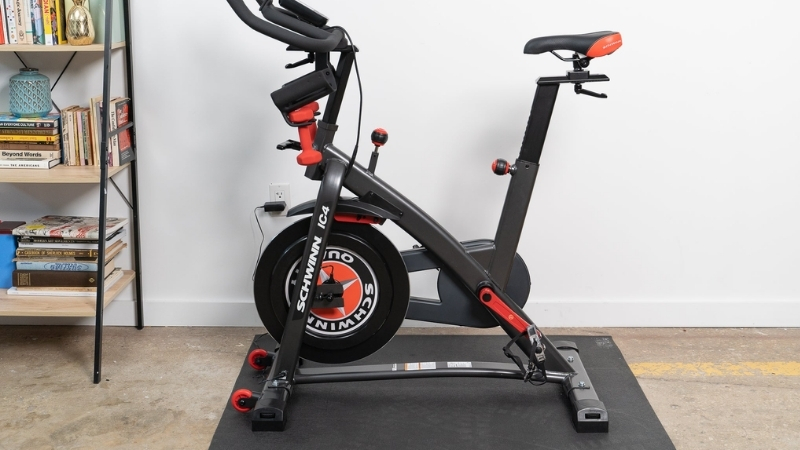
Measure the proposed location with the bike’s documented operating area in mind. Include access around the pedals and the route used to approach the seat. Avoid positioning it so a chair, cupboard door or curtain conflicts with moving components.
Look at the room during its normal daily use. A bike may fit in a corner but still obstruct a drawer or create an awkward path around a sofa. Choose a location that works without requiring the household to constantly negotiate around it.
Separate entertainment from operating requirements
Decide whether you actually want a built-in screen, device holder or connected service. Check what works independently and what requires an account, subscription or compatible device. Do not assume the feature shown in a promotional image is included in the selected version.
Consider the screen’s position only after the riding arrangement is suitable. Rearranging the room around entertainment should not compromise access to the bike’s controls or the operating space described in its instructions.
Check placement and care information
Review the floor and any proposed protective layer together with the manufacturer’s placement requirements. A decorative rug is not automatically an appropriate base. Resolve material compatibility questions before leaving equipment in one place for an extended period.
Leave room for cleaning and the required checks. If the bike needs power, follow its installation directions and keep connections arranged appropriately. Do not select a location that depends on improvising around unclear electrical or maintenance requirements.
Decide whether it will move
If the cycle must be stored elsewhere, read exactly how it is intended to be moved. Transport wheels or a folding feature do not establish that every person can relocate it or that every storage position is permitted. Compare the complete handling routine with leaving it assembled in a suitable place.
Check the route between those locations as well. Narrow turns, thresholds and furniture can make a seemingly compact product difficult to manage. A permanent but well-chosen location may be the more practical compromise.
Make the final comparison specific
- Record the exact model and selected variation.
- Check user adjustments and documented limits.
- Measure operating and storage areas separately.
- Confirm included features and ongoing service costs.
- Read delivery, assembly, return and support terms.
Choose the home gym cycle that satisfies these requirements before paying for extra features. A bike that fits the user and the furnished room is a better foundation than one selected primarily for its display or an unsupported ranking.
Additional product links
- Start 30-Day Prime Free Trial →
- See Today’s Amazon Deals
- ▸ Try Amazon Prime — free 30-day trial
- ▸ Start an Audible Premium Plus free trial
- ▸ Read free with Kindle Unlimited
Related reading
- Best home gym cycle
- Chris Parker
- Best Gym Mat for Home: Rubber vs Foam Picks for Any Floor
- Best Rowers for Home Gym: Air, Magnetic and Water Compared
- Best Weight Home Gym: 6 All-in-One Machines for Small Rooms
- Best Home Gym Equipment for Beginners: The Starter Setup
- Best Treadmills for Home Gym: 5 Picks by Deck and Motor
- Best changeable dumbbells
- Best rated yoga mat
- Best mat yoga
- Best home gym equipmen
- Best fitness equipment for home gym
- Best Home Gym Set Ups: 6 Builds by Room Size and Budget
- Best Home Gym Cardio Machine: 6 Compared on Space and Noise
- Best Exercise Bike Home Gym Owners Can Fit Around Weights
Write Your Review
No reviews yet. Be the first to share your experience!