Key takeaways
- Measure the narrowest doorway and route, including turns; compare those dimensions with the assembled rack.
- Assemble on a protected, level floor and tighten fasteners in the sequence given in the instructions.
- Level the feet or lock the casters before loading. Recheck fasteners after the rack has been used for a while if the instructions recommend it.
- Move the rack empty when possible. If it must be shifted while loaded, remove heavy items first and avoid pulling it by a shelf or countertop.
Best baker racks: choose by width, load, and where you’ll use them
The best baker racks are sized to your available floor space, rated for the weight you’ll store, and built from materials suited to the room: choose a narrow, stable metal rack for a tight kitchen, a wider model with a solid work surface for dining-area prep, or a lightweight rack with locking casters for a utility space. Before buying, check shelf dimensions and weight limits—not just the overall height—and confirm that the assembled rack will fit through your doorway.
Compare common baker-rack sizes
Product dimensions vary, but these size bands are useful for screening options. Measure the rack’s actual footprint and shelf depth on the product specifications; a rack advertised as “compact” may still project far enough to obstruct a cabinet or walkway.

SUPERJARE Large Bakers Rack with Power Outlets, 39.6 Inches Microwave Stand
Included for 'Best Baker Racks for Extra Kitchen and Home Storage' because the listing specifies 39.6 Inches Microwave Stand, details this guide uses to compare options.
View on Amazon
YASONIC Coffee Bar, Bakers Rack with Storage, 25.6 Inches Microwave Stand, 5 Tier Kitchen Shelves Appliance Storage, 12 S Hooks Large Coffee Station for Spices, Pots and Pans, Rustic Brown
Included for 'Best Baker Racks for Extra Kitchen and Home Storage' because the listing specifies Bakers Rack with Storage and 25.6 Inches Microwave Stand, details this guide uses to compare options.
View on Amazon
MAHANCRIS Bakers Rack with Storage, Microwave Stand with Paper Holder, Bakers Rack with Power Outlet, Coffee Bar Station with 6 Hooks, for Kitchen, Dining Room, Rustic Brown and Black BRHR36E01
Included for 'Best Baker Racks for Extra Kitchen and Home Storage' because the listing specifies Microwave Stand with Paper Holder and Bakers Rack with Power Outlet, details this guide uses to compare options.
View on Amazon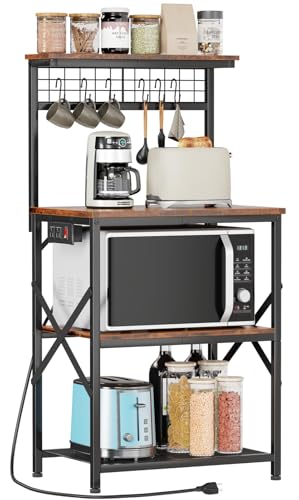
Furologee Kitchen Bakers Rack with Power Outlet, 22-Inch Microwave Stand
Included for 'Best Baker Racks for Extra Kitchen and Home Storage' because the listing specifies 22-Inch Microwave Stand, details this guide uses to compare options.
View on Amazon| Rack width | Typical depth | Useful for | Check before choosing |
|---|---|---|---|
| 18–24 in | 12–16 in | Small kitchens, narrow gaps, coffee stations | Shelf clearance for appliances; whether the base is deep enough to prevent wobble |
| 25–36 in | 14–18 in | Everyday kitchen storage or a compact dining-area station | Usable shelf width after accounting for the frame and side rails |
| 37–48 in | 16–20 in | More countertop space, bulk pantry storage, or utility use | Wall clearance, floor space, and whether loaded shelves remain accessible |
For comfortable circulation, aim to keep roughly 36 in of clear passage in a frequently used kitchen walkway. In a less-trafficked spot, 30 in may be workable, but measure with cabinet and appliance doors open. A rack that fits an empty wall can still block a dishwasher, refrigerator, or route through the room.
Choose by the job the rack needs to do
For a small apartment kitchen: narrow metal rack
Look for a 18–24 in-wide model with a footprint that fits the available gap and shelves deep enough for the items you actually own. Open metal shelves keep the rack visually light and are often easier to wipe down than porous wood. Check the distance between shelves if you plan to store a blender, toaster, or tall bottles; overall rack height does not tell you whether those items will fit.
For a dining area or coffee station: a wider rack with a solid top
A 25–36 in-wide rack with a wood or engineered-wood work surface can hold a coffee maker, serving pieces, or small appliances. Confirm the top’s load limit separately from the limits for lower shelves. If the rack will be used for food preparation, choose a surface that is easy to clean and follow the manufacturer’s care instructions; a decorative finish is not automatically a food-safe cutting surface.
For pantry overflow or a utility space: capacity and mobility first
For jars, cleaning supplies, or laundry items, prioritize the stated weight limit per shelf and for the whole rack. A high total capacity does not mean each shelf can carry that amount. Locking casters help when you need to move the rack for cleaning, but the rack should be stationary and locked before you load or use it. For heavy appliances or dense pantry goods, a fixed-leg design may feel steadier.
| Situation | Practical choice | Trade-off to expect |
|---|---|---|
| Small apartment | 18–24 in metal rack; measure depth against walkway clearance | Less shelf area and possibly limited appliance clearance |
| Dining-area coffee station | 25–36 in rack with a solid, cleanable top | More visual weight; verify countertop and shelf load limits |
| Utility room that needs frequent cleaning | Rack with locking casters and wipeable shelves | Casters can reduce stability compared with fixed feet |
| Heavy pantry storage | Fixed-leg rack with clearly stated per-shelf capacity | Harder to move once loaded; may need two people to reposition |
| Humid or spill-prone area | Coated metal or sealed surfaces, with prompt spill cleanup | Coatings and joints still need care; inspect for chips or rust over time |
Materials: what changes in daily use
| Material | Advantages | Limitations and care |
|---|---|---|
| Coated metal | Usually light for its strength, easy to wipe, and suitable for open shelving | Scratches or chipped coating can expose metal; thin frames may wobble if poorly braced |
| Solid wood | Warm appearance and a substantial feel; can suit dining spaces | Heavier to move and sensitive to standing moisture; finish and joinery affect durability |
| Engineered wood | Often provides a solid-looking top at a moderate cost | Edges and joints can swell if water gets in; avoid prolonged dampness and overloading |
| Mixed metal and wood | Combines an open frame with a more useful work surface | Inspect how the top attaches and whether the frame has cross-bracing to limit sway |
For any material, stability depends on more than the shelf itself. A rack with diagonal bracing, secure joints, and level feet is generally a better bet than a tall, narrow frame with no visible reinforcement. If the manufacturer specifies a wall-anchoring point, use the supplied hardware as directed—especially in homes with children or pets.
Check shelf capacity and clearance before ordering
Write down what will go on each shelf, then compare those items with the rack’s stated limits. A microwave or stand mixer is heavy and may need a broad, level shelf with enough depth for its feet. Keep heavy objects on the lowest shelf to reduce the chance of tipping, and leave enough space around appliances for ventilation as their manuals require. Do not assume a shelf can support a person leaning or sitting on it.
Measure the height of your tallest planned item and the vertical gap between shelves. Also check whether a raised rail or lip reduces the usable shelf area. If you plan to store bottles, measure their height with any pump or pour spout attached.
Assembly, moving, and long-term use
Most flat-packed racks require basic assembly, but the process can range from fitting a few shelves onto a frame to fastening numerous bolts and braces. Check the assembly guide and package dimensions before purchase, and plan to assemble a tall rack near its final location. The carton may be easier to carry through a doorway than the finished unit, but a fully assembled rack can be awkward to turn in a narrow hall.
- Measure the narrowest doorway and route, including turns; compare those dimensions with the assembled rack.
- Assemble on a protected, level floor and tighten fasteners in the sequence given in the instructions.
- Level the feet or lock the casters before loading. Recheck fasteners after the rack has been used for a while if the instructions recommend it.
- Move the rack empty when possible. If it must be shifted while loaded, remove heavy items first and avoid pulling it by a shelf or countertop.
Over time, the first problems are often loose fasteners, uneven feet, scratched coatings, or moisture damage at exposed engineered-wood edges. Keeping the rack level, distributing weight across shelves, and wiping up spills promptly can help prevent avoidable wear.
Final buying check
Before choosing among the best baker racks for your home, confirm five details: overall width and depth, shelf-by-shelf load limits, vertical clearance, frame bracing and foot style, and the assembly and anchoring requirements. Match those details to the room: a slim fixed rack for a cramped kitchen, a wider solid-top model for a dining-area station, or a locking-caster option for light-duty storage that needs to move. The right fit is the rack that stores your actual items without narrowing the walkway or exceeding its stated capacity.