Key takeaways
- Standalone net vs. integrated system: A separate net sleeves over any hammock and stores in its own small sack, which is ideal if you rotate between hammocks or need modular storage. An integrated hammock-and-net combo eliminates one item from your shelf but locks you into that specific hammock.
- Packed volume, not just weight: Ounces matter on the trail; compressed size matters in an apartment. Look for nets that stuff into a sack roughly the size of a grapefruit, and check whether the sack is attached so it doesn’t disappear into a drawer.
- Mesh density and no-see-um rating: Standard mosquito mesh won’t stop biting midges or gnats. Finer no-see-um netting has smaller apertures, and if you camp near water or in the Southeast, that upgrade is worth the marginal airflow tradeoff.
- Zipper placement and entry access: Dual-sided or diagonal zippers let you get in and out without contorting, which is a genuine quality-of-life difference when your hammock is strung in a tight balcony corner with one accessible side.
- Length and hammock compatibility: Measure your hammock body before buying. An 11-foot net covers most standard and double hammocks, but a longer 11×4.6 net gives you room to spread out diagonally without pressing mesh against your face.
What's inside
Anyone who has tried to sleep in a hammock without netting knows the specific frustration: you finally get the ridgeline tension right, the sag feels perfect, and then a single mosquito starts circling your ear at 2 a.m. The problem gets worse when your hammock lives in a studio apartment closet, on a balcony, or in the trunk of a small car alongside everything else you own. Most bug nets are sold as camping gear, but they get used far more often by people working with limited square footage who want a hammock that functions as real sleeping furniture without becoming a permanent fixture.
This guide looks at bug nets through that lens. I’ve evaluated how compactly each option packs down, whether it integrates with a hammock you already own or replaces it entirely, and how quickly it goes from stuff sack to fully deployed. Some of these are standalone nets that slip over your existing setup, which is the smarter choice if you’re storing gear in a shoebox-sized space. Others are complete hammock systems with netting sewn in, which makes sense if you’re starting fresh and want one item instead of three.
As an Amazon Associate we earn from qualifying purchases.


How to Choose a Bug Net For Hammock (2026)
- Standalone net vs. integrated system: A separate net sleeves over any hammock and stores in its own small sack, which is ideal if you rotate between hammocks or need modular storage. An integrated hammock-and-net combo eliminates one item from your shelf but locks you into that specific hammock.
- Packed volume, not just weight: Ounces matter on the trail; compressed size matters in an apartment. Look for nets that stuff into a sack roughly the size of a grapefruit, and check whether the sack is attached so it doesn’t disappear into a drawer.
- Mesh density and no-see-um rating: Standard mosquito mesh won’t stop biting midges or gnats. Finer no-see-um netting has smaller apertures, and if you camp near water or in the Southeast, that upgrade is worth the marginal airflow tradeoff.
- Zipper placement and entry access: Dual-sided or diagonal zippers let you get in and out without contorting, which is a genuine quality-of-life difference when your hammock is strung in a tight balcony corner with one accessible side.
- Length and hammock compatibility: Measure your hammock body before buying. An 11-foot net covers most standard and double hammocks, but a longer 11×4.6 net gives you room to spread out diagonally without pressing mesh against your face.
The Best Bug Net For Hammock (2026)s Reviewed
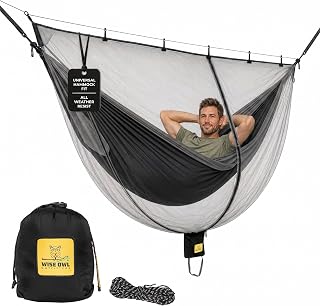
Wise Owl Outfitters Hammock Bug Net
This is the reliable default for most people: a well-constructed standalone net from a brand that has been refining hammock gear for years, and it packs down small enough to live in a bag pocket permanently. The fit is generous across most hammock widths, and the ridgeline sleeve setup means you’re deployed in under a minute.
XL 11×4.6FT No-See-Ums Hammock Bug Net
The extra width here is the real selling point, giving you meaningful clearance above your face instead of mesh resting on your nose. The no-see-um rated polyester handles the tiny biting insects that walk straight through coarser netting, and the dual diagonal zippers make midnight exits painless.
Camping Hammock with Mosquito Net and Rain Fly
If you want one purchase that handles bugs and weather together, this bundled system is the efficient answer, and it consolidates three separate stuff sacks into one. The tradeoff is flexibility: you’re committed to this hammock, so make sure the dimensions suit how you like to lie.
G4Free Large Camping Hammock with Mosquito Net
The 440-pound capacity and included tree straps and tarp make this the most complete kit on the list, genuinely two-person capable rather than optimistically labeled. Durable nylon holds up to repeated setup cycles, which matters if you’re pitching and packing weekly rather than seasonally.
AYAMAYA Hammock Bug Net
AYAMAYA’s 11-foot net prioritizes speed, and the double-sided zipper layout plus simple ridgeline threading gets it up faster than most competitors. It’s a strong pick if you’re adding protection to a hammock you already like and want minimal added bulk.
Frequently Asked Questions
Will a bug net fit my existing hammock?
Most standalone nets are sized for hammocks between 9 and 11 feet long and work across single and double widths. Measure your hammock body end to end and compare it to the net’s stated length; a net slightly longer than your hammock is better than one slightly shorter.
Do I need a separate ridgeline?
Yes, for most standalone nets. The net threads onto a continuous line running above the hammock, which lifts the mesh off your body. Some nets include a line and spreader; others assume you have one, so check the package contents before ordering.
How much storage space does a bug net actually take?
A typical standalone net compresses to roughly the size of a one-liter bottle, which fits inside the hammock’s own stuff sack in most cases. Full hammock-and-net systems with a tarp run closer to a small daypack’s volume.
Can I use a hammock bug net indoors?
Absolutely, and it’s underrated. If you hang a hammock on a balcony or in a room with open windows and no screens, the net creates a sealed sleeping space without installing anything permanent to walls or ceilings.
Final Thoughts
For most buyers, the Wise Owl Outfitters net is the sensible starting point: proven construction, compact storage, and broad hammock compatibility at a reasonable price. If you deal with no-see-ums or simply want more breathing room overhead, the XL 11×4.6FT net earns its extra inches. And if you’re building a setup from scratch and want one item on the shelf instead of three, the G4Free complete kit with straps and tarp delivers the most capability per cubic inch of storage.