Key takeaways
- Clearance, not length: Chalk the island’s footprint on your deck, then add 36 inches on every working side and 42 inches where traffic passes behind a cook. If that outline crosses a door swing, a stair nose, or a railing gate, size down before you shop further.
- Fixed or rolling: Locking-caster carts let you park the island against a wall between uses and pull it out to an L-shape when you’re hosting, which effectively doubles a tight patio. Built-in stations with plumbing and refrigeration commit that ground permanently, so reserve them for yards where the layout is settled.
- Material against your climate: 304 stainless resists salt and chlorine far better than 430, granite tolerates hot pans but adds serious mass, and HIPS resin shrugs off rain without the rust risk. Coastal and freeze-thaw regions should treat this as the deciding spec, not a finish preference.
- Storage that matches your rhythm: Enclosed cabinets protect charcoal, propane spares, and linens from weather; open shelving is faster to reach mid-cook but collects pollen and grit. A pull-out plate or drop leaf buys landing space without permanent width.
- Utility reality check: Sinks need a supply line and a drain path, and refrigerators need a GFCI outlet within reach. Confirm both exist before paying for features that will sit unused, and factor installation cost into the comparison.
What's inside
Outdoor kitchen islands have a footprint problem that showroom photos never admit. A 98-inch run looks generous on a patio drawn to scale, but on a real 12-by-14 deck it swallows the walkway, blocks the door swing, and forces every guest into a single-file shuffle past the grill. The buyers who end up disappointed usually didn’t pick the wrong island — they picked the right island for a yard three feet wider than theirs.
This guide approaches the category the way a small-space planner would: measuring clearance before capacity, weighing mobility against permanence, and separating the units that genuinely earn their square footage from the ones that just fill it. Below you’ll find six 2026 options spanning compact rolling carts to full built-in stations with sinks and refrigeration, plus the sizing math and material trade-offs worth knowing before you commit.
As an Amazon Associate we earn from qualifying purchases.



How to Choose a/an Outdoor Kitchen Island (2026)
- Clearance, not length: Chalk the island’s footprint on your deck, then add 36 inches on every working side and 42 inches where traffic passes behind a cook. If that outline crosses a door swing, a stair nose, or a railing gate, size down before you shop further.
- Fixed or rolling: Locking-caster carts let you park the island against a wall between uses and pull it out to an L-shape when you’re hosting, which effectively doubles a tight patio. Built-in stations with plumbing and refrigeration commit that ground permanently, so reserve them for yards where the layout is settled.
- Material against your climate: 304 stainless resists salt and chlorine far better than 430, granite tolerates hot pans but adds serious mass, and HIPS resin shrugs off rain without the rust risk. Coastal and freeze-thaw regions should treat this as the deciding spec, not a finish preference.
- Storage that matches your rhythm: Enclosed cabinets protect charcoal, propane spares, and linens from weather; open shelving is faster to reach mid-cook but collects pollen and grit. A pull-out plate or drop leaf buys landing space without permanent width.
- Utility reality check: Sinks need a supply line and a drain path, and refrigerators need a GFCI outlet within reach. Confirm both exist before paying for features that will sit unused, and factor installation cost into the comparison.
The Best Outdoor Kitchen Island (2026)s Reviewed
98″ Deluxe Outdoor Kitchen Island
Four burners at 72,000 BTU, a rotisserie, refrigerator, and granite counters make this the closest thing to an indoor kitchen you can park outside. It demands a genuinely large patio, but if you have the run, the 304 stainless construction and cabinet storage handle high-volume entertaining without compromise.
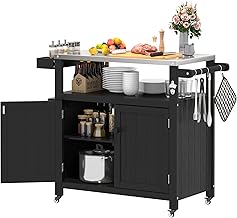
Weatherproof HIPS Island with Stainless Top
The smartest small-space pick here: HIPS resin construction shrugs off rain and won’t rust, and the wheels let you tuck it flat against a wall when the patio needs to be a patio again. The stainless top handles hot pans, and the enclosed cabinet keeps supplies dry between cookouts.
BODEGACOOLER 6-Burner Island
Ninety-seven thousand BTU across six burners with a built-in fridge and sink puts this in serious host territory — you can prep, cook, and rinse without leaving the station. Budget for a water line and a nearby outlet, since the sink and refrigerator only pay off when both utilities are already in place.
Feasto 74″ Rolling Grill Table
At 74 by 26 inches, this hits the sweet spot for mid-size decks: enough stainless surface for a pizza oven or griddle, narrow enough to keep a walkway clear. The pull-out plate adds landing space exactly when you need it, then disappears.
Feasto Modular Outdoor Kitchen Island
The modular design is the point — start with one unit, add sections as your layout settles, and reconfigure when you rearrange the patio. Stainless top and enclosed storage make each module useful on its own rather than only as part of a set.
Frequently Asked Questions
How much clearance does an outdoor kitchen island really need?
Plan on 36 inches of open space on any side you’ll work from and 42 inches where someone must walk behind the cook. Below 36 inches you’ll be bumping cabinet doors and drawers against furniture constantly.
Can I leave one of these outside year-round?
304 stainless, teak, and HIPS resin all tolerate outdoor exposure well, but appliances, gaskets, and granite still benefit from a fitted cover. In freeze-thaw climates, drain any sink lines before the first hard frost.
Are rolling islands stable enough to cook on?
Yes, provided the casters lock and the deck is reasonably level. Engage all locks before lighting a burner, and avoid rolling a loaded unit across thresholds or gaps between deck boards.
Do I need a professional to install a sink or fridge model?
Refrigerators generally need a GFCI outlet, which is electrician territory if one isn’t nearby. Sinks require a supply line and drainage plan, and local codes often govern where that water can go.
Final Thoughts
For tight patios and decks, the Weatherproof HIPS Island is the most practical buy in this group — it rolls out of the way and survives the weather without fuss. Mid-size spaces are best served by the Feasto 74″ Rolling Grill Table, which delivers real prep surface without eating your walkway, while anyone with genuine room to spare should look at the 98″ Deluxe Island for its four-burner output, refrigeration, and granite work surface.