Key takeaways
- Total lumens, not per-bulb lumens: Multiply output by the number of sockets. A six-arm fixture with 460-lumen bulbs delivers roughly 2,760 lumens — plenty for a small dining area, potentially overwhelming in a 60-square-foot entry. Scale down to 380-lumen bulbs in tight quarters.
- Base and shape must both match: E12 is the standard candelabra thread, but shape determines whether the bulb clears the shade or socket cover. B10 and B11 are slim torpedo profiles; CA10 has the bent flame tip. Measure your existing bulb before ordering.
- Color temperature consistency: Pick one Kelvin rating and commit across the whole fixture. 2700K reads as clean warm white; 2500K leans amber and flatters wood tones and warm paint. Mixing the two in one chandelier is instantly visible.
- Verify dimmer compatibility: Older leading-edge dimmers frequently flicker with LEDs. If you’re keeping the existing switch, buy bulbs explicitly rated dimmable and be prepared to swap to a trailing-edge dimmer if you notice strobing at low output.
- Buy more than you need: A 12-pack costs marginally more than a 6-pack and gives you exact-match spares. In a small space where the chandelier is always in your sightline, one replacement bulb of the wrong tint ruins the effect.
What's inside
In a compact home, a chandelier does double duty: it’s the room’s light source and often its only real architectural gesture. That makes bulb choice unusually high-stakes. Swap in the wrong candelabra bulb and a five-arm fixture in a 10×12 dining nook goes from warm focal point to harsh, buzzing eyesore — or worse, six mismatched color temperatures glaring down at a table you also use as a desk. The candelabra aisle doesn’t help, with E12 bases, B10 versus B11 versus CA10 shapes, and wattage equivalents that rarely mean what they claim.
This guide breaks down what actually matters when you’re lighting a small room from above: lumen output scaled to square footage, dimmer compatibility, filament styling for exposed-bulb fixtures, and why buying in multipacks saves you from the mismatch problem down the line. Below are six candelabra bulbs worth your money in 2026, with notes on which rooms and fixtures each one suits best.
As an Amazon Associate we earn from qualifying purchases.


How to Choose a Bulb For Chandelier (2026)
- Total lumens, not per-bulb lumens: Multiply output by the number of sockets. A six-arm fixture with 460-lumen bulbs delivers roughly 2,760 lumens — plenty for a small dining area, potentially overwhelming in a 60-square-foot entry. Scale down to 380-lumen bulbs in tight quarters.
- Base and shape must both match: E12 is the standard candelabra thread, but shape determines whether the bulb clears the shade or socket cover. B10 and B11 are slim torpedo profiles; CA10 has the bent flame tip. Measure your existing bulb before ordering.
- Color temperature consistency: Pick one Kelvin rating and commit across the whole fixture. 2700K reads as clean warm white; 2500K leans amber and flatters wood tones and warm paint. Mixing the two in one chandelier is instantly visible.
- Verify dimmer compatibility: Older leading-edge dimmers frequently flicker with LEDs. If you’re keeping the existing switch, buy bulbs explicitly rated dimmable and be prepared to swap to a trailing-edge dimmer if you notice strobing at low output.
- Buy more than you need: A 12-pack costs marginally more than a 6-pack and gives you exact-match spares. In a small space where the chandelier is always in your sightline, one replacement bulb of the wrong tint ruins the effect.
The Best Bulb For Chandelier (2026)s Reviewed
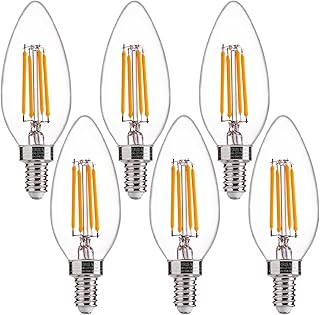
60W Equivalent Dimmable E12 Clear B11 LED Filament, 2700K, 6-Pack
The brightest LED option here, and the right call for a chandelier that has to light an entire open-plan studio or a dining zone doing double duty as a workspace. The clear B11 glass and visible filament read as genuinely vintage rather than plastic-imitation, which matters when the bulbs sit at eye level.
E12 Flame Tip Candle Bulbs, 4W 460 LM, 2700K, 12-Pack
The flame-tip profile suits traditional and transitional fixtures where a blunt torpedo bulb looks unfinished. At 460 lumens across 12 bulbs, this pack covers a chandelier plus a matching sconce pair with spares left over — practical if you’re coordinating lighting across a small footprint.
COLWATT 12-Pack Candelabra Bulbs, 2500K, CA10 Clear
At 380 lumens and 2500K, these are the most restrained bulbs in the roundup, and the ones I’d reach for in a low-ceilinged room or a hallway chandelier. The warmer amber cast softens the shadows that low ceilings tend to exaggerate, and the outdoor rating extends their use to covered porches.
12-Pack Dimmable E12 LED B11 Vintage Filament, 2700K, 450 Lumens
A well-balanced middle option: enough output for a standard small dining room without the intensity of 60W-equivalent bulbs, and clear glass that flatters exposed-socket fixtures. Reliable dimming performance makes these the flexible choice if your chandelier serves both dinner and daylight work.
E12 LED Candelabra Bulbs 4W, 470Lm, 2700K B10 Edison, 5-Pack
The narrower B10 diameter is the fix for tight sockets and small shades where a B11 won’t seat properly. The 5-pack sizing suits a single five-arm fixture exactly, though I’d buy two packs to keep spares on hand.
Frequently Asked Questions
How many lumens does a small-room chandelier need?
Aim for roughly 20 lumens per square foot in a dining area. A 100-square-foot room needs about 2,000 total lumens, which five 450-lumen bulbs cover comfortably. Reduce that figure for entryways and hallways, where lower light is preferable.
Can I mix LED and incandescent candelabra bulbs?
Technically yes, but the result looks off. Incandescent bulbs like the MEQIQTEK 60W run warmer and dimmer as they age, while LEDs hold their output steady. Choose one technology per fixture.
Why do my LED chandelier bulbs flicker when dimmed?
Usually a dimmer mismatch. Older triac dimmers were designed for incandescent loads and struggle with low-wattage LEDs. Replacing the switch with an LED-rated trailing-edge dimmer resolves it in most cases.
Is 2500K too warm for a small space?
Not at all — it tends to work in its favor. The amber tone visually softens boundaries and makes compact rooms feel enveloping rather than cramped. Reserve 2700K and above for spaces where task visibility comes first.
Final Thoughts
For most small-space chandeliers, the 12-Pack Dimmable E12 LED B11 Vintage Filament bulbs hit the right balance of output, styling, and spare-bulb value. Choose the 60W Equivalent B11 Filament 6-Pack if your fixture is the sole light source in an open-plan room, or the COLWATT 2500K CA10 pack if you want a warmer, gentler glow under a low ceiling.