Key takeaways
- Total lumen math, not per-bulb: Multiply lumens by socket count before you buy. Six 450-lumen bulbs put out 2,700 lumens — plenty for a large dining room, potentially overwhelming above a two-seat bistro table. In small spaces, choose lower-output bulbs rather than fighting brightness with a dimmer you’ll never turn past 30%.
- Dimmer compatibility: Older leading-edge dimmers were built for incandescent loads and often flicker or buzz with low-wattage LEDs. If your switch is more than a decade old, either budget for a modern LED-rated dimmer or stick with incandescent candelabra bulbs, which dim flawlessly on anything.
- Color rendering above 90 CRI: This matters more in a small room than a large one. When your walls, cabinetry, and textiles all sit within a few feet of the fixture, low-CRI light visibly flattens them. 90+ CRI keeps warm woods warm and whites clean.
- Bulb shape versus fixture scale: B10 and CA10 flame-tip bulbs read slimmer and are the safer pick for petite fixtures or anything with tight glass shades. B11 filament bulbs are marginally larger and more sculptural — beautiful on an exposed-socket chandelier, cramped inside a small shade.
- Pack size and spares: Twelve-packs cost barely more than sixes and solve the mismatched-bulb problem later. Storage is the tradeoff, but a slim 12-pack box on a closet shelf is a fair trade for never having one bulb that’s a shade cooler than the rest.
What's inside
In a compact apartment or a studio where the dining nook doubles as a desk, a chandelier isn’t just decoration — it’s the primary light source doing three jobs at once. That puts an unusual amount of pressure on six or twelve tiny bulbs. Pick the wrong ones and you get a fixture that hums at half-dim, casts a greenish tint on your walls, or floods a 90-square-foot room with more glare than a kitchen ceiling panel. Small rooms amplify every flaw, because there’s nowhere for bad light to hide.
This guide focuses on E12 candelabra bulbs from the perspective of tight square footage: which ones dim smoothly down to a genuinely low glow, which render wood tones and paint colors honestly, and which cluster cleanly without visually crowding a small fixture. We’ve grouped the standout options below, then broken down the specs that actually matter so you can buy once and be done.
As an Amazon Associate we earn from qualifying purchases.




How to Choose a Chandelier Light Bulbs (2026)
- Total lumen math, not per-bulb: Multiply lumens by socket count before you buy. Six 450-lumen bulbs put out 2,700 lumens — plenty for a large dining room, potentially overwhelming above a two-seat bistro table. In small spaces, choose lower-output bulbs rather than fighting brightness with a dimmer you’ll never turn past 30%.
- Dimmer compatibility: Older leading-edge dimmers were built for incandescent loads and often flicker or buzz with low-wattage LEDs. If your switch is more than a decade old, either budget for a modern LED-rated dimmer or stick with incandescent candelabra bulbs, which dim flawlessly on anything.
- Color rendering above 90 CRI: This matters more in a small room than a large one. When your walls, cabinetry, and textiles all sit within a few feet of the fixture, low-CRI light visibly flattens them. 90+ CRI keeps warm woods warm and whites clean.
- Bulb shape versus fixture scale: B10 and CA10 flame-tip bulbs read slimmer and are the safer pick for petite fixtures or anything with tight glass shades. B11 filament bulbs are marginally larger and more sculptural — beautiful on an exposed-socket chandelier, cramped inside a small shade.
- Pack size and spares: Twelve-packs cost barely more than sixes and solve the mismatched-bulb problem later. Storage is the tradeoff, but a slim 12-pack box on a closet shelf is a fair trade for never having one bulb that’s a shade cooler than the rest.
The Best Chandelier Light Bulbs (2026)s Reviewed
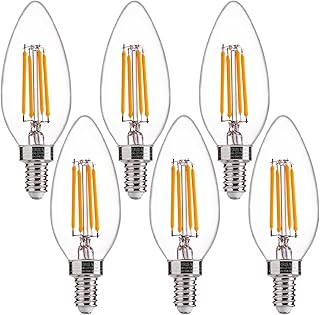
12-Pack Dimmable E12 LED Candelabra Bulbs, 4W B11 Filament
These clear-glass filament bulbs are the best all-around answer for exposed-socket fixtures, delivering 450 lumens at 2700K with a visible filament that looks intentional rather than utilitarian. At 4W each, a six-arm chandelier draws about 24W total — an easy win if your studio is on a shared circuit.
Hizashi 90+ CRI LED Candelabra Bulb, CA10 Flame Tip
The 90+ CRI rating and UL listing make these the pick when light quality is non-negotiable, and the narrow CA10 flame-tip profile fits fixtures that reject chunkier bulbs. Dimming performance is genuinely smooth on modern LED dimmers, holding a low warm glow without the stepped drop-off cheaper LEDs show.
GvvooHome E12 Candelabra Bulbs, 400LM B10
At 400 lumens these are the lowest-output option here, which is precisely the point in a small dining area or entryway where 450 to 600 lumens per socket becomes glaring. Clear glass, 90+ CRI, and a slim B10 body make them a thoughtful choice for tight fixtures.
60W Candelabra Incandescent Bulbs, B10 Clear (12-Pack)
If you have a vintage dimmer you don’t want to replace, incandescent remains the path of least resistance — flawless dimming, warm color shift as it fades, zero compatibility guesswork. The tradeoffs are real: 600 lumens at 60W each, noticeable heat, and a shorter life than any LED on this list.
60W Equivalent LED Chandelier Bulbs, B11 Filament (6-Pack)
The brighter LED option, sized for larger fixtures or rooms where a chandelier is genuinely the only ceiling light. The six-pack suits a standard five- or six-arm fixture without leftover storage, though buying twelve is usually the better long-term value.
Frequently Asked Questions
Why do my LED candelabra bulbs flicker when dimmed?
Almost always a dimmer mismatch. LEDs draw far less current than the incandescent bulbs older dimmers were designed to handle, and below a certain threshold the dimmer can’t regulate steadily. Swapping in an LED-compatible dimmer resolves it in most cases.
What’s the difference between B10, B11, and CA10?
B10 and B11 are bullet-shaped bulbs, with B11 slightly larger in diameter. CA10 has a bent flame tip mimicking a candle. All use the same E12 base, so any of them will thread into a standard candelabra socket.
How many lumens do I need for a small dining area?
Roughly 1,500 to 2,000 total lumens for a compact space, assuming the chandelier is your main source. Divide by your socket count: a six-arm fixture lands comfortably at 250 to 350 lumens per bulb, which is why 400-lumen options often suit small rooms better than 600.
Is 2700K too yellow for a modern space?
2700K reads warm and relaxed, matching classic incandescent light. In small rooms it also makes tight spaces feel less clinical. If you want something crisper for a work-adjacent nook, look at 3000K, but avoid mixing temperatures within one fixture.
Final Thoughts
For most small-space setups, the Hizashi 90+ CRI CA10 bulbs are the strongest overall choice — accurate color rendering, a slim profile, and reliable dimming in a twelve-pack. The 12-Pack Dimmable E12 B11 Filament bulbs are the better fit for exposed-socket fixtures where the bulb itself is part of the look, while the GvvooHome 400-lumen B10 bulbs make the most sense in genuinely tight rooms where lower output is a feature rather than a compromise.