Key takeaways
- Walkway clearance: Leave at least 30 inches for a main walkway and 36 inches in front of dresser drawers so you can stand and pull a drawer fully open (most drawers extend 14-16 inches).
- Bed and door swing: Measure from the edge of your bed frame and the arc of your bedroom and closet doors. A dresser should sit at least 24 inches from the side of the bed and never block a door’s 90-degree swing.
- The 10×12 foot room test: A typical 10×12 foot room with a queen bed (60×80 inches) and two nightstands has about 60-64 inches of usable wall left on the dresser wall. That fits a 6-drawer up to 60 inches wide with minimal side clearance, but a 9-drawer at 70+ inches will pinch the corners and limit traffic flow.
- Weight and floor limits: An empty dresser weighs 70-150 lbs depending on material. Loaded with clothes, add 80-120 lbs. For upstairs bedrooms, solid wood dressers at the high end of that range are fine for standard residential floors, but avoid overloading a single drawer beyond 25-30 lbs or the slides will sag.
For most bedrooms, the best dressers bedroom furniture choice comes down to this: pick a 3-drawer dresser for rooms under 10×10 feet or as a secondary storage piece, a 6-drawer dresser for standard 10×12 to 12×14 foot bedrooms needing everyday clothing storage for one to two people, and a 9-drawer dresser only if you have at least 11 feet of uninterrupted wall space and need to replace a closet.
- 3-Drawer vs. 6-Drawer vs. 9-Drawer: Head-to-Head
- How to Measure Your Bedroom for the Right Dresser Size
- Style Guide: Matching Your Dresser to Bed and Nightstands
- Material and Construction Trade-Offs
- Decision Matrix: Which Dresser Fits Your Situation
- Assembly, Moving, and What Wears First
- Final Checklist Before You Buy
3-Drawer vs. 6-Drawer vs. 9-Drawer: Head-to-Head
The drawer count dictates footprint, storage volume, and how the dresser functions in your layout. Width matters more than height for stability and usability.

Orgobysol 6 Drawer Double Dresser for Bedroom, Modern Simply Chest of Drawers, Wood Storage Dresser with Anti-Tipping for Living Room Hallway Entryway, Nursy Black (15.3" D x 47.2" W x 32.3" H)
Included for 'Best Dressers for Bedroom Furniture: Sizes and Styles Guide' because the listing specifies Modern Simply Chest of Drawers and Nursy Black (15.3" D x 47.2" W x 32.3" H), details this guide uses to compare options.
View on Amazon
YANSNWO Black 6 Drawer Dresser for Bedroom, 44" Tall Chest of Drawers
Included for 'Best Dressers for Bedroom Furniture: Sizes and Styles Guide' because the listing specifies 44" Tall Chest of Drawers, details this guide uses to compare options.
View on Amazon
VASAGLE Modern 6-Drawer Dresser, Clothes Storage Cabinet
Included for 'Best Dressers for Bedroom Furniture: Sizes and Styles Guide' because the listing specifies Clothes Storage Cabinet, details this guide uses to compare options.
View on Amazon
FOTOSOK Black Dresser, 6 Drawer Dresser with Handleless Drawer Cabinet
Included for 'Best Dressers for Bedroom Furniture: Sizes and Styles Guide' because the listing specifies 6 Drawer Dresser with Handleless Drawer Cabinet, details this guide uses to compare options.
View on Amazon| Dresser Type | Typical Dimensions (W x H x D) | Drawer Size | Clothing Capacity | Best For Room Size | Minimum Wall Space Needed |
|---|---|---|---|---|---|
| 3-Drawer (Small / Compact) | 32-40″ W x 28-34″ H x 16-18″ D | Wide, shallow: 28-36″ W x 6-8″ H | 30-45 folded items | Under 100 sq ft, e.g., 9×10 or 10×10 ft | 44-52″ (includes 6″ clearance each side) |
| 6-Drawer (Standard Double) | 50-64″ W x 30-36″ H x 18-20″ D | 2 columns of 3: 22-28″ W x 6-7″ H | 70-100 folded items | 120-168 sq ft, e.g., 10×12 to 12×14 ft | 62-76″ (includes 6″ clearance each side) |
| 9-Drawer (Large / Triple) | 64-72″ W x 32-36″ H x 18-20″ D | 3 columns of 3: 20-22″ W x 6-7″ H | 110-150 folded items | Over 170 sq ft, e.g., 12×15 ft or primary suite | 76-84″ (includes 6″ clearance each side) |
Height note: Dressers under 34 inches high work as a TV stand for a 50-65 inch television without straining your neck from bed. Taller than 36 inches, you will need to wall-mount the TV. Depth over 20 inches makes a small room feel cramped and blocks closet doors.
When a 3-Drawer Wins
A 3-drawer is ideal when floor space is tighter than storage needs. It fits inside a closet alcove, at the foot of a queen bed with 24 inches of walkway remaining, or in a nursery where it doubles as a changing table with a 32-inch height. It also works as a secondary dresser: pair a 3-drawer for accessories and workout clothes while your main closet handles hanging items.
When a 6-Drawer Is the Sweet Spot
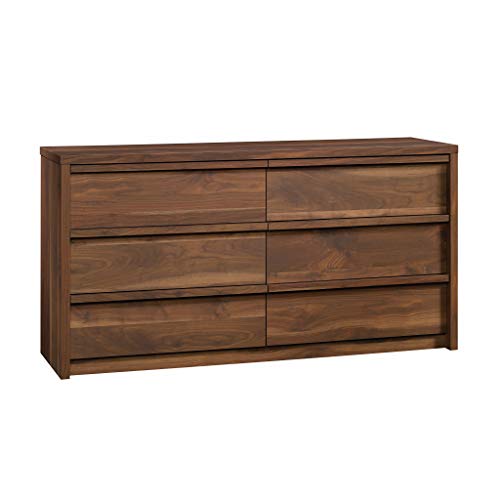
The 6-drawer double dresser is the standard for dressers bedroom furniture because it stores a full week of clothes for two adults without dominating the wall. With two columns, you can assign left vs. right for partners, or top row for daily essentials and bottom rows for seasonal storage. Most 6-drawer models allow a 30- to 36-inch mirror or artwork centered above without overhang.
When a 9-Drawer Makes Sense
Choose a 9-drawer only if you have a long, uninterrupted wall and want to avoid a separate chest of drawers or armoire. In a 12×15 foot primary bedroom, a 72-inch wide 9-drawer leaves room for two 22- to 24-inch wide nightstands flanking a king bed on the opposite wall. It is less efficient in narrow rooms because you cannot open three columns of drawers fully if a bed or doorway is within 36 inches.
How to Measure Your Bedroom for the Right Dresser Size
Do not rely on wall length alone. Measure for function and clearance:
- Walkway clearance: Leave at least 30 inches for a main walkway and 36 inches in front of dresser drawers so you can stand and pull a drawer fully open (most drawers extend 14-16 inches).
- Bed and door swing: Measure from the edge of your bed frame and the arc of your bedroom and closet doors. A dresser should sit at least 24 inches from the side of the bed and never block a door’s 90-degree swing.
- The 10×12 foot room test: A typical 10×12 foot room with a queen bed (60×80 inches) and two nightstands has about 60-64 inches of usable wall left on the dresser wall. That fits a 6-drawer up to 60 inches wide with minimal side clearance, but a 9-drawer at 70+ inches will pinch the corners and limit traffic flow.
- Weight and floor limits: An empty dresser weighs 70-150 lbs depending on material. Loaded with clothes, add 80-120 lbs. For upstairs bedrooms, solid wood dressers at the high end of that range are fine for standard residential floors, but avoid overloading a single drawer beyond 25-30 lbs or the slides will sag.
Pro tip: Tape the dresser footprint on the floor with painter’s tape and simulate opening drawers with a 36-inch cardboard depth in front. If you have to sidestep the bed to open it, go smaller.
Style Guide: Matching Your Dresser to Bed and Nightstands
Your dresser should relate to your bed and nightstands in height, finish, and hardware, not necessarily match exactly as a set.
By Bedroom Style
- Modern / Minimal: Low profile (30-32″ H), flat fronts, recessed or bar pulls, finishes like white, warm walnut, or matte black. Pair with a platform bed and simple rectangular nightstands. Keep top decor minimal to emphasize horizontal lines.
- Mid-Century Modern: 32-36″ H with tapered legs, 6-8 inches of visible floor underneath to lighten the look, and mixed materials like wood with cane or slatted fronts. Match the leg taper of your bed and nightstands.
- Traditional / Classic: 34-36″ H with framed drawer fronts, beveled edges, and knob or bail hardware in brushed brass or antique bronze. Works best with a paneled or upholstered bed and nightstands with matching molding.
- Farmhouse / Coastal: 32-35″ H, often with a slightly distressed or natural wood finish, shaker-style fronts, and larger knobs. Pair with a wood or slipcovered upholstered bed; nightstands can be slightly mismatched in finish for a collected look.
Matching Rules That Actually Matter
- Keep dresser top at or below the height of your nightstand tops by 2-4 inches for visual balance, unless the dresser is on a different wall.
- Match metal finishes, not wood tones exactly. If your bed has black metal legs, choose a dresser with black pulls even if the wood is walnut.
- If your bed is heavily upholstered, choose a dresser with clean wood lines to avoid a fabric-heavy room.
Material and Construction Trade-Offs
For dressers bedroom furniture, construction determines longevity, weight, and how it handles moves and humidity.
| Material / Build | Durability & Lifespan | Weight & Moving | Humidity & Wear | Price Range (2026 Market) |
|---|---|---|---|---|
| Solid Wood (e.g., pine, rubberwood, poplar, acacia) with dovetail drawers | Highest; 15-25 years; can be refinished; resists sagging | Heaviest: 110-160 lbs; requires two people to move | Expands/contracts slightly; best with sealed finish | Usually $600-$1,400 for 6-drawer |
| Engineered Wood (MDF / Particleboard with veneer or laminate) with cam-lock assembly | Moderate; 5-10 years; vulnerable to chipping and swelling if veneer is damaged | Medium: 70-110 lbs; flat-pack, easier through doorways | Swells with moisture; avoid in basements or near exterior walls without vapor barrier | Usually $250-$600 for 6-drawer |
| Metal Frame with Wood or Fabric Drawers | Frame very durable; fabric drawers less durable, sag under heavy items | Lightest: 45-75 lbs; easiest to assemble and move | Metal resists humidity; fabric absorbs dust and odors | Usually $120-$350 for 6-drawer equivalent |
Look for these construction details regardless of material: full-extension ball-bearing slides rated for 40-50 lbs per drawer, corner-blocked joints, and a solid back panel (not thin cardboard) which prevents racking. Drawer bottoms should be at least 0.4-inch thick plywood or MDF to avoid bowing under jeans and sweaters.
Decision Matrix: Which Dresser Fits Your Situation
| Your Situation | Recommended Dresser | Why It Works |
|---|---|---|
| Small apartment / studio, room under 10×10 ft, limited closet | 3-Drawer, 32-36″ W + vertical 5-drawer chest | Preserves 30″+ walkways; vertical storage uses height not floor area |
| Shared primary bedroom for two, 10×12 ft or larger | 6-Drawer double, 54-64″ W | Divides storage by person or category; top serves as display or TV surface |
| Large primary suite, want one piece instead of two | 9-Drawer or 6-Drawer + 3-Drawer combo | 9-drawer consolidates storage but two smaller pieces are easier to move and rearrange |
| Renter who moves every 1-2 years | Engineered wood or metal frame 3- or 6-drawer with flat-pack | Lighter boxes (55-85 lbs), fits through 28-30″ doorways when assembled; less risk of wall damage |
| Kids and pets, high daily use | Solid wood 6-drawer with wall anchor | Withstands climbing attempts, rounded edges safer; anchor to studs is mandatory for heights over 30″ |
| Back pain / accessibility needs | 6-Drawer at 32-34″ H, avoid low 3-drawer | Reduces bending; top drawers at waist height 30-36″ |
Assembly, Moving, and What Wears First
Real-world ownership matters more than showroom photos. Expect these realities:
- Box size and doorway fit: A flat-pack 6-drawer ships in one or two boxes at 55-68 inches long and 80-110 lbs total. A fully assembled solid wood 6-drawer is 60+ inches wide and will not fit through a 28-inch apartment doorway diagonally. Measure stairwell turns and elevator depth before delivery.
- Assembly time: Flat-pack engineered wood dressers typically take 60-120 minutes with two people and a drill. Solid wood often comes pre-assembled except for legs and hardware, taking 15-30 minutes.
- What fails first: Drawer slides and handles loosen within 2-3 years on budget builds; tightening screws every 6 months prevents wobble. Laminate edges chip at corners during moves. Fabric drawers stretch and the bottom sags after 12-18 months of heavy use.
- Durability tip: Always anchor any dresser taller than 30 inches or deeper than 18 inches to a wall stud with the included anti-tip hardware, even if you do not have children. Loaded top drawers make any dresser top-heavy.
- Top load limit: Most dresser tops are rated for 50-80 lbs. A 65-inch TV plus soundbar can approach that limit on engineered wood; use a TV stand or wall mount if your top bows.
Final Checklist Before You Buy
Confirm wall space plus 12 inches total side breathing room, 36 inches of pull-out clearance, drawer extension type (full-extension is worth it), slide weight rating, and that the finish matches your bed’s hardware. For dressers bedroom furniture, a well-measured 6-drawer in a durable build will serve most homes longer than an oversized 9-drawer that crowds the room.