Our Top Picks
 INSINKERATOR BADGER 5 Garbage Disposal with Cord0.5 HP6.31 x 6.31 x 11.5 inches5 poundsCheck on Amazon
If you want the lowest-cost route to a working disposal, the entry-level continuous-feed models in the 1/3 to 3/4 horsepower range are the sensible place to look, and the InSinkErator Badger line is the most widely referenced example. Choose the Badger 1 for a light-use kitchen, the Badger 5 as the general-purpose budget pick, and step up to the Badger 5XP or a Power model if your household cooks a lot and you want more grinding capacity without jumping to premium pricing.
At a Glance: Budget-Friendly Disposal Options
The table below uses the specifications the maker, InSinkErator, lists on its current disposal range. Other brands such as Waste King also sell entry-level units; confirm their current specs on the maker’s own pages before buying, because model lines change often.

InSinkErator Badger 5 Garbage Disposal, Badger Series 1/2 HP Continuous Feed Food Waste Disposer
Chosen because it specifies Badger Series 1/2 HP Continuous Feed Food Waste Disposer.
View on AmazonINSINKERATOR BADGER 5 Garbage Disposal with Cord, 1/2 HP Continuous Feed | BADGER Series, LIFT AND LATCH Technology, Power Cord Included, Septic Safe, 5-Year Limited Warranty, Compact Disposer
Chosen because it specifies 1/2 HP Continuous Feed and BADGER Series.
View on Amazon
INSINKERATOR BADGER 1 Garbage Disposal, 1/3 HP Continuous Feed, BGR 1 | BADGER Series, LIFT AND LATCH Technology, Septic Safe, 2-Year Limited Warranty, Compact Food Waste Disposer
Chosen because it specifies 1/3 HP Continuous Feed and BGR 1.
View on Amazon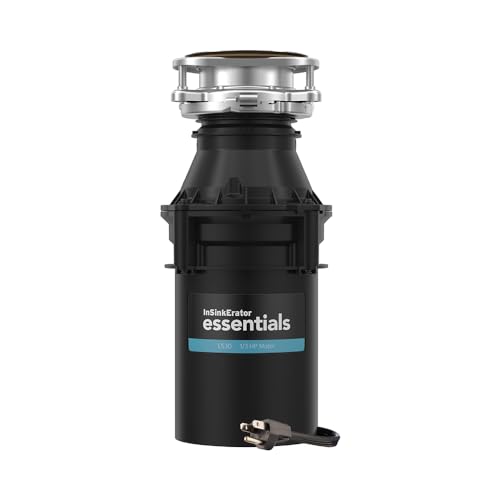
INSINKERATOR ES30 W/C, 1/3 HP Continuous Feed Garbage Disposal with Cord | Essentials Series, Power Cord, Septic Safe
Chosen because it specifies 1/3 HP Continuous Feed Garbage Disposal with Cord and Essentials Series.
View on Amazon| Model | Motor (maker’s figure) | Grind stages | Warranty (maker’s figure) | Best for | Main limit |
|---|---|---|---|---|---|
| Badger 1 | 1/3 HP | 1-stage | 2-year | Singles, couples, rental kitchens, light scraps | Smallest motor; slower on tougher scraps |
| Badger 5 | 1/2 HP | 1-stage | 5-year | Small families, everyday scraps | Single grind stage; can be louder than premium units |
| Badger 5XP | 3/4 HP | 1-stage | 6-year | Busy kitchens on a budget | Still a basic grind and basic sound insulation |
| Power .75HP | 3/4 HP | 2-stage | 6-year | Households wanting finer grinding while staying mid-range | Costs more than the Badger line |
What “Inexpensive” Should Actually Mean
A low sticker price is only one part of the cost. A disposal that jams often, leaks at the flange, or fails after two years ends up costing more than a mid-range unit that lasts a decade. When you compare budget models, weigh these factors together: warranty length, motor size, how the unit mounts, and whether your plumber will charge extra for fitting it. The maker’s warranty period is a useful shorthand for how much confidence the company has in the unit, although it is not a guarantee of lifespan.
On InSinkErator’s current range, warranty length rises with the model tier, from two years on the Badger 1 up to ten years on the top Evolution models. That pattern means the cheapest unit has the shortest coverage, so a household that expects to stay in a home for many years may find a step-up model better value over time.
Horsepower: How Much Do You Need?
Horsepower is the headline number on every box, and it is worth understanding what it does and does not tell you. InSinkErator states that the figures on its range reflect mechanical horsepower, meaning the actual output of the motor, rather than another calculation. Not every brand states the figure the same way, so comparing horsepower across brands is less reliable than comparing within one maker’s line.
- 1/3 HP: Suitable for one or two people who mostly scrape plates and small food scraps. Avoid feeding it fibrous or dense waste.
- 1/2 HP: A common budget choice for three or four people with ordinary cooking habits.
- 3/4 HP: A better fit if you prep fresh vegetables regularly or cook for a larger household. This is where many reviewers say budget units begin to feel noticeably more capable.
More power does not mean you can put anything down the drain. Every maker lists items to keep out of the unit, and following the manual is the best way to avoid clogs and warranty problems.
Single-Stage Versus Multi-Stage Grinding
Entry-level disposals generally use a single grind stage. That means one set of grinding components breaks food down before it passes into the drain line. The maker lists the Power .75HP with a two-stage design, and the Evolution models with three or four stages. Additional stages are intended to reduce food into finer particles, which can help with older drain lines. If your pipes are in good condition and you cook simply, a single-stage unit is usually enough. If you have an older home with narrow or slow-draining pipes, consider whether a multi-stage model is worth the extra outlay, and ask a plumber for advice about your specific drainage.
Continuous Feed Versus Batch Feed
All of the budget models above are continuous feed: you switch the unit on, then feed scraps through the opening while water runs. Batch feed models run only when a stopper or cover is in place, which some households prefer for safety around children. Within InSinkErator’s current lineup, the batch-feed option is the Evolution Cover Control, which sits in a higher tier than the Badger models. If a batch-feed design matters to you, expect to budget above the entry level.
Fit and Compatibility Checks Before You Buy
Disposal replacement is often straightforward, but a cheap unit can become expensive if it does not fit. Check these points first:
- Sink opening: Most kitchen sinks use a standard three-bolt mounting opening, and many makers sell models that fit it. Confirm the specific mounting system in the product literature.
- Cabinet clearance: Measure the space under the sink, including the height below the flange and any pipes or filters nearby. Higher-powered units are often physically larger.
- Dishwasher connection: If a dishwasher drains through the disposal, confirm the unit has a dishwasher inlet and plan to remove the knockout plug as the instructions direct.
- Electrical supply: Many disposals are hard-wired or plugged into a switched outlet under the sink. A power cord kit is often sold separately. If you are unsure about wiring, hire a licensed electrician rather than guessing.
- Septic systems: If your home uses a septic tank, check with the maker and a septic professional. InSinkErator lists a dedicated Evolution Septic Guard model for this situation, which suggests the standard budget models are not designed with septic use as a feature.
Noise, Materials, and Longevity
Budget disposals are typically louder than premium ones, because premium models add more insulation around the motor and grinding chamber. If your kitchen opens onto a living area, noise may matter more than a small price saving. Reviewers regularly point out that sound insulation is one of the clearest differences between entry-level and top-tier units.
Materials also differ. Entry-level units often use galvanized steel grinding components, while premium models use stainless steel. Check the maker’s description of the grinding chamber, shredder ring, and corrosion protection, as these affect how long the unit keeps working.
Care and Safety Notes
- Never place your hand in the disposal. Turn off the switch and, if you must retrieve an item, use tongs or pliers and disconnect power at the breaker as your manual instructs.
- Run cold water before, during, and for a short time after use so scraps are flushed through the drain line.
- Avoid grease, large bones, fibrous stalks, and non-food items. Follow the exact list in the user manual.
- For a jammed unit, most manuals describe a reset button on the underside and a hex-key socket to free the turntable. Follow the maker’s steps rather than improvised methods.
- Never pour chemical drain openers into a disposal unless the manual allows it.
Pick X If… Decision Table
| If you… | Pick | Why |
|---|---|---|
| Live alone or in a rental and cook lightly | Badger 1 | Lowest tier in the maker’s range, smallest motor, short warranty |
| Want a general budget unit for a small family | Badger 5 | Mid-tier motor and a five-year warranty as the maker lists |
| Cook frequently and still want a low entry cost | Badger 5XP | 3/4 HP and six-year warranty on the maker’s list |
| Have older pipes or want finer grinding | Power .75HP | Two-stage design at a modest step up |
| Use a septic system | Evolution Septic Guard or a septic-compatible model | Maker lists a dedicated septic variant |
| Want batch feed for safety around children | Evolution Cover Control | Operates with the cover in place |
Alternatives to Consider
Step-up premium disposals
If you plan to remain in your home for years, a premium Evolution unit offers longer warranties and quieter operation. It sits in a higher budget tier, but the longer coverage can offset the initial outlay for heavy users.
Other brands in the entry range
Brands such as Waste King and Moen also sell lower-priced disposals. Compare their stated horsepower, warranty, and included parts, and read independent reviews to see how they hold up.
Composting or a scrap bin
If your budget is tight, or your drainage is delicate, a countertop scrap bin or compost service avoids both the purchase and the plumbing load. It does not replace a disposal for convenience, but it is a no-install alternative.
Budget Tier Summary
- Budget: Badger 1 and Badger 5. Fine for light to moderate use, with basic noise levels.
- Upper-budget / low mid-range: Badger 5XP and Power .75HP. More motor and, on the Power, additional grind stage.
- Mid-range to premium: Evolution models. Longer warranties and multi-stage grinding, at a clear step up in price.
Frequently Asked Questions
What is the cheapest type of garbage disposal worth buying?
A 1/3 to 1/2 horsepower continuous-feed unit is the usual entry point. It is suitable for light scraps in a small household. If you cook often, the 3/4 horsepower class is a more comfortable choice for modest extra outlay.
Is a one-stage disposal good enough?
For many homes with healthy drain lines, yes. Multi-stage grinders aim to produce finer particles, which can matter more with older or narrow pipes. A plumber can tell you whether your drainage warrants it.
Can I install a budget disposal myself?
Many people do, since the mounting system is designed to be replaced. You will still need to handle the drain connections and electrical supply correctly. If wiring is involved and you are unsure, hire a licensed electrician or plumber.
How long should an inexpensive disposal last?
Lifespan depends on use, what goes down it, and water quality. The maker’s warranty, such as two to six years on InSinkErator’s budget range, indicates minimum expectations only. Careful use and regular cold-water flushing help any unit last longer.
Are cheap disposals safe for septic systems?
Not automatically. Septic tanks respond differently to added solids, so check the maker’s guidance and consult a septic professional before installing any disposal. The maker lists a dedicated septic-oriented model in its range.
Why is my new disposal humming but not grinding?
A hum without rotation usually means something is jammed. Switch off power, follow your manual’s instructions to free the turntable, and press the reset button once the unit has cooled. If the problem repeats, contact the maker or a plumber.