Key takeaways
- Keyed 3-point locking system: Locks at top, bottom, and center with a turn handle. Keeps tall doors from bowing open and is the standard for garage chemicals, tools, and office records. Usually comes with two keys. Look for recessed handles so the handle does not snag in tight spaces.
- Keyed central cam lock: Single point lock in the middle. Fine for pantry or office where you just want to keep kids or guests out. Less resistant to prying than 3-point.
- Electronic or digital keypad lock: Common on office personnel cabinets. Convenient for shared spaces, but check battery access – the best versions have an external battery jump or key override if power fails.
- Padlock hasp or no lock: Lower cost, good for open garage storage where ventilation matters more than security. Add a hasp if you store hazardous materials and local regulations require locking.
What's inside
The best metal storage cabinet for most homes is a 16 to 18-gauge welded steel cabinet with adjustable shelves, a 3-point locking system, and a powder-coated finish – choose 14 to 16-gauge for heavy garage tools, 18 to 22-gauge for office and pantry use, and always check rust protection if you will use it in a garage, basement, or utility room.
What Actually Matters When Comparing Metal Storage Cabinets
Listings focus on height and color. The long-term difference comes from four specs: steel gauge, lock type, shelf adjustability, and rust resistance. Get those right for your space and the cabinet will last 10 to 15 years; get them wrong and you will deal with sagging shelves, stuck doors, or rust in two winters.

Guizeeopo Metal Storage Cabinet with Adjustable Shelves, Garage Storage Cabinets with Doors and Shelves, File Cabinets for Home Office, Kitchen Pantry Cabinet, 71'H, Black
Included for 'Best Metal Storage Cabinets for Home, Garage and Office' because the listing specifies Garage Storage Cabinets with Doors and Shelves and File Cabinets for Home Office, details this guide uses to compare options.
View on Amazon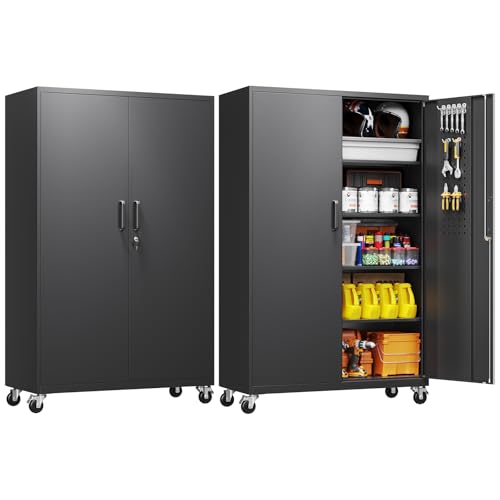
Yizosh Metal Garage Storage Cabinet with Locking Doors and Adjustable Shelves,- 71" Rolling Steel Tool Cabinet for Home Office,Garage,Warehouse
Included for 'Best Metal Storage Cabinets for Home, Garage and Office' because the listing specifies 71" Rolling Steel Tool Cabinet for Home Office and Garage, details this guide uses to compare options.
View on Amazon
Crownland 72" Metal Storage Cabinet, Lockable Garage Storage Cabinets, High Office Cabinet with Adjustable Shelves for Home Office, Pantry,Classroom, Garage, File(Black)
Included for 'Best Metal Storage Cabinets for Home, Garage and Office' because the listing specifies Lockable Garage Storage Cabinets and High Office Cabinet with Adjustable Shelves for Home Office, details this guide uses to compare options.
View on Amazon1. Steel Gauge: Strength vs. Weight and Cost
Gauge works backward – lower number means thicker steel. Most home cabinets range from 14-gauge (heavy-duty) to 24-gauge (light-duty). Gauge affects dent resistance, how much weight shelves hold without bowing, and how heavy the cabinet is to move.
| Steel Gauge | Steel Thickness | Typical Shelf Capacity (evenly distributed) | Cabinet Weight (36″W x 18″D x 72″H, 2-door) | Best For |
|---|---|---|---|---|
| 14-gauge | 1.90 mm (0.075″) | 350-500 lbs per shelf | 140-180 lbs | Power tools, auto parts, heavy hardware in garage |
| 16-gauge | 1.52 mm (0.060″) | 200-300 lbs per shelf | 110-135 lbs | Mixed garage and utility storage, paint cans, bulk pantry |
| 18-gauge | 1.21 mm (0.048″) | 120-180 lbs per shelf | 85-110 lbs | Office files, craft supplies, pantry, linen storage |
| 20-22-gauge | 0.91-0.76 mm (0.036″-0.030″) | 60-120 lbs per shelf | 65-85 lbs | Light office documents, medical or classroom storage |
| 24-gauge | 0.61 mm (0.024″) | 40-70 lbs per shelf | 50-70 lbs | Flimsy – avoid for anything heavier than office paper |
Trade-off: Welded 14 to 16-gauge cabinets rarely need assembly and do not wobble, but you will need two people and a hand truck to get them through a 30 to 32-inch doorway. Knock-down 18 to 22-gauge cabinets ship flat in a 60 to 90 lb box and fit through any door, but the bolted seams can loosen and the shelves will sag if you overload them.
2. Lock Type: Security and Daily Use
Not every home needs a high-security lock, but the mechanism changes how the doors stay closed and aligned.
- Keyed 3-point locking system: Locks at top, bottom, and center with a turn handle. Keeps tall doors from bowing open and is the standard for garage chemicals, tools, and office records. Usually comes with two keys. Look for recessed handles so the handle does not snag in tight spaces.
- Keyed central cam lock: Single point lock in the middle. Fine for pantry or office where you just want to keep kids or guests out. Less resistant to prying than 3-point.
- Electronic or digital keypad lock: Common on office personnel cabinets. Convenient for shared spaces, but check battery access – the best versions have an external battery jump or key override if power fails.
- Padlock hasp or no lock: Lower cost, good for open garage storage where ventilation matters more than security. Add a hasp if you store hazardous materials and local regulations require locking.
If the cabinet will hold fertilizers, solvents, or firearms-related items, many insurers and fire codes require a lockable metal cabinet. For pantry use, a lock is usually unnecessary and makes daily access slower.
3. Shelf Adjustability and Usable Space
Fixed shelves limit what you can store. Adjustable shelves on 1 to 2-inch increments turn a standard 72-inch cabinet into flexible storage.
- Check increments: Shelves that adjust every 1 inch give you space for tall items like a 15-inch stand mixer or 18-inch power drill case without wasting 4 inches of air.
- Check shelf lip: A 0.5 to 1-inch raised lip prevents bins from sliding, but a flat shelf lets you slide heavy boxes straight off.
- Check shelf clips: Double-flanged shelves with four clips per shelf hold more weight and do not tilt. Single-clip or hook-in shelves bend first at the corners.
- Count usable shelves: A 78-inch tall cabinet with 4 shelves has 5 storage levels including the base. A 36-inch tall counter-height cabinet with 1 adjustable shelf gives you two levels and can double as a work surface for a printer or microwave (usually rated for 100 to 200 lbs on top).
Measurement tip: Measure what you plan to store before you buy. A standard letter-size file box is 10″ H x 12″ W x 15″ D. A 36″W x 18″D cabinet fits three boxes per shelf side by side with about 1 inch of clearance on each side. If you store 1-gallon paint cans (7.5″ tall), you can fit two rows per shelf in a 72-inch cabinet with shelves set at 9 to 10 inches apart.
4. Rust Resistance: Finish and Environment
Bare or thinly painted steel rusts quickly in garages, basements, and coastal homes. Humidity above 60% and temperature swings cause condensation inside the cabinet.
- Powder-coated finish: The minimum you want. Electrostatically applied and baked powder coat is 3 to 4 times thicker than spray paint and resists chipping. Look for powder coat inside and out, including shelves.
- Galvanized or Galfan steel: Steel coated with zinc before powder coating. Essential for unheated garages, sheds, or near-pool storage. Brands marketed for garage systems, such as Gladiator, Sandusky, and Edsal, often use galvanized steel for this reason.
- Seams and welds: Fully welded seams and hemmed door edges keep moisture out better than bolted panels with exposed edges. If you buy a knock-down model, run a thin bead of clear silicone along the interior base seams if it will sit on concrete.
Never place a metal cabinet directly on a damp concrete floor. Use 0.5-inch plastic or composite shims or adjustable leveling feet to lift it. This prevents bottom rust and keeps doors from binding when floors are uneven.
Decision Matrix: Match the Cabinet to Your Situation
| Your Situation | Recommended Spec | Size to Look For | Why This Works |
|---|---|---|---|
| Garage with power tools and chemicals | 14-16 gauge, welded, galvanized + powder coat, 3-point lock | 36″W x 24″D x 72-78″H, 4 shelves | Deep shelves hold tool cases, high weight limit, lock keeps children out, rust protection for concrete floors |
| Home office for files and supplies | 18-gauge, powder coat, cam or electronic lock, adjustable shelves | 36″W x 18″D x 72″H or 36″W x 18″D x 42″H under window | Lighter to move, shelves adjust for binders (11″ tall) and file boxes, lock secures personnel files |
| Pantry or utility closet | 18-20 gauge, powder coat, no lock needed, 1″ shelf increments | 30-36″W x 16-18″D x 72″H | Narrow depth fits past standard 24″ closet door, adjustable spacing for appliances and bulk food |
| Small apartment or renter | 18-20 gauge, knock-down flat-pack, light color | 30″W x 15″D x 66-72″H | Ships in one box under 90 lbs, fits small elevators (door 36″ wide), can disassemble when moving |
| Basement or coastal home | 16-18 gauge, galvanized, fully welded | 36″W x 18″D x 72″H with leveling feet | Maximum corrosion resistance where humidity stays above 55% |
Size, Clearance, and Room Fit: The Numbers Listings Skip
Metal cabinets are unforgiving – you cannot trim them down. Measure before you order.
- Door swing: A 36-inch wide two-door cabinet needs 38 to 40 inches of clear floor in front to open doors to 90 degrees. For a 180-degree opening, you need 18 inches on each side of the cabinet. If the cabinet faces a wall, leave at least 42 inches between the cabinet face and the opposite wall.
- Room fit: In a 10 x 12 ft garage bay, a 36″W x 24″D cabinet along the 10-ft wall leaves 96 inches – 24 inches = 72 inches for a workbench and walking path, which still allows a 30-inch aisle if a bench is 24 inches deep. In a 10 x 10 ft office, a 36″W x 18″D cabinet on one wall uses less than 5 sq ft and does not block a standard 80-inch tall door.
- Height clearance: Tall 78-inch cabinets need 82 to 84 inches of vertical clearance to stand upright if delivered horizontal. In basements with 84-inch ceilings, order a 66-inch height or assemble upright inside the room.
- Weight on floors: A fully loaded 14-gauge cabinet can reach 800 to 1,200 lbs total. On wood-framed floors upstairs, keep total load under 40 lbs per square foot. A 36″ x 18″ footprint is 4.5 sq ft, so spread weight or choose a lighter 18-gauge cabinet for second-floor use and keep each shelf under 150 lbs.
Assembly, Moving, and What Wears Out First
Understanding delivery reality saves a return. Welded garage cabinets, common from Gladiator, Uline, and Sandusky, come fully assembled on a pallet. You will need a driveway drop and two adults to upright them – they do not fit in a sedan. Flat-pack cabinets from office brands like HON and IKEA (such as the IKEA KOLBJÖRN line) ship via parcel in one or two boxes, each 50 to 90 lbs, and take 45 to 90 minutes to assemble with a socket wrench and Phillips driver.
What wears first is not the steel but the hardware: shelf clips that bend under constant load, door hinges that loosen, and magnetic catches that weaken. Choose cabinets with welded hinges or hinges secured with bolts and nuts, not sheet-metal screws. Replaceable shelf clips sold by the manufacturer are a sign of a long-life product. Once a year, tighten hinge and handle bolts, vacuum dust from shelf rails, and touch up any paint chip with appliance touch-up paint to stop rust.
Price Ranges in 2026
Expect general market ranges of usually $120 to $250 for light-duty 20 to 22-gauge flat-pack office cabinets, $250 to $500 for mid-duty 18-gauge adjustable cabinets with locks, and $500 to $900 for heavy-duty 14 to 16-gauge welded and galvanized garage cabinets. Very tall or fire-rated models and sets with workstation tops sit above that range. Powder coating, galvanized steel, and 3-point locks add $80 to $200 compared to a basic shell.
Which Type Should You Buy?
For a garage that sees winter moisture and heavy tools, prioritize low gauge and galvanized steel over extra shelves. For an office, prioritize shelf adjustability and lock convenience over raw steel thickness. For a pantry, prioritize narrow depth and frequent adjustability so the same cabinet can hold both 11-inch cereal boxes and a 16-inch tall slow cooker. If you move often or rent, a knock-down 18-gauge cabinet gives the best balance of strength, weight, and the ability to get it through a 29-inch apartment doorway.