Key takeaways
- Wall clearance: Leave at least 3-4 inches between the rack and any door swing, and 24 inches of clear walkway in front of the rack to step in and out. A standard 3-tier rack is 10-12 inches deep; with shoes overhanging slightly, it needs 13-14 inches total depth.
- Tier height: Flat shoes need 4-5 inches, sneakers need 5-6 inches, ankle boots need 7-8 inches. If you own boots taller than 8 inches, choose a rack with one tall tier or an open top you can use for boots.
- Room-size fit: In a small entry (4×5 ft), a 26-28 inch wide, 2-tier low rack keeps the space open and doubles as a narrow bench area if paired with a wall hook. In a 10×12 ft mudroom or hallway, a 36-48 inch wide, 3-tier rack or a 30-inch wide shoe bench with storage underneath holds 9-12 pairs without blocking traffic.
- Box and doorway realities: Flat-pack solid wood and MDF racks ship in boxes weighing 25-45 lbs and up to 40 inches long. Bamboo pole racks ship lighter at 15-25 lbs. All will fit through a standard 30-inch interior doorway when assembled, but tall 5-tier towers over 48 inches high can be unstable in homes with kids or pets unless anchored to the wall.
What's inside
For most homes in 2026, solid wood is the most durable choice for a wooden shoe rack, bamboo is the best for damp entryways and light weight, and engineered wood (MDF or particleboard) is the affordable option that only lasts if you keep it dry and under its weight limit.
Solid Wood vs Bamboo vs Engineered Wood at a Glance
| Feature | Solid Wood (Rubberwood, Sheesham, Acacia) | Bamboo (Laminated / Strand-Woven) | Engineered Wood (MDF / Particleboard with Veneer/Laminate) |
|---|---|---|---|
| Weight capacity per tier | 35-50 lbs (holds 3-4 pairs heavy boots) | 25-35 lbs (holds 3 pairs sneakers/loafers) | 15-25 lbs (holds 2-3 pairs lightweight shoes) |
| Moisture resistance | Moderate – needs sealant, swells slowly if sealed | High – naturally resists humidity, least swelling | Low – swells and bubbles quickly if water seeps into edges |
| Typical unit weight (3-tier, 28-32 inch wide) | 28-42 lbs | 15-22 lbs | 20-30 lbs |
| Tier clearance (shelf-to-shelf height) | 6-8 inches (fits ankle boots flat) | 6-7 inches (taller boots must go on top) | 5.5-6.5 inches (tight for boots, fine for flats) |
| Expected lifespan with daily use | 10-20+ years, refinishable | 7-12 years, not easily refinished | 2-5 years in dry conditions, 1-2 years in damp areas |
| General market price range | usually $120-$350 | usually $60-$180 | usually $45-$130 |
| Best for | Family entryway, heavy shoes, long-term furniture | Rental, humid climate, frequent moving | Budget, guest room, dry closet organization |
This table reflects typical freestanding open wooden shoe rack designs with 2 to 5 tiers, not enclosed shoe cabinets with doors. Weight limits and dimensions drop significantly for tall, narrow tower racks and increase for low, wide bench-style racks.

Pipishell 3 Tier Bamboo Shoe Rack Bench for Entryway, Brown
Included for 'Best Wooden Shoe Racks: Solid Wood vs Bamboo vs Engineered Wood' because the listing specifies Brown, details this guide uses to compare options.
View on Amazon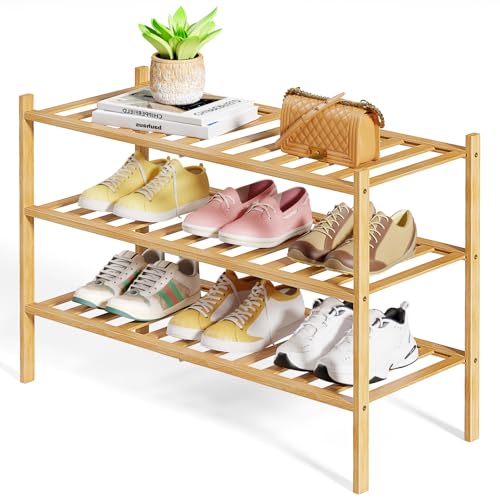
Kitsure Bamboo Wooden Shoe Rack for Closet, 26.8" Wide - 3 Tiers, Natural
Included for 'Best Wooden Shoe Racks: Solid Wood vs Bamboo vs Engineered Wood' because the listing specifies 26.8" Wide and 3 Tiers, details this guide uses to compare options.
View on Amazon
SONGMICS Shoe Rack Bench, 3-Tier Bamboo Entryway Bench, 27.6 Inches Width
Included for 'Best Wooden Shoe Racks: Solid Wood vs Bamboo vs Engineered Wood' because the listing specifies 3-Tier Bamboo Entryway Bench and 27.6 Inches Width, details this guide uses to compare options.
View on Amazon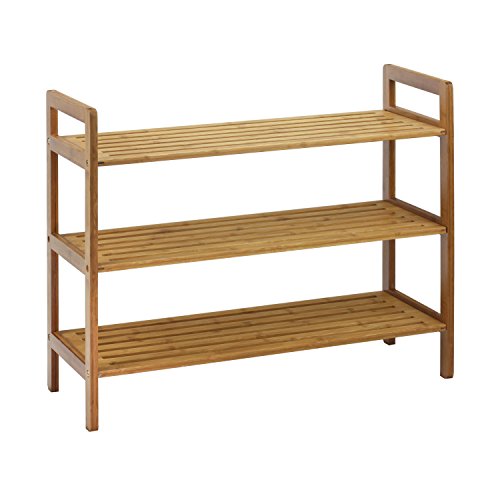
Oceanstar 3-Tier Bamboo Shoe Rack, Natural
Included for 'Best Wooden Shoe Racks: Solid Wood vs Bamboo vs Engineered Wood' because the listing specifies Natural, details this guide uses to compare options.
View on AmazonHow Each Material Actually Performs
Solid Wood: Strongest and Most Repairable
A solid wood wooden shoe rack is made from single boards of rubberwood, acacia, sheesham, mango or pine. Joints are usually screwed, doweled or mortise-and-tenon, which is why the weight capacity is highest. Most solid wood racks handle 100-150 lbs total, so the bottom tier can hold winter boots, work boots and even a storage basket without sagging.
Trade-offs are weight and maintenance. A 4-tier solid acacia rack at 32 inches wide weighs over 35 lbs empty, so it is stable but harder to move. Solid wood moves with humidity – it can develop hairline cracks if placed next to a heater or in direct sun, and the finish matters. Look for a polyurethane or lacquer seal on all sides, including the underside and bottom of shelves, not just the top faces. If water sits on an unsealed edge for hours, you will see dark spots. The advantage is that solid wood can be sanded and resealed after years of scuffs from shoe soles.
Bamboo: Light, Moisture-Tolerant, and Renter-Friendly
Bamboo is technically a grass, pressed into laminated or strand-woven boards. Strand-woven bamboo is denser and harder than most solid woods and resists daily scuffs well. Its natural silica content helps it resist moisture better than MDF and most softwoods, making it the most forgiving choice if your rack sits by a wet, snowy entryway, near a balcony door, or in an unventilated apartment hallway.
Bamboo racks are typically 30-40% lighter than solid wood for the same footprint, which helps if you move often or need to lift the rack to clean underneath. Most use round bamboo poles with plastic or metal connectors for tiered designs, or flat laminated shelves with metal side frames. The weak point is not the bamboo itself but the connectors and the thin varnish. Overtightening screws can split the laminated layers, and prolonged sun exposure can fade the finish. Bamboo cannot be sanded and stained like solid wood, so deep scratches are harder to hide.
Engineered Wood: Budget-Friendly but Sensitive to Water and Weight
Engineered wood covers MDF (medium-density fiberboard) and particleboard with a wood-grain veneer, melamine or paper laminate. It looks clean and uniform and usually costs the least. Construction is almost always cam-lock and dowel, with a thin backer board.
Durability is limited by two things: moisture and span. If the veneer chips at an edge or screw hole, humidity enters the core and causes swelling that never goes flat again. A single winter of wet boots dripping onto MDF shelves can bubble the surface. For weight, engineered wood sags over time. A 30-inch wide MDF shelf with no center support will start to bow at around 20 lbs of constant load within 12-18 months. That is fine for flats, loafers, sneakers and kids’ shoes, but not for a full load of boots or a person sitting on a shoe bench. If you choose engineered wood, pick designs with a center divider, thicker shelves (over 0.6 inches), and sealed edges, and place a tray or mat for wet shoes.
Sizing and Fit: Will It Work in Your Space?
Before choosing wood type, measure your entryway with real clearances, not just the rack’s footprint.
- Wall clearance: Leave at least 3-4 inches between the rack and any door swing, and 24 inches of clear walkway in front of the rack to step in and out. A standard 3-tier rack is 10-12 inches deep; with shoes overhanging slightly, it needs 13-14 inches total depth.
- Tier height: Flat shoes need 4-5 inches, sneakers need 5-6 inches, ankle boots need 7-8 inches. If you own boots taller than 8 inches, choose a rack with one tall tier or an open top you can use for boots.
- Room-size fit: In a small entry (4×5 ft), a 26-28 inch wide, 2-tier low rack keeps the space open and doubles as a narrow bench area if paired with a wall hook. In a 10×12 ft mudroom or hallway, a 36-48 inch wide, 3-tier rack or a 30-inch wide shoe bench with storage underneath holds 9-12 pairs without blocking traffic.
- Box and doorway realities: Flat-pack solid wood and MDF racks ship in boxes weighing 25-45 lbs and up to 40 inches long. Bamboo pole racks ship lighter at 15-25 lbs. All will fit through a standard 30-inch interior doorway when assembled, but tall 5-tier towers over 48 inches high can be unstable in homes with kids or pets unless anchored to the wall.
For closets, measure interior depth. Many closets are only 24 inches deep, so a 12-inch deep wooden shoe rack fits with hanging clothes in front, but a 14-inch deep rack will block the door.
Which Wooden Shoe Rack Should You Choose?
Match your situation to the material, not just the look.
| Your Situation | Best Pick | Why |
|---|---|---|
| Busy family, 4+ people, heavy shoes and boots daily | Solid Wood | Highest weight per tier and longest lifespan; tolerates daily dragging of shoes |
| Damp entryway, coastal or humid climate, wet winters | Bamboo | Resists swelling and cleans quickly; survives puddles better than MDF |
| Small apartment or rental, moving within 1-2 years | Bamboo | Lightest to carry up stairs and through narrow halls; no wall anchoring needed for low tiers |
| Growing kids and pets who scuff and knock into furniture | Solid Wood (with rounded edges) | Solid edges dent instead of chipping; can be touched up with wood marker or refinish |
| Need a shoe bench to sit and put shoes on | Solid Wood Bench (supports 200-250 lbs) | Only solid wood benches reliably support adult sitting weight; MDF/bamboo benches are usually limited to 150-180 lbs |
| Tight budget, dry bedroom closet, mostly flats and sneakers | Engineered Wood | Lowest cost and looks neat in a dry closet; add a drip tray to protect from occasional damp |
Assembly, Moving and What Wears Out First
Assembly time reflects construction. Bamboo pole racks with push connectors take 10-20 minutes with no tools. Solid wood racks with pre-drilled holes and wood screws take 25-45 minutes and need a Phillips screwdriver. Engineered wood with cam-locks takes 40-70 minutes, and the particleboard can strip if you overtighten – hand-tighten only and never use a power drill on the final turn.
For moving, solid wood can be carried assembled – it stays square. Bamboo should be moved assembled but lifted by the frame, not the shelves, to avoid popping connectors. Engineered wood is weakest when moved assembled; carry it empty, keep it level, and expect to retighten cam-locks after one move.
What fails first is predictable. On solid wood, the finish dulls where shoes slide. On bamboo, plastic corner connectors crack after 3-5 years. On engineered wood, the laminate chips at the front edge and shelf centers sag. You can extend life by placing a boot tray on the bottom tier, wiping moisture the same day, and not exceeding the per-tier limit – overloading by even 5 lbs consistently is what causes MDF to bow permanently.
Care Tips by Wood Type
- Solid wood: Dust weekly, wipe with a lightly damp cloth and dry immediately, re-oil or reseal once a year if in a sunny spot. Use felt pads on feet to protect floors.
- Bamboo: Wipe moisture promptly, keep out of prolonged direct sun to prevent fading, check connectors every 6 months and hand-tighten.
- Engineered wood: Keep completely dry, use a plastic tray for wet shoes, avoid dragging shoes across the edge, and distribute weight evenly – place heavier pairs on the bottom tier near the supports.
Frequently Asked Questions
Can a wooden shoe rack go outside or in an uncovered entry?
No wooden type should sit uncovered outdoors. Even bamboo will gray and crack with rain and UV. For a semi-outdoor covered porch, strand-woven bamboo with a marine-grade sealant is the only wood option that holds up reasonably, and you should still bring it in during prolonged rain.
Is a wooden shoe rack with fabric or metal tiers better?
If you need maximum airflow for odor control, metal and wood hybrid racks dry shoes faster. Full wood shelves hold more weight and look like furniture, but leave a 1-inch gap behind the rack for air circulation if your shoes are often damp.
How many pairs will a typical wooden shoe rack hold?
A 28-inch wide, 3-tier rack holds 6-9 pairs of adult shoes (2-3 per tier). A 4-tier holds 8-12 pairs. Count boots as 1.5 pairs of space and measure your largest shoes – men’s size 12 sneakers are about 12-13 inches long and will overhang a 10-inch deep rack.