Key takeaways
- 11-inch cubes: Interior opening around 10.5″. Fits small 10.5″ bins only. Too tight for vinyl records (12.3″ sleeves) and large photo boxes. Usually found on compact or budget units.
- 13-inch cubes: Interior opening 12.75″ to 13.25″. Fits standard 13″ fabric bins, 12″ vinyl records, letter-size file boxes, and folded sweaters. This is the most compatible size in 2026 and what most bin manufacturers target.
- 15-inch cubes: Interior opening 14.5″ to 15″. Fits oversized bins, large baskets, and folded blankets. Takes more floor depth (often 15.5″ to 17″ deep) and leaves wasted space if you only use 13″ bins.
Cube storage units work best when you match the cube count to your wall space and storage goal: 4-cube and 6-cube units for small spaces and nightstands, 8-cube and 9-cube units for most living rooms and bedrooms, and 12-cube to 16-cube units for large walls, home offices, and shared family storage.
Cube Storage Units by Configuration: What Each Size Actually Fits
Most cube storage units use 11-inch, 13-inch, or 15-inch square openings. The 13-inch cube is the current standard and determines whether fabric bins, vinyl records, or books fit without wasted space. The overall footprint grows predictably with cube count, so you can plan by wall length rather than guessing.
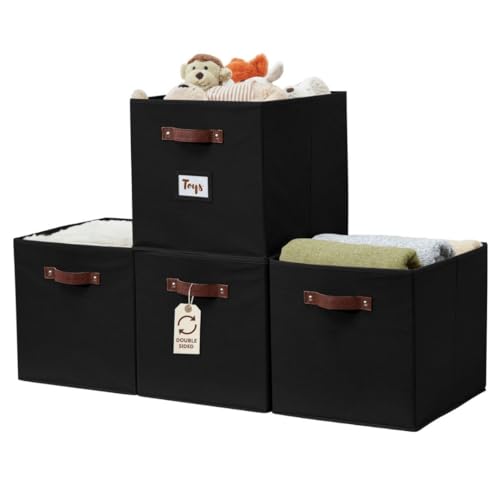
DECOMOMO Storage Bins, Storage Baskets for Shelves
Included for 'Cube Storage Units: Best Configurations for Living Room, Bedroom and Office' because the listing specifies Storage Baskets for Shelves, details this guide uses to compare options.
View on Amazon
Amazon Basics Collapsible Fabric Storage Cube Bins Organizer with Handles for Organization and Organizing Solution, 13"x13"x13", Beige, 6-Pack
Included for 'Cube Storage Units: Best Configurations for Living Room, Bedroom and Office' because the listing specifies 13"x13"x13" and Beige, details this guide uses to compare options.
View on Amazon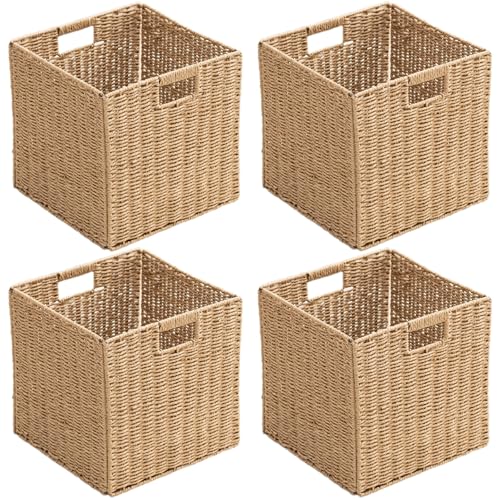
Handwoven Paper Woven Cube Basket Organizer with Handles set of 4 Foldable Storage baskets for Bedroom Living Room Cubby Storage Units for Clothes Books Toys (Natural, 13" L x 13" W x 13" H)
Included for 'Cube Storage Units: Best Configurations for Living Room, Bedroom and Office' because the listing specifies 13" L x 13" W x 13" H), details this guide uses to compare options.
View on Amazon
Furinno Cubicle 3-Shelf Cube Insert, Cube Organizer, Plain White
Included for 'Cube Storage Units: Best Configurations for Living Room, Bedroom and Office' because the listing specifies Cube Organizer and Plain White, details this guide uses to compare options.
View on Amazon| Configuration | Typical Overall Dimensions (W x H x D) | Footprint on Floor | Best For | Total Weight Limit (Evenly Distributed) |
|---|---|---|---|---|
| 4-Cube (2×2) | 30″ x 30″ x 15″ | 3.1 sq ft | Nightstand, entryway bench base, small nursery | 120-150 lbs |
| 6-Cube (3×2 Horizontal) | 45″ x 30″ x 15″ | 4.7 sq ft | Under-window storage, TV stand for up to 55″ TV | 180-220 lbs |
| 8-Cube (4×2 Horizontal) | 58″ x 30″ x 15″ | 6.0 sq ft | Living room low console, bedroom foot-of-bed storage | 220-280 lbs |
| 9-Cube (3×3) | 45″ x 45″ x 15″ | 4.7 sq ft | Small-space room divider, kids’ toy wall | 250-320 lbs |
| 12-Cube (4×3) | 58″ x 45″ x 15″ | 6.0 sq ft | Full living room wall, craft and office supply wall | 300-400 lbs |
| 16-Cube (4×4) | 58″ x 58″ x 15″ | 6.0 sq ft | Large family room, home office archive wall | 350-450 lbs |
Vertical orientation flips width and height for 6-cube (30″W x 45″H) and 8-cube (30″W x 58″H) units. Use vertical when floor space is tight but you have at least 60 inches of wall height clearance. Horizontal orientation is more stable for TVs and displays because the center of gravity is lower and you have more top surface.
Cube Size and Bin Compatibility: Why 13-Inch Matters
Not all bins fit all cubes, even if they are sold as “cube storage bins.” Measure the interior opening, not the exterior frame.
- 11-inch cubes: Interior opening around 10.5″. Fits small 10.5″ bins only. Too tight for vinyl records (12.3″ sleeves) and large photo boxes. Usually found on compact or budget units.
- 13-inch cubes: Interior opening 12.75″ to 13.25″. Fits standard 13″ fabric bins, 12″ vinyl records, letter-size file boxes, and folded sweaters. This is the most compatible size in 2026 and what most bin manufacturers target.
- 15-inch cubes: Interior opening 14.5″ to 15″. Fits oversized bins, large baskets, and folded blankets. Takes more floor depth (often 15.5″ to 17″ deep) and leaves wasted space if you only use 13″ bins.
If you already own bins, measure them at the widest point including seams and handles. Allow 0.5″ clearance per side so bins slide in and out without scraping the laminate. For book storage, skip bins entirely: a 13-inch cube holds about 12-15 average paperbacks per cube when stacked vertically, or 8-10 hardcovers.
Weight Capacity Per Cube vs. Total Unit
Total weight limits are misleading if you load one cube heavily. Most engineered wood cube units are rated for 25-35 lbs per cube shelf with an additional 40-60 lbs allowed on the top panel. Solid wood and metal-frame units typically handle 40-50 lbs per cube.
What this means in practice:
- Books are heavy: a single cube filled with hardcovers can hit 35-40 lbs quickly. Spread books across the bottom row only and use upper cubes for lighter bins.
- TVs and aquariums: A 55-inch TV is usually 30-40 lbs, fine on a 6-cube or 8-cube top panel. A 10-gallon fish tank is 85 lbs when filled – too heavy for any standard cube top. Use a dedicated stand.
- Vinyl records: About 35 lbs per cube when full. Limit records to the bottom two rows on 9-cube and larger units and anchor tall units to the wall.
Best Cube Storage Configuration by Room
Living Room: Low and Wide Wins
For living rooms, a 6-cube or 8-cube placed horizontally doubles as a console. In a 10×12 ft living room, a 58-inch wide 8-cube leaves about 30-32 inches of clearance on each side if centered on the 12-foot wall, which maintains a 36-inch walkway – the minimum for comfortable traffic flow. Keep 3-4 inches of clearance from the wall for baseboards and anti-tip hardware, and at least 18 inches in front for bin pull-out.
Use closed bins on the bottom row for clutter (cables, controllers, blankets) and open display with books and plants on top. If the unit holds a TV, choose a unit with a solid top panel thickness of 0.75″ or more and avoid stacking two 4-cube units to make an 8-cube; the seam creates a weak point under the center of the TV.
Bedroom: Height and Accessibility
In bedrooms, a 4-cube (30″ high) works as a nightstand alternative on one side and provides a 30-inch high surface that aligns with standard bed height (24-27″ for platform beds, 28-30″ for pillow-tops). A 6-cube horizontal under a window uses dead space without blocking light if your sill is 32″ or higher.
A 9-cube is ideal for a 10×10 ft bedroom closet wall. At 45″ wide, it fits inside most reach-in closet openings (typically 48-60″ wide) if you remove doors, or against the opposite wall with 40+ inches of floor space left for making the bed. Use fabric bins for clothing categories and add one or two insert drawers for socks and accessories.
Home Office: Vertical Storage and File Fit
Offices need more closed storage and vertical space. A 12-cube (4×3) or 16-cube (4×4) provides filing without a separate cabinet. Standard letter files are 12.25″ wide and need a 13-inch cube placed on its side with a file insert, or a dedicated file bin. Legal size (15″) requires a 15-inch cube.
Place tall units 24-30 inches from your desk edge so you can roll your chair back without hitting bins. For a 9×11 ft home office, a 16-cube on the 9-foot wall consumes nearly the entire wall; a 12-cube leaves room for a 30-inch wide desk beside it. If you need a standing desk converter, avoid placing it on top of a cube unit – the top height of 45″ to 58″ is too high for ergonomic typing (ideal desk height is 28-30″ for most adults).
Material and Construction Trade-Offs
| Material / Construction | Weight of 8-Cube Box | Durability and Feel | Weak Points | Price Range (8-Cube Size) |
|---|---|---|---|---|
| Engineered Wood (MDF/particleboard with laminate) | 55-75 lbs flat-pack | Smooth finish, many colors, budget-friendly | Swells with water, chips at corners, sags if overloaded; dowel + cam lock joints loosen after moves | Usually $80-$180 |
| Engineered Wood with Solid Wood Edges | 70-90 lbs | More rigid shelves, better screw hold for anti-tip kits | Still vulnerable to moisture on panels | Usually $150-$300 |
| Solid Wood (pine, rubberwood) | 85-120 lbs | Highest per-shelf strength, refinishes well, resists sagging | Heavier to move, can be 1-2″ deeper; natural wood movement in dry climates | Usually $280-$550 |
| Metal Frame with Wood or Fabric Shelves | 45-65 lbs | Strongest frame, open look, easy to move and reassemble | Fabric shelves sag, thinner shelves rattle; less dust protection | Usually $120-$250 |
Laminate thickness matters more than the product photo suggests. Units with 0.5″ (12mm) panels flex more than 0.625″ to 0.75″ (15-18mm) panels. Thicker back panels (0.2″ or more) also reduce racking, which is the wobble you feel when the unit is not anchored.
Decision Matrix: Pick Your Configuration in 30 Seconds
Use your primary constraint to choose:
- Small apartment or renter (no wall anchoring allowed): Choose 4-cube or 6-cube horizontal. Stays under 30″ high so it does not need anchoring in most cases and fits through 29-30″ doorways without disassembly. Add non-slip pads instead of wall anchors.
- Kids and pets: Choose 6-cube or 8-cube horizontal over tall 9-cube or 16-cube. Lower center of gravity reduces tip risk. Anchor any unit over 36″ tall regardless of load. Use bins with lids on bottom rows to keep toys contained and prevent climbing.
- Need to hide clutter fast: Choose 9-cube or 12-cube and plan for one bin per cube. One 13″ bin holds roughly 10-12 folded t-shirts or 2-3 throw blankets. Budget usually $8-$18 per fabric bin, $25-$40 per insert with drawer or door.
- Back pain or frequent bending issues: Choose 9-cube or 12-cube and reserve bottom row for rarely used items. Daily-use items should live at 30″ to 48″ high – the second and third rows.
- Display + storage mix: Choose 8-cube horizontal. Use 2-3 cubes open for books/plants and 5-6 cubes with bins. This keeps the top surface clear for decor while hiding the rest.
Assembly, Moving, and What Wears Out First
Cube units ship flat-pack in one or two boxes. A 16-cube box can weigh 90-120 lbs and will not fit in a small sedan. Measure your entry path: interior doorways are typically 28-30″ wide, apartment entry doors 32-36″ wide. A fully assembled 4×4 unit is 58″ wide and will not turn through a 30″ doorway; assemble it in the room where it will live.
Assembly time is usually 45-90 minutes for 4-cube to 8-cube units and 90-150 minutes for 12-cube to 16-cube units with two people. You will need a Phillips screwdriver and included hex key. A drill speeds up cam locks but overtightening strips particleboard – stop when snug.
What fails first is not the shelf but the joints and the surface: cam locks loosen after one or two moves, laminate peels at the front edge near frequent bin contact, and the thin cardboard back panel bows if the unit is dragged. Reinforce with wood glue on dowels during first assembly if you plan to keep the unit more than 3 years, and lift rather than slide when repositioning.
For renters or anyone who moves annually, metal-frame cubes or solid-wood units with bolt-through hardware reassemble more reliably than budget particleboard with single-use cam locks.