
Key takeaways
- There is no single correct floating tv stand height from floor for every room. Start by positioning the television at a comfortable seated viewing height, then fit the cabinet below it while leaving practical space for equipment, cables, and cleaning.…
There is no single correct floating tv stand height from floor for every room. Start by positioning the television at a comfortable seated viewing height, then fit the cabinet below it while leaving practical space for equipment, cables, and cleaning. A low floating cabinet should serve the TV and the wall structure, not dictate where your screen goes.
As an Amazon Associate we earn from qualifying purchases.
By KK Home Furnishings Editorial Team
Floating TV Stand Height From Floor: What to Measure
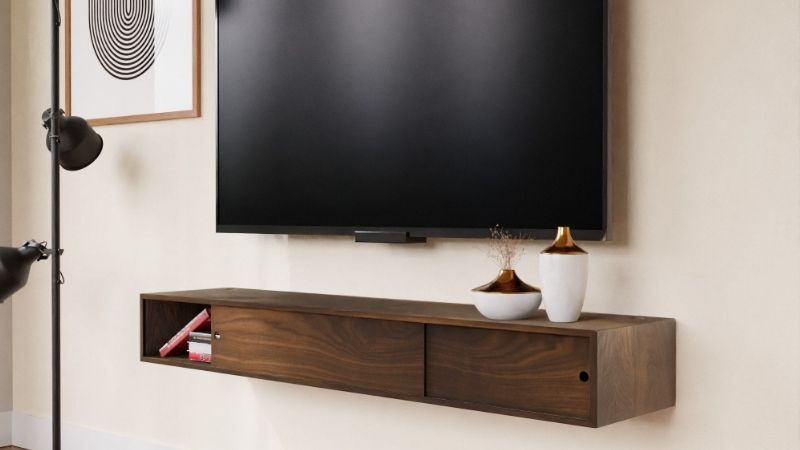
A floating TV stand has two useful height measurements: where its bottom ends above the finished floor, and where its top begins below the TV. Manufacturer dimensions tell you how tall the case is, but not the perfect mounting elevation. The viewing position and actual furniture model determine whether the arrangement fits.
| Bottom Above Floor | Top With a 15-Inch Cabinet | Possible Use | Check Before Choosing |
|---|---|---|---|
| 6 inches | 21 inches | Lower screen and modest lift | Cleaning-tool reach and doors |
| 8 inches | 23 inches | Low lounge arrangement | Gap below actual TV |
| 10 inches | 25 inches | Extra floor visibility | Soundbar and TV bottom |
| 12 inches | 27 inches | More exposed wall beneath | Potentially raised TV center |
| 14 inches | 29 inches | Taller visual composition | TV may become uncomfortably high |
| 16 inches | 31 inches | Higher cabinet in a special layout | Recheck viewing height and wall |
The table is a set of arithmetic examples using a cabinet 15 inches tall, not a universal installation recommendation. IKEA sells 15-inch-high BESTÅ TV units that can be wall mounted subject to their model instructions [IKEA, BESTÅ TV unit 005.657.77, October 2026]. Other cabinets have different case heights.
Locate the TV Screen at Your Seated Eye Level
For conventional living-room seating, SANUS and Crutchfield both use roughly 42 inches from the floor to the center of a TV screen as a starting reference [SANUS, HeightFinder; Crutchfield, How to Wall-Mount Your TV]. That is a seated-eye guideline for the TV, not a mounting measurement for a floating cabinet.
Measure your own eye height while seated where you actually watch, particularly if your sofa is unusually low or your favorite recliner changes your posture. A taller or shorter viewer can require a different TV position. If the room layout forces the screen higher, acknowledge that compromise rather than calling it ideal.
Measure Both the Cabinet Bottom and the Cabinet Top
The space visible beneath the console creates the floating effect, but the cabinet top decides whether the television, soundbar, and storage still fit. For a 15-inch-high case, a planned 8-inch floor gap places the top at 23 inches. That example makes sense only if the television bottom remains safely above that top.
Do not transfer the floor-gap figure from a design photograph without checking actual product dimensions. Decorative doors, protruding handles, router shelves, and a soundbar can all consume space. Mock up the case with painter’s tape and view it from your usual seat before choosing any final marks on the wall.
Confirm That the Particular Cabinet Can Hang on Your Wall
IKEA describes its 70 7/8-inch-wide, 15-inch-high BESTÅ TV unit as suitable for either floor-standing or wall-mounted use, while warning that the maximum load of a wall-hung unit depends on the wall material [IKEA, product 005.657.77]. Its listed 66-pound maximum TV weight is not a universal hanging-load allowance.
The shorter 47 1/4-inch BESTÅ TV unit also requires the specified wall fasteners, and IKEA states that the BESTÅ suspension rail must not be used for that TV bench [IKEA, product 705.660.33]. Other product variants explicitly forbid wall hanging. Check your own article number, wall construction, and complete instructions before installation.
Adjust the Cabinet Height for Your Situation
Use the position of the screen first and the storage unit second. The same cabinet can work below a modest television and collide with a larger one at the same wall elevation. These six situations show when a lower, higher, narrower, or floor-standing solution is more sensible than copying a single height from a photo.
When the Television Is Mounted on the Wall
Make the bottom edge of your actual TV the upper limit for the furniture layout. Crutchfield notes that a 75-inch TV centered at 42 inches places its bottom approximately two feet above the floor [Crutchfield, How to Wall-Mount Your TV]. That leaves relatively little space for a tall cabinet and an extra gap directly below the screen.
A shorter or lower-mounted console may fit under that screen without moving the television higher. Use the visible gap you prefer only after you account for the cabinet top, the lower TV bezel, and any device sitting on the furniture. If the proposed cabinet crowds the screen, change the furniture, not automatically the viewing height.
One practical approach is to tape the screen outline and the full cabinet silhouette on the wall. Sit down and check whether the arrangement looks balanced. This is a design trial, not a substitute for inspecting the wall and the cabinet mounting instructions. The visual spacing can be adjusted before a single permanent attachment is made.
When the TV Sits Directly on the Floating Console
A floating TV stand that physically carries a television has a different job from a storage cabinet hung underneath a separately wall-mounted screen. Confirm that the exact unit is designed to support the TV’s complete weight, footprint, and feet configuration while suspended. A product’s floor-standing rating is not enough on its own.
For instance, the 70 7/8-inch IKEA BESTÅ bench lists a 66-pound maximum TV weight but separately says hanging capacity depends on wall material [IKEA, 005.657.77]. Keep those two limits separate. If the approved wall-mounted load is not clear, do not assume the listed television weight resolves the engineering question.
The cabinet elevation also becomes the television base elevation. A 15-inch case with its bottom 12 inches above the floor presents a considerably higher standing surface than the same unit with an 8-inch bottom gap. Try the television at both heights on a safe temporary support before deciding whether that view is comfortable.
In a Small Apartment or Low-Ceiling Room
A modest floor gap can make a small wall look less crowded without sacrificing as much vertical room as a high-mounted cabinet. Check whether you actually need a robot vacuum to pass underneath or merely want the floor visible. Measure the cleaning device itself, including any raised sensors, instead of assuming one clearance fits every model.
A shallow wall unit can also help traffic flow where furniture projects into a narrow aisle. IKEA’s 15-inch-high BESTÅ TV bench, for example, is listed at 15 3/4 inches deep [IKEA, 705.660.33]. That is a model-specific dimension to compare with your actual floor plan, not proof that every floating console is equally shallow.
Avoid committing to an elevated cabinet just because its floor gap looks generous in a showroom. In a compact living room, the television may end up too high to clear the cabinet. A shorter cabinet, fewer components, or a properly secured floor-standing console may preserve comfortable viewing better.
When You Need Space for a Soundbar or Game Console
Plan the space between the TV and the cabinet around the actual dimensions of your soundbar, receiver, or game system. Do not assign one generic vertical gap to every speaker. A soundbar on the cabinet top must leave the screen and TV remote sensor unobstructed; a speaker mounted separately follows its own hardware instructions.
Electronic equipment also needs ventilation and accessible cables. If a receiver must sit behind a closed cabinet door, read its stated ventilation and operating-environment requirements rather than assuming a larger floor gap below the entire unit solves interior heat buildup. The cabinet elevation is only one part of the layout.
Remember that a floating TV console can have a convenient top surface but awkward access to wall sockets located low near the baseboard. Dry-fit the actual plugs and cable paths without pinching them. If the best-looking height forces inaccessible outlets or bent power cords, adjust the cabinet layout before mounting.
With a Taller Cabinet or Larger TV Screen
Taller media cases leave less room between the furniture and an eye-level television. IKEA offers taller BESTÅ variants as well as 15-inch models, but one 25 1/4-inch-high BESTÅ TV unit is explicitly marked as unsuitable for wall hanging [IKEA, product 805.660.37]. Matching the family name does not make the tall version floating-compatible.
A larger TV usually extends farther down below the same screen center. If you choose a high-mounted cabinet and a large screen simultaneously, the screen may have to move up to avoid overlap. The 42-inch center reference is useful precisely because it makes that trade-off visible before you purchase or drill.
Where the screen and furniture cannot coexist at comfortable heights, try a lower cabinet, a purpose-built slim wall shelf, or a separate floor unit. Do not substitute unapproved brackets or remove load-bearing panels to save height. Those changes affect the support conditions, not just the appearance of the wall.
When Wall Structure or Rental Rules Limit Installation
Before finalizing a mounting line, verify that your wall can accept the mounting method required by the selected unit. IKEA says wall-hung TV bench capacity depends on wall material and warns that appropriate fasteners are necessary [IKEA, 005.657.77]. Its installation guidance for BESTÅ can vary by country, article, and available backing.
If the wall cannot accommodate the specified hardware, adjusting the cabinet height does not make an unsafe fixing suitable. Renters should also get permission for permanent fasteners and any necessary electrical work. Use an installer familiar with the actual wall construction when stud placement, masonry, or hidden utilities remain uncertain.
A floor-standing cabinet secured as its manufacturer directs can be the safer alternative when a floating installation is impractical. That choice may still look uncluttered and preserve the correct TV viewing height. Do not put a wall-mounted-only cabinet on the floor unless its manufacturer explicitly permits that configuration.
Frequently Asked Questions
These final checks address measurements that are easily confused during planning. They do not replace a manufacturer’s installation guide, and the sample sizes below should be understood as illustrations, not a building standard for suspended furniture.
Is 12 Inches Off the Floor Too High for a Floating TV Stand?
Not necessarily. Twelve inches describes the bottom of the cabinet, not its top. With a 15-inch case, that example puts the top at 27 inches. Whether that is workable depends on the TV’s lower edge, other equipment, and the seated viewing position; it is not a height the cabinet manufacturer automatically endorses.
If a large TV is centered near seated eye level, the cabinet may be too close to the picture at that elevation. Check with a full-size wall outline and reduce the cabinet elevation or choose a shorter case when necessary. Do not raise the TV just to make an arbitrary floating gap look larger.
Does a Floating TV Stand Need to Be Centered Under the TV?
No structural rule requires a separately wall-mounted television to align perfectly with the visual center of the furniture. Centering is a common design choice, not a substitute for determining how the TV and cabinet each attach to the wall. Their supporting hardware and loads must be considered independently.
If outlets, a door, or an architectural feature make perfect centering awkward, a deliberate offset can still work visually. Keep the screen comfortable from the main seat and make sure cabinet doors open fully. Never shift mounting points away from approved positions solely to achieve symmetry.
Can You Put a Wall-Mount-Only Floating Console on the Floor?
Only if the manufacturer expressly allows floor-standing use for that exact product and configuration. Some BESTÅ TV bench models permit both options [IKEA, product 705.660.33], while other wall-mounted furniture is not designed to bear loads at floor level. The appearance of a flat cabinet bottom is not enough evidence.
Check whether the unit needs feet, support legs, wall anchoring, or a different base panel when used on the floor. Even furniture intended to stand on the floor may require wall restraint against tipping. Follow the current instructions for your specific article number rather than a photo of a similar item.
Will a Higher Cabinet Make the TV Viewing Height Better?
Not by itself. SANUS recommends starting with the center of the screen around seated eye level, commonly about 42 inches from the finished floor [SANUS, HeightFinder]. A taller cabinet can force the TV higher, making the viewing angle worse even when the wall composition looks more balanced.
Measure the screen center where you normally sit, then find storage that fits beneath the television. If you routinely watch while reclining or standing, the practical eye height may differ. A mount with tilt can accommodate some layouts, but it does not eliminate the need to check actual sight lines.
Final Thoughts
The best floating tv stand height from floor is the one that keeps your television comfortable to watch while accommodating the real cabinet height and approved wall support. Start with seated eye level, test the TV and cabinet outlines together, and verify model-specific installation limits. Favor a lower cabinet or a different design whenever a taller floating gap would push the screen too high.
