Key takeaways
- Above a TV: the shelf run (or the outer shelves in a symmetrical pair) should extend at least 4 to 6 inches beyond each side of the TV, so a 55 inch TV (about 48 inches wide) wants a shelf span of at least 56 to 60 inches total.
- Flanking a TV console: individual shelves of 24 to 36 inches on each side read as intentional; anything shorter than 18 inches looks like an afterthought.
- Wall to wall floating shelves: leave at least 3 to 4 inches of clearance from each side wall so the shelf doesn’t look jammed into the corner, and check ceiling and outlet locations before committing to a full-width run.
- Large floating shelves for living room feature walls: single shelves 48 inches or longer need mounting into at least 3 studs, not 2, to avoid sag under any real weight (see below).
What's inside
The right height for floating shelves above a living room sofa is 8 to 12 inches above the sofa back, or roughly 60 to 66 inches from the floor to the bottom of the shelf. Get that number wrong and the whole wall feels off, no matter how good the shelves themselves are. Everything else, spacing between shelves, how long a run should be, and where the brackets actually go, follows from a few measurable rules tied to your furniture and your studs.
Height above the sofa
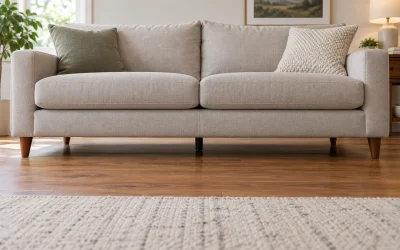
Measure from the floor to the top of your sofa back, then add 8 to 12 inches. For a standard sofa with a 34 to 36 inch back height, that puts the bottom of the shelf around 42 to 48 inches up from the seat cushion, or about 60 to 66 inches from the floor. If you’re mounting a single long floating shelf as art-ledge style storage rather than a shelf grid, stay closer to the 8 inch gap so it reads as connected to the sofa instead of floating awkwardly in the upper wall.
For tall shelves for living room walls that run floor to ceiling or close to it, the sofa-relative math still applies to the lowest shelf. Everything above follows the spacing rules below, not a fixed ceiling offset, because ceiling heights vary too much (8 ft in many homes, 9 to 10 ft in newer builds) to give one universal number.
Vertical spacing: books versus decor
This is where most layouts go wrong. Books and decor need different clearances, and cramming both into the same spacing makes one or the other look squeezed.
| Use case | Vertical clearance needed | Typical shelf depth |
|---|---|---|
| Paperbacks | 8-9 in | 6-8 in |
| Hardcover books | 10-11 in | 8-10 in |
| Decor and small objects (candles, framed photos, small plants) | 10-12 in | 6-8 in |
| Larger decor (vases, sculptural pieces, stacked baskets) | 14-16 in | 10-12 in |
| Mixed display (books laid flat + objects on top) | 12-14 in | 8-10 in |
If you’re building a bookshelf wall out of floating shelves rather than a bookcase, plan for hardcover clearance even if your current collection is mostly paperback. Book collections grow taller before they grow shorter. For a purely decorative wall of framed art, small sculptures, and greenery, you can tighten spacing to 10 inches and fit more shelves into the same vertical run.
How many shelves fit a given wall height
A common living room wall segment above a sofa, from 60 inches up to an 8 ft ceiling, gives you about 36 usable inches. That’s realistically 3 shelves at 12 inch spacing, or 2 shelves at 16 inch spacing if you want more breathing room for larger decor. Trying to fit 4 shelves into that same 36 inches means dropping to 9 inch spacing, which only works for paperbacks and small objects, not anything with height.
Sizing the shelf run to your wall and TV
Long floating shelves living room setups, especially ones flanking or floating above a TV, need to relate to the TV’s width, not just fill available wall.
- Above a TV: the shelf run (or the outer shelves in a symmetrical pair) should extend at least 4 to 6 inches beyond each side of the TV, so a 55 inch TV (about 48 inches wide) wants a shelf span of at least 56 to 60 inches total.
- Flanking a TV console: individual shelves of 24 to 36 inches on each side read as intentional; anything shorter than 18 inches looks like an afterthought.
- Wall to wall floating shelves: leave at least 3 to 4 inches of clearance from each side wall so the shelf doesn’t look jammed into the corner, and check ceiling and outlet locations before committing to a full-width run.
- Large floating shelves for living room feature walls: single shelves 48 inches or longer need mounting into at least 3 studs, not 2, to avoid sag under any real weight (see below).
As a general rule, a shelf run should occupy 60 to 75 percent of the width of the furniture or TV it’s paired with. Much narrower and it looks disconnected; much wider and it competes with the room instead of framing it.
Stud spacing and bracket placement
North American residential framing puts studs on 16 inch centers (occasionally 24 inch in some newer construction), and this single number should drive your bracket layout more than aesthetics do.
| Shelf length | Studs typically caught | Bracket recommendation |
|---|---|---|
| 18-24 in | 1-2 | Anchor into at least 1 stud; use rated drywall anchors for the second point |
| 30-36 in | 2 | 2 brackets, each on a stud, 16 in apart is common if wall layout allows |
| 42-48 in | 2-3 | 3 brackets when possible; center bracket adds real sag resistance |
| 60+ in | 3-4 | Bracket at every stud the shelf crosses; skipping one invites visible dip over months |
Find studs with a stud finder before you finalize shelf length, not after. If your ideal 36 inch shelf position lands with brackets falling between studs on both ends, it’s usually better to shift the shelf a few inches than to rely on drywall anchors alone for a load-bearing shelf carrying books. Toggle bolts rated for 50-75 lbs each can substitute at non-stud points, but stud mounting is still stronger and cheaper.
Material and finish trade-offs
| Material | Weight capacity (per bracket pair, stud-mounted) | Best for | Trade-off |
|---|---|---|---|
| Solid wood | 25-40 lbs | Floating wood shelves living room, natural grain look | Heavier shelf itself; can warp in humid rooms over years |
| Engineered wood/MDF core | 15-25 lbs | Budget runs, painted or veneered finishes | Sags faster under sustained heavy loads; avoid for dense book collections |
| Metal-framed with wood top | 30-50 lbs | Black floating shelves living room, industrial or modern styling | Visible brackets unless hidden-mount hardware is used |
| Solid metal/steel | 40-60 lbs | Heavy decor, mixed-media display walls | Cold visual tone; needs careful anchoring due to shelf weight itself |
Black floating shelves in either metal or a dark-stained wood finish read as more deliberate against light or neutral walls, but they also show dust and fingerprints more visibly than lighter wood tones, worth factoring in if the shelves sit within easy reach.
Quick layout checklist
- Bottom shelf: 8-12 in above sofa back, or 60-66 in from floor as a general baseline
- Book shelf spacing: 10-11 in; decor spacing: 10-12 in; mixed use: 12-14 in
- Shelf run width: 60-75% of the TV or furniture width it pairs with
- Bracket points: on-stud whenever possible, every 16 in of shelf length
- Shelf longer than 48 in: plan for 3+ mounting points, not 2
Once these numbers are set, the decorative choices, wood tone, black metal frame, open versus closed brackets, are just style decisions layered on top of a layout that will actually hold weight and look balanced on the wall.