Key takeaways
- Check a storage ottoman beside a sofa through opening, lid placement and retrieval. Compare removable and hinged lids using the actual room layout.
What's inside
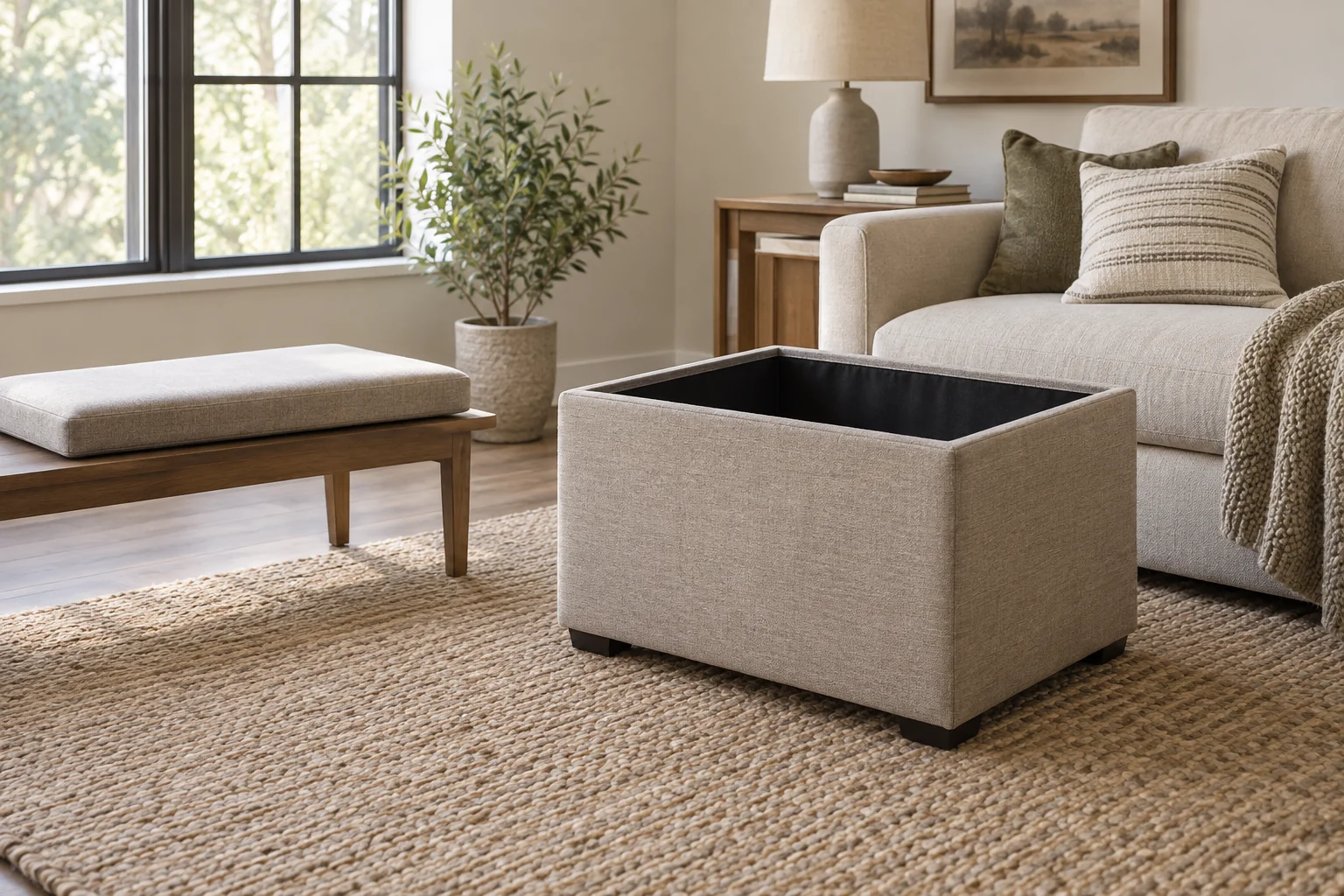
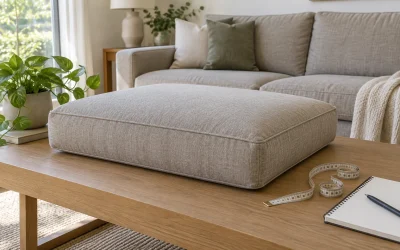
A storage ottoman can fit beside a sofa when closed and still be awkward to open. Check the complete access sequence: clear the top, move or open the lid as designed, reach the intended contents and close it again. The closed footprint answers only the first part of that sequence.
Identify the lid action before measuring the gap
Ask whether the exact ottoman has a removable top, a hinged top, split sections or another documented opening arrangement. A photograph showing storage beneath the seat may not show where the lid goes. Do not assume the presence of a hinge or support mechanism from the word storage.
As a named example of the basic feature, IKEA’s KIVIK ottoman listing describes storage under the seat and provides overall measurements. Those facts identify the storage furniture; they do not establish the usable opening space in your room. Consult the exact product’s documents or ask to see the complete opening action.
For a removable lid, identify a suitable place where it can rest without leaning or falling into the access route. For a hinged design, obtain the documented opening path and operating instructions. Do not substitute a stick, cushion or another improvised prop for the manufacturer’s intended arrangement.
Draw two views of the same position
A top view shows the ottoman, sofa arm, nearby table and the space where a person approaches. A side view shows what happens above the closed top: an overhanging arm, lamp shelf or table edge may occupy the path that the lid needs. Neither view alone describes the whole problem.
Use the sofa’s actual projecting parts, including cushions in their normal positions. A nominal sofa width may not describe the nearest soft edge or arm profile. If a recliner or sleeper is involved, its own movement requirements remain separate; do not position the ottoman in that operating area merely because it can be moved later.
| Stage | Space to identify | Useful question |
|---|---|---|
| Closed placement | Base footprint and ordinary route past the sofa | Can the room be used as intended? |
| Clearing the top | Place for tray, books or decorative items | What has to move first? |
| Opening | Actual lid path or removable-lid landing area | Does anything obstruct the documented action? |
| Retrieving contents | Opening plus room for hands and the stored item | Can the largest intended item come out? |
| Closing | Clear edge and intended return path | Can the lid close as instructed? |
Include the things normally left on top
If the ottoman also acts as a surface for a tray, decide where the tray goes before opening storage. Moving it onto the sofa cushion may block your own approach or leave an unsuitable resting place. Choose a stable surface suited to what the tray contains; clear drinks and fragile items before evaluating the opening action.
This affects how useful the storage will be. A frequently used blanket and a rarely used spare textile create different access routines. That is a household planning choice, not a reason to disregard the opening instructions or store objects beyond the manufacturer’s limits.
A worked example with a removable top
Imagine a fictional rectangular ottoman measuring 80 by 50 centimeters with a top that the maker confirms lifts off completely. The proposed position has sufficient room for the closed base, but the nearby table is covered with a lamp and books. There is no suitable place for the removed top.
The buyer adds a stable landing location to the layout and measures it against the actual lid, not just the base. They also check that moving the lid there would not occupy the route needed to reach the compartment. If that sequence remains awkward, a different ottoman or position may serve the intended storage better.
The invented dimensions illustrate the missing step; they are not an opening-clearance recommendation. A top may project beyond its base or be awkward to handle even when its outline fits a surface. Its actual construction and handling instructions still govern.
For a hinged lid, inspect the full path
Obtain a side-view drawing or observe the permitted opening action on a showroom sample. Check intermediate positions as well as the final open position. A lid can pass close to a sofa arm partway through movement even if the final view looks clear.
Use the maker’s stated requirements instead of calculating a universal gap from lid width. Hinge location, thickness and mechanism can affect the path. Keep hands and other people clear of moving parts and follow all product warnings. An observed opening is a fit check, not proof of a safety certification.
Check retrieval with the actual intended object
Interior volume does not establish that a large cushion or folded throw passes through the opening conveniently. Compare the item’s stored shape with the clear opening and any fittings. Where a showroom permits it, use a representative clean item or simple dimensions to assess the proposed use without forcing anything.
Then repeat the complete sequence on your plan, including replacing the lid and returning the top items. The right position lets you use the ottoman as documented without shifting the sofa every time. Save the opening arrangement alongside the closed dimensions so a storage purchase is judged by access as well as appearance.