Key takeaways
- Stiffener panels in fabric boxes soften if they get damp, and the box sags. Keep them off concrete floors and away from exterior walls.
- Handles on cheap fabric boxes are often stitched only to the outer layer and tear when a full box is lifted. Reinforced or riveted handles last longer.
- Zippers on storage bags split when overstuffed. Leave an inch of slack.
- Plastic hinges on folding crates whiten and crack after repeated folding in cold garages.
- Wire frames bend at the corners if folded the wrong way; follow the fold order printed on the panel.
A foldable storage box for clothes is worth buying when you need storage that collapses flat between seasons; for most closets a fabric box with a stiff base panel and a lid is the best all-round choice, while folding plastic crates suit garages and steel-frame boxes suit heavy stacking. The real differences are how much each type holds, how well it stacks when full and how it protects fabric from dust, moisture and pests.
The Four Main Types
Fabric collapsible boxes
Non-woven polypropylene or polyester canvas over cardboard or MDF stiffener panels. They fold flat in seconds, weigh under 2 lb and come in cube sizes that fit standard shelving. Look for a removable base board, since that is the part that keeps the box square under weight.

Sorbus Storage Bins with Clear Window, 6 Pack (13", Pastel Multi-Color)
Included for 'Foldable Storage Boxes for Clothes: Fabric vs Plastic vs Steel Frame and How Much Each Holds' because the listing specifies 6 Pack (13" and Pastel Multi-Color), details this guide uses to compare options.
View on Amazon
Sorbus Clothes Storage Bins, Clear Window & Handles (2 Pack, Gray)
Included for 'Foldable Storage Boxes for Clothes: Fabric vs Plastic vs Steel Frame and How Much Each Holds' because the listing specifies Clear Window & Handles (2 Pack and Gray), details this guide uses to compare options.
View on Amazon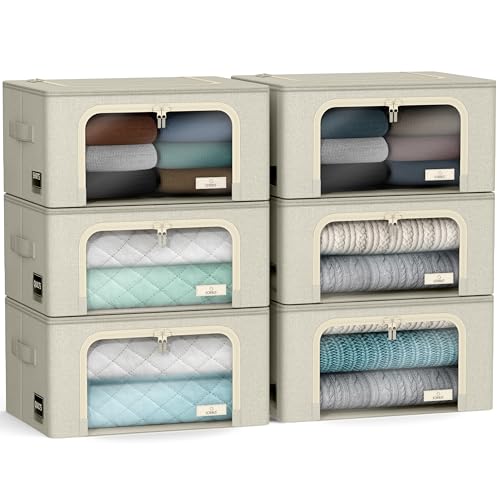
Sorbus Clothes Storage Bins, Clear Window & Handles (6 Pack, Beige)
Included for 'Foldable Storage Boxes for Clothes: Fabric vs Plastic vs Steel Frame and How Much Each Holds' because the listing specifies Clear Window & Handles (6 Pack and Beige), details this guide uses to compare options.
View on AmazonFoldable storage bags
Soft, oversized zippered bags, often with a clear window and side handles. They hold bulky items like comforters and coats but do not stack well; anything on top crushes the contents.
Folding plastic crates and bins
Rigid polypropylene walls hinge down into the base. They stack when full, wipe clean and resist damp, but most have vented sides that let in dust unless they come with a solid lid.
Steel or wire-frame foldable boxes
A fabric shell over a fold-down steel wire frame, or a fully metal folding box. These hold their shape best and stack highest, but weigh more and the frame can bend at the hinge points if folded carelessly.
Capacity: How Many Clothes Actually Fit
Listings give liters or inches, not garments. The table below converts common sizes into realistic folded-clothing capacity. Bulky knits take roughly twice the space of T-shirts.
| Box size (W x D x H) | Volume | Folded T-shirts | Sweaters | Jeans |
|---|---|---|---|---|
| 11 x 11 x 11 in (cube) | about 22 L | 12–15 | 5–6 | 6–8 |
| 13 x 13 x 13 in (cube) | about 36 L | 18–24 | 8–10 | 10–12 |
| 16 x 12 x 10 in | about 31 L | 15–20 | 7–9 | 8–10 |
| 20 x 15 x 12 in | about 59 L | 30–40 | 14–18 | 16–20 |
| 24 x 16 x 13 in (underbed/large) | about 82 L | 45–55 | 20–25 | 22–28 |
A useful rule of thumb: a sweater folded to about 12 x 9 inches is 2 to 3 inches thick, a T-shirt about 1 inch. Measure the inside of the box, not the outside; padded fabric walls can steal half an inch per side.
Material Trade-Offs
| Feature | Fabric box | Fabric bag | Folding plastic | Steel/wire frame |
|---|---|---|---|---|
| Weight empty | 0.5–2 lb | 0.5–1.5 lb | 2–5 lb | 3–8 lb |
| Stack when full | 2–3 high | No | 3–5 high | 4–5 high |
| Folded thickness | 1–2 in | Under 1 in | 2–4 in | 2–3 in |
| Dust protection | Good with lid | Good (zipped) | Poor if vented | Good with lid |
| Moisture tolerance | Low | Low | High | Medium (frame can rust) |
| Breathability | High | High | Low | High |
| Typical price each | $6–$20 | $5–$15 | $10–$30 | $15–$40 |
Breathability vs Protection
Natural fibers such as wool, cotton and linen store best in containers that breathe. Sealed plastic traps residual moisture, which can lead to musty smells, mildew spots or yellowing over a long season. Fabric boxes allow airflow but give pests easier access. If you store wool or cashmere, wash or dry-clean items first, since moths are drawn to body oils and food residue, and add cedar blocks or lavender sachets. In damp basements or garages, rigid plastic with a lid is the safer choice; add a silica gel pack and open the box every couple of months.
Compartment Boxes for Smaller Items
Divided foldable boxes, with 6 to 24 cells, are designed for underwear, socks, scarves, belts and leggings rather than bulky clothes. They usually measure 12 to 16 inches wide and 4 to 6 inches tall, sized to slip into a dresser drawer or onto a closet shelf. Choose ones with a firm bottom panel; floppy compartment organizers collapse when lifted out.
What Fails First
- Stiffener panels in fabric boxes soften if they get damp, and the box sags. Keep them off concrete floors and away from exterior walls.
- Handles on cheap fabric boxes are often stitched only to the outer layer and tear when a full box is lifted. Reinforced or riveted handles last longer.
- Zippers on storage bags split when overstuffed. Leave an inch of slack.
- Plastic hinges on folding crates whiten and crack after repeated folding in cold garages.
- Wire frames bend at the corners if folded the wrong way; follow the fold order printed on the panel.
Which Type for Which Situation
| Situation | Best choice | Why |
|---|---|---|
| Closet shelf or cube shelving | Fabric box with lid, sized to shelf | Light, neat, breathable |
| Seasonal coats and comforters | Large foldable bag with window | Bulky items, flat storage off-season |
| Basement, garage or attic | Folding plastic crate with solid lid | Moisture and pest resistance |
| Tall stacks in a storage room | Steel-frame foldable box | Stacks 4–5 high without crushing |
| Dorm or frequent mover | Fabric boxes or bags | Fold flat into a suitcase |
| Drawer organization | Compartment box | Keeps small items separated |
Packing Tips That Extend Clothing Life
- Clean everything first; stains set and attract pests.
- Fold rather than roll knitwear, to avoid stretching.
- Put heavier items at the bottom and delicate pieces on top.
- Do not overfill: a box filled past the rim stresses the seams and crushes fibers.
- Label the short end so you can read it on a shelf.
- Air items out for a day when you unpack them for the new season.
Choose by location first, then by size. Fabric for indoor shelves, plastic for damp spaces, steel frames for tall stacks and bags for bulky bedding. Matching the box to where it will live matters more than any single feature on the label.