Key takeaways
- Shopping for kids bedroom furniture works best when you plan the room by function first, since sleep, study, clothing and reading each need different pieces. This guide compares four current items, one for each zone, on footprint, age and load…
Shopping for kids bedroom furniture works best when you plan the room by function first, since sleep, study, clothing and reading each need different pieces. This guide compares four current items, one for each zone, on footprint, age and load limits, and safety, so you buy what the room and the child actually need.
As an Amazon Associate we earn from qualifying purchases.
By KK Home Furnishings Editorial Team
How to Choose Kids Bedroom Furniture
Because kids bedroom furniture spans several categories, there is no single winner; you choose a piece per zone. Footprint, age suitability, load limits and anchoring all matter, and they differ by item. These four cover sleep, clothing, study and reading, so map the room into zones before measuring anything.
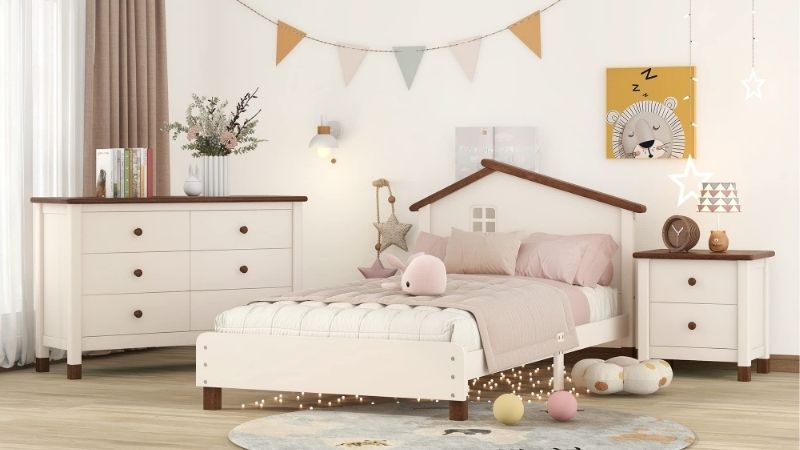
Plan the Room by Zones Before Buying
Start by dividing the room into functions rather than browsing products. A child’s room typically needs a sleep zone, somewhere to store clothes, a study spot once school starts, and a reading or book corner, though not every room needs all four at once, depending on the child’s age and the space.
Planning by zone keeps you from over-buying. A toddler’s room may only need sleep and clothing storage, while an older child adds a desk and reading nook. Deciding which zones matter now, and which can wait, stops a small room filling with furniture the child has not grown into yet.
These four picks map to those zones: a loft bed for sleep and study, a dresser for clothing, an adjustable desk set for study, and a reading nook for books. Because they serve different functions, compare each to its job rather than against the others, since a bed and a bookcase are not alternatives.
Measure the Full Occupied Envelope
Measure the real space each piece takes in use, not just its footprint. The IKEA VITVAL loft bed occupies a large envelope once the ladder is counted, around 77.5 by 55.5 inches, while the Costway desk is about 31.5 by 21.5 but needs extra floor for the chair to pull out.
These are room-planning figures, not a compactness contest, because the items serve different functions. The loft bed’s roughly 30-square-foot envelope and the KidKraft nook’s 3.33 square feet are not comparable as if one were smaller; each must simply fit its zone with clearance to use it safely.
Add circulation space too, since a child needs room to climb a ladder, slide out a chair or sit at a reading nook. Map each piece’s full occupied area, including pull-outs and access, against the room, so the finished layout leaves safe, usable paths rather than a crammed space.
Match Age and Load Limits to the Child
Age and load limits are safety specs, not suggestions, and they vary by item. The VITVAL loft bed is rated to 220 pounds and is not for children under six, while the Costway set lists age three and up with a 176-pound desk and 220-pound chair, and the KidKraft nook is age three and up with a 110-pound seat.
Match each limit to the actual child. A loft bed’s age restriction is about the fall risk from height, so it genuinely excludes younger children regardless of weight, while a reading-nook seat limit protects the structure. Read each piece’s own figures rather than assuming a general kids label means any age or size.
Because these limits describe different things, do not compare them across pieces; a bed’s 220-pound rating and a chair’s 220-pound rating are not the same kind of number. Treat each limit as a hard requirement for its item, and err toward the maker’s stated minimum age rather than pushing a younger child into a loft bed.
Treat Anchoring and Anti-Tip Features as Hard Requirements
Anchoring and anti-tip features are mandatory for tall kids furniture. The VITVAL loft bed requires anchoring and a minimum ceiling of 94.5 inches, and the Delta Essex dresser pairs interlocking drawers with a tip restraint and a current ASTM F2057 claim, so neither should be used unsecured.
A mandatory federal stability standard based on ASTM F2057-23 (16 CFR 1261) covers many clothing storage units made from September 1, 2023 [CPSC, 2023], and loft and bunk beds have their own CPSC requirements, so follow each item’s instructions. Anchor the dresser to a stud and secure the bed as specified before the room is in use.
Do not treat a kids label as proof a piece is automatically safe; safety comes from meeting each item’s age limits, load ratings and anchoring. Fit the included hardware, check the ceiling height for a loft bed, and verify each piece’s own instructions rather than assuming one item’s safety features apply to another.
Furniture Picks by Room Function
These four cover the core zones of a child’s room, one piece each for sleep, clothing, study and reading. Each lists at least two hard specs and its age or safety scope; pricing runs across budget to mid tiers, so confirm the current price, age rating and stock before you order.
| Product | Best For | Key Spec | Watch Out For |
|---|---|---|---|
| IKEA VITVAL | Sleep + study zone | Twin loft + 40.125″ desk | under 6 prohibited; 94.5″ minimum ceiling |
| Delta Essex 3-drawer | Clothing storage | interlocking drawers + restraint | 34 vs 34.25″ height source split |
| Costway Desk & Chair Set | Adjustable study station | 21.6–27.9″ desktop height | chair movement needs extra floor |
| KidKraft Reading Nook | Reading + book storage | 40 x 12″; 110-lb seat | age 3 and up |
IKEA VITVAL — Best for a Sleep and Study Zone
The VITVAL combines sleeping and studying over one footprint. This Twin loft bed has an envelope around 77.5 by 40.5 by 76.75 inches, widening to about 55.5 with the ladder, an integrated desk near 40.125 by 17.75 by 28.75, a 220-pound limit, a minimum ceiling of 94.5 inches, and required anchoring. It sits in the mid tier.
Lifting the bed frees the floor beneath for the built-in desk, which makes it ideal for a small shared room where sleep and study must share space. It is a strong choice for an older child who has outgrown a standard bed and needs a dedicated work surface without adding a separate desk.
The key constraints are safety and ceiling: it is not for children under six, and it needs a 94.5-inch ceiling plus anchoring, so measure the room height before buying. Flat-pack assembly takes time and two people, and the 220-pound bed limit is its own figure, not comparable to a chair’s load rating.
Delta Essex 3-Drawer — Best for Clothing Storage
The Essex handles the clothing zone with real safety features. This three-drawer dresser measures 34 inches wide by 19.75 deep by roughly 34 high, with interior drawers around 30.5 by 13.5 by 5.75, interlocking drawers, a tip restraint and a current ASTM F2057 claim. It sits in the mid tier.
The interlock, which lets one drawer open at a time, plus the restraint make it well suited to a young child’s room, and three roomy drawers hold a child’s clothes without a large footprint. Flat-pack assembly is straightforward, and the compact width fits beside a bed or in a nursery that will grow with the child.
Two notes apply. Its overall height is listed as 34 to 34.25 inches across sources, so do not rely on that figure for precise stacking, and anchor it to the wall regardless of the interlock, since the restraint and anchor address different risks and the standard expects securing to the wall.
Costway Desk & Chair Set — Best for an Adjustable Study Station
The Costway set gives a study zone that grows with the child. The desk measures about 31.5 by 21.5 inches with a tilt top adjusting over roughly 21.6 to 27.9 inches in height, paired with a chair, rated for age three and up, with a 176-pound desk and 220-pound chair limit. It sits in the budget tier.
The adjustable desktop height means it suits a child across several years rather than being outgrown quickly, and the tilt top helps with reading and drawing. As an affordable, matched desk-and-chair set, it is an easy way to add a proper study spot without buying office furniture a child does not fit.
The watch-out is floor space: the chair needs room to pull out, so the desk’s footprint understates the area it occupies in use. Match the desktop height to the child’s seated fit using the adjustment range, and note the desk and chair load limits describe their own structures, not each other.
KidKraft Reading Nook — Best for Reading and Book Storage
The KidKraft nook pairs a reading seat with book storage. It measures 40 inches wide by 12 deep by 22.5 high in MDF and fabric, with an integrated seat rated to 110 pounds and six storage spaces, suitable for age three and up. It sits in the budget tier.
Its slim 12-inch depth tucks against a wall without claiming much floor, and the combined seat and shelving create a dedicated reading corner that encourages books. For a younger child it is a charming, low-footprint way to add a reading zone that doubles as organized storage for toys and books.
The limits are its age-three-and-up rating and the 110-pound seat, which suit a young child rather than an older or heavier one. The MDF construction is fine for light use but dislikes damp, and the seat limit is a structural figure, so keep to the stated age and weight for safe, lasting use.
Frequently Asked Questions
Parents furnishing a child’s room ask the same practical questions. The answers below use the published specs of these four pieces and avoid treating different load limits as comparable, so you can plan each zone and check safety against the actual child and room before buying.
What furniture does a child’s bedroom actually need?
It depends on the child’s age and the room, since not every bedroom needs all four zones. A core set is somewhere to sleep and somewhere to store clothes, with a study spot and a reading corner added as the child starts school and accumulates books.
Planning by function keeps the room from filling with furniture a child has not grown into. A toddler may need only a bed and a dresser, while an older child benefits from a desk and reading nook, so decide which zones the child uses now rather than buying the full set up front.
Match each zone to the space you have, prioritizing the pieces used daily. In a small room, a loft bed that combines sleep and study can cover two zones at once, while a reading nook adds a zone with little footprint, so choose pieces that earn their floor space.
Can a child under six sleep in a loft bed?
Not in the VITVAL, which IKEA lists as unsuitable for children under six. The age limit on loft and bunk beds is about the fall risk from height, so it applies regardless of the child’s weight and should be followed strictly. For a younger child, choose a floor-level bed and revisit a loft bed once they reach the stated age.
Loft and bunk beds carry CPSC requirements precisely because of that height, and the guardrails and ladders are designed for older children who can use them safely. A younger child on a raised bed faces a real fall hazard that no weight rating offsets, which is why the minimum age is a firm limit.
For a child under six, choose a standard low bed and revisit a loft bed when they reach the stated age. If a small room pushes you toward a loft for space, the age restriction still applies, so plan the layout around a floor-level bed until the child is old enough.
Should a kids dresser be anchored to the wall?
Yes, always. Anchoring is the key safety step for any child’s dresser, and a mandatory federal stability standard based on ASTM F2057-23 (16 CFR 1261) now covers many such clothing storage units made from September 1, 2023 onward [CPSC, 2023]. It stops the dresser tipping if a child climbs or pulls on drawers, which the interlock alone cannot prevent.
Anchoring stops the dresser tipping if a child climbs or pulls on open drawers, which a freestanding unit cannot resist once loaded. The Essex includes an interlock and tip restraint, but those address different risks than a wall anchor, so fit the anchor as well rather than relying on the drawer mechanism alone.
Fix the bracket into a stud or a rated drywall anchor during assembly, following the manual rather than guessing. If you rent and drilling is restricted, ask about approved anchors first, since an unsecured dresser is exactly the hazard the stability standard was written to prevent in children’s rooms.
How do I choose desk height for a growing child?
Use an adjustable desk and set it to the child’s seated fit rather than a fixed number. The Costway desktop adjusts over roughly 21.6 to 27.9 inches, so you can raise it as the child grows, keeping their forearms level and feet supported while seated.
The right height lets the child sit with elbows near desk level and feet flat or on a rest, which changes as they grow. A fixed-height desk is quickly outgrown, so an adjustable one spanning several inches is the practical choice for a child who will use it for years rather than months.
Set the height by having the child sit in their chair and adjusting the top to their forearms, then revisit it periodically. Pair it with a chair that also fits, and use the maker’s adjustment range rather than a generic figure, since children of the same age vary widely in size.
Final Thoughts
The best kids bedroom furniture is the right piece for each zone, sized to the child and the room, not a single overall winner. Plan the room by function, measure the full occupied envelope, match age and load limits to the child, and anchor tall pieces. On that basis the VITVAL, Essex, Costway set and KidKraft nook each serve their zone.