
Key takeaways
- A metal frame king size bed frame has to handle a lot more than a King mattress — it has to bridge the gap between the 76-by-80-inch mattress and the larger outer frame. This guide keeps every spec on the…
A metal frame king size bed frame has to handle a lot more than a King mattress — it has to bridge the gap between the 76-by-80-inch mattress and the larger outer frame. This guide keeps every spec on the exact King version, comparing real outer size, under-bed clearance and the support a King actually needs.
As an Amazon Associate we earn from qualifying purchases.
By KK Home Furnishings Editorial Team
How to Choose a Metal King Bed Frame
A King is wide, so a metal frame lives or dies on its outer footprint and its center support, not the headline size. The nominal mattress is 76 by 80 inches, but the frame around it is larger, and a span that wide needs real middle bracing. Four things decide the buy: variant, footprint, clearance and support.
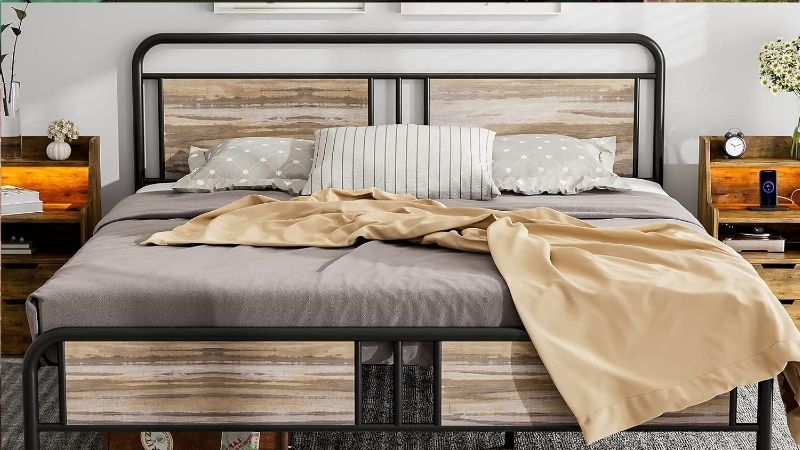
Confirm the Exact King Variant
King is not one size. A standard King mattress is 76 by 80 inches, but a California King is 72 by 84, and RV or short sizes differ again, so a frame must match the exact variant you own. The IKEA VEVELSTAD King, for example, assembles to a 78⅜ by 81⅞ inch outer frame — larger than the mattress it holds.
Before buying, confirm which King your mattress is and which King the frame lists. A standard-King frame will not fit a Cal King mattress, and the reverse leaves a gap. If a listing just says King with no dimension, treat that as unverified and measure your mattress, since the label alone does not guarantee a fit.
Variant mistakes are expensive to undo on a bulky metal frame. A frame sized for the wrong King wastes a return on something heavy to pack, and a too-large frame leaves the mattress sliding. Keep every spec — size, clearance, capacity — tied to the King variant you actually have, and never borrow a Queen figure.
Measure the Outer Footprint Against the Room
The outer frame is bigger than the mattress, and a King already dominates a room. VEVELSTAD lists a 78⅜ by 81⅞ inch footprint, while a Zinus Mia King lists an outer frame of 75.5 by 79.5 inches. Those few inches, plus a walkway, decide whether a King leaves room to move on both sides of the bed.
Map the room before ordering. A King needs the mattress width plus a walkway on each side, and planning guidance often suggests around 30 inches of clearance per side, though that depends on the door swing and closet placement. In a tight room, the outer frame width is what closes that gap, not the mattress number.
A King frame is also a delivery problem. Long, heavy boxes have to clear the doorway, the hallway turn and the stairs, so measure the route before buying. Metal frames ship flat and assemble in the room, which helps, but the rails are long — confirm they will physically reach the bedroom before you commit to one.
Check Under-Bed Clearance and Storage
Clearance is the floor-to-frame gap, and on a King it buys a lot of storage because the footprint is huge. VEVELSTAD lists 7⅞ inches of under-bed clearance, which suits flat boxes and shallow bins rather than tall wheeled drawers. Read the frame’s own clearance figure, not the overall height, to know what fits.
Decide what you will store before you choose. Under 8 inches handles off-season bedding and flat containers; tall totes and rolling drawers want 10 inches or more, which not every platform King offers. Measure your bins first, because clearance is one of the few specs makers publish clearly for metal frames.
A low deck also sets the final bed height once a thick King mattress is on top, which matters for getting in and out. Taller clearance raises that surface further. Whichever you pick, make sure the center support legs reach the floor across the span, since unsupported storage weight can push a wide deck down over time.
Demand Real Center Support
A King is wide enough that the middle is the weak point. Unlike a Twin, a King metal frame needs center support legs and a center rail to stop the deck sagging under two sleepers and a heavy mattress. Check how many center legs a frame includes and that they reach the floor, since this is what carries the span.
Support also ties to your mattress warranty. Many foam and hybrid makers require a center-supported foundation with a maximum slat gap, often around 2.5 to 3 inches, but the exact rule is set by the mattress brand, so read its warranty before buying a wide-slat King frame or you risk voiding coverage.
Capacity numbers help only loosely here. A King frame carries a heavy load — mattress, two sleepers and bedding — but ratings are not standardized between makers, so a bigger number is not automatically sturdier. Favor a frame with verified center support and a seller that stocks replacement legs and slats instead.
Top Picks
Three metal King frames with published specs lead here, plus a checklist row for the many listings that skip dimensions. Outer footprint and center support separate them; capacity figures are not standardized, so they do not drive the ranking. Each entry leans on manufacturer-stated specs and a tier, not a fixed price.
| Product | Best For | Key Spec | Watch Out For |
|---|---|---|---|
| IKEA VEVELSTAD King | Best overall for a published fit | 78⅜×81⅞ in; 7⅞ in clearance | Low clearance limits tall bins |
| Zinus Mia King | Best for a compact outer frame | 75.5×79.5 in outer frame | Confirm center support for the span |
| WONDER COMFORT King | Best for a steel platform on a budget | Steel; King platform | Outer dimensions not published |
| Any metal King frame | Measure before you order | Outer footprint; slat gap; clearance | Confirm the exact King variant |
IKEA VEVELSTAD King: Best Overall for a Published Fit
For a predictable buy, VEVELSTAD leads because IKEA publishes the numbers: a 78⅜ by 81⅞ inch outer frame and 7⅞ inches of clearance, both for the King variant. It reads budget-to-mid tier for a metal King frame; prices move, so confirm the current price at IKEA before you order anything for the room.
Its strength is that you can plan around it. With outer dimensions stated, you can map the walkway on both sides and check the delivery route before the box arrives, which matters most on a King. The 7⅞-inch clearance still takes flat storage boxes and off-season bedding across that large footprint underneath.
The limits are the clearance and the usual flat-pack care. Under 8 inches rules out tall wheeled drawers, so heavy-storage shoppers should look higher. Cam-lock joints can loosen after a move, so keep the hardware sheet and re-torque them; IKEA parts are easy to source if a slat or leg needs replacing later.
Zinus Mia King: Best for a Compact Outer Frame
When room is tight, the Zinus Mia King keeps the outer frame close to the mattress at 75.5 by 79.5 inches, which can ease the walkway squeeze a bigger frame creates. It lands budget tier for a steel platform King; verify the current price and the center-support detail for the current run before buying it.
A tighter outer frame helps in a bedroom where a King barely fits, leaving a little more floor on each side. The low-profile steel platform suits a foam or hybrid mattress directly, with no box spring needed. Still, measure the delivery route, because even a compact King ships as long, heavy rails to carry in.
On a span this wide, center support is the thing to confirm: check the number of center legs and that they reach the floor, since the middle is where a King deck sags. Steel platforms can creak at the joints over time; felt pads and re-tightening help, and Zinus generally stocks replacement slats and hardware.
WONDER COMFORT King: Best for a Steel Platform on a Budget
For a straightforward steel King platform, the WONDER COMFORT King is a budget-tier option sold through Home Depot, listed in steel for the King size. Because the outer dimensions are not published, confirm the current price and ask the seller for the exact footprint and clearance before you place an order.
It suits a shopper who wants a no-frills metal King to hold a foam or hybrid mattress without a box spring. The catch is the missing dimensions: with no published outer size, you cannot map the walkway or the delivery route from the listing, so treat the stated steel build as manufacturer-stated and verify the rest.
Without a published footprint or clearance, this is the pick that most needs the checklist below. Confirm the outer width and length, the under-bed gap and the number of center legs with the seller, and ask whether replacement parts exist. A low price is only a deal if the frame fits the room and the mattress.
What to Verify on Any Metal King Frame
Many King listings skip the numbers that decide the fit, so verify four before ordering. First, the exact King variant — standard 76 by 80 or California 72 by 84 — because the frame must match the mattress you own, never a Queen figure borrowed from a sibling listing in the same product line elsewhere.
Second, the outer footprint, since the frame runs larger than the mattress and sets the walkway. Third, the under-bed clearance against your storage bins. Fourth, the center support: how many legs, and whether they reach the floor across the span. Ask the seller for any figure a listing leaves blank rather than guessing.
Finally, line up the support with your mattress warranty. If a foam or hybrid bed requires a maximum slat gap or a center foundation, confirm the frame meets it before buying, since a wide-slat deck can void coverage. These four checks cost a few minutes and save a heavy, awkward return on a King-size frame.
Frequently Asked Questions
King-frame shoppers circle a few recurring questions: whether a box spring is needed, how much bigger the frame runs than the mattress, whether metal frames squeak, and what support a King really requires. The answers below use published King dimensions and the support rules makers write into warranties.
Does a Metal King Frame Need a Box Spring?
Usually not, if it is a platform with slats or a deck. Most metal King platforms are built to hold the mattress directly, so a traditional box spring is optional. A foam or hybrid mattress in particular wants a firm, even base, which a slatted platform provides, rather than the give of a spring foundation beneath.
Check the mattress warranty, though, because it may require a specific foundation or slat gap. If the frame’s slats sit wider than the brand allows, add a bunkie board rather than voiding coverage. On a King, also confirm the center support is in place, since the span is where an unsupported deck gives first.
If you prefer the look or height of a box spring, a low-profile foundation works on most platform Kings, but confirm the total height stays comfortable to get into and that the frame is rated for the added weight. On a King, the center support still matters more than the foundation style on top.
How Much Bigger Is the Frame Than the Mattress?
Plan for a few inches on each side. A 76-by-80-inch standard King sits inside outer frames that run larger — around 78 by 82 inches on the VEVELSTAD, for example — with the headboard or rails adding the extra. Always check the frame’s overall figure, not the mattress size, when you measure the room.
That overhang is why a King can feel impossible in a room that looks big enough on paper. Add a walkway on both sides and the footprint grows fast. Measure corner to corner, subtract the outer dimensions, and confirm the delivery route too, since long King rails are harder to carry in than the made bed looks.
Height is the other dimension to plan: add the frame deck height, any foundation and the mattress thickness to find the final sleep surface, which decides how easy the bed is to get into. A tall King mattress on a high-clearance frame can sit higher than expected, so total the numbers before buying.
Do Metal Bed Frames Squeak?
They can, and usually it is the joints, not the metal itself. Squeaks on a metal King most often come from slats shifting against the rail or bolts working loose over time, not from a failing frame. The fix is mechanical: tighten the hardware and isolate the contact points rather than replacing anything outright.
Work cheap to expensive: re-torque every bolt, add felt pads or adhesive strips where slats meet the rail, and check the center legs are firm on the floor. Most King-frame noise clears with those steps. Favor a frame that sells replacement slats and hardware, so a single worn part is a quick fix, not a new bed.
If re-tightening and felt pads do not settle it, check that all the center legs actually touch the floor; a leg sitting slightly short lets the deck flex and knock under load. Adjust or shim it level, since on a King the center is where both the sag and most of the noise begin under two sleepers.
How Much Weight Can a Metal King Frame Hold?
More than you might think, but the number is not standardized. A King frame carries the mattress, two sleepers and bedding, and makers rate capacity differently, so a higher figure is not automatically sturdier. Count the real load — mattress plus people plus bedding — against the rating, not body weight alone.
What actually carries a King is the center support, not the headline number. Confirm the frame has center legs that reach the floor and a center rail, since the middle of a wide span is where sagging starts. Treat capacity as a rough ceiling, and prioritize verified support over the biggest number on the page.
For heavier sleepers or a heavy hybrid, prioritize a frame that states more center legs and a steel-gauge deck over one chasing a bigger headline figure. Count the full load — two people, bedding and a mattress that can top one hundred pounds on a King — against the rating, and treat it as a floor, not a target.
Final Thoughts
The right metal frame king size bed frame is the one whose exact King variant, outer footprint and center support all check out, not the one with the biggest capacity number. Confirm the King size against your mattress, measure the walkway and the delivery route, and verify the center legs before you buy.
