Key takeaways
- A console labeled narrow can still block a hallway if the door swings into it or its depth eats the walkway. This guide to a narrow entryway table shows how to measure the space properly, using hallway depth minus table…
A console labeled narrow can still block a hallway if the door swings into it or its depth eats the walkway. This guide to a narrow entryway table shows how to measure the space properly, using hallway depth minus table depth and the door swing, and lists four candidates with one fully verified depth.
As an Amazon Associate we earn from qualifying purchases.
By KK Home Furnishings Editorial Team
How to Know Whether a Console Is Actually Narrow Enough
The four steps below decide fit by measurement, not by a retailer’s narrow label: measure the hallway or foyer depth, subtract the actual table depth, mark the entry-door swing, and check the table width against the usable wall. Because exact depth is verified for only one candidate, this guide teaches the method rather than naming a narrowest winner.
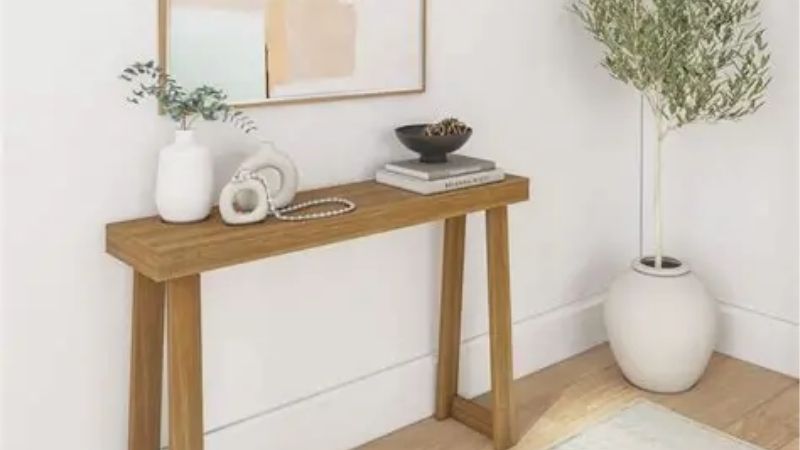
Measure hallway/foyer depth
Start by measuring the depth of the hallway or foyer where the table will sit, from the wall to the opposite edge of the walkway. This is the space you have to work with, and it is the first number in deciding whether a console leaves enough room to pass, so measure it before looking at any table.
The usable depth is what remains clear for walking, so note any baseboards, trim or fixtures that reduce it. For a narrow entryway table, this hallway depth sets the ceiling on how deep a console you can place while still leaving a comfortable path, which the next step calculates directly.
Record the depth at the exact spot the table will go, since hallways can vary along their length. With this figure in hand, you can subtract a table’s depth to find the remaining passage, which is the real test of whether a console fits, rather than trusting a listing’s narrow classification.
Subtract actual table depth
Subtract the table’s actual depth from the hallway depth to find the passage left for walking. For example, with a 48-inch usable entryway depth and the verified 10-inch Maypex console, 48 minus 10 leaves 38 inches of passage, while a 13-inch table would leave 35 inches, a 3-inch difference that matters in a tight hall.
This calculation is why the table’s exact depth is the decisive spec, and it is where many consoles fall short on published data. Only the Maypex here has a verified depth of 10 inches, while the others are classified under 14 inches without an exact figure, so you must confirm each one’s depth before doing the math.
A retailer’s narrow filter, such as Home Depot’s under-14-inch classification, is a rough guide, not proof a given table fits your hall. So treat the under-14 label as a starting shortlist, then get the exact depth and subtract it from your hallway depth, since a 13.9-inch table and a 10-inch table leave very different passages.
Mark the entry-door swing
A shallow table can still be wrong if the entry door swings into it, so mark the door’s swing arc on the floor. Open the door fully and note the area it sweeps, since the usable table zone is the wall segment outside that swing envelope, and not simply any otherwise clear wall space nearby.
This step catches the common mistake of choosing a narrow table that physically collides with the opening door. A console placed within the door’s arc will block the door or be struck by it, so the table must sit on the wall outside the swing, which may limit where along the wall it can go.
Mark the swing with tape before buying, then measure the clear wall outside it for the table. This door-swing check, combined with the depth subtraction, is the real fit test for a narrow entryway table, since a table can pass the depth math yet still foul the door if placed in its path.
Check table width against usable wall
Finally, check the table’s width against the usable wall length outside the door swing. The candidates here range from 30 to 47.3 inches wide, so confirm the wall segment that stays clear of the door and any fixtures is long enough for the table you want without crowding the doorway or the entry path.
Width matters because a table that fits the depth and avoids the door swing can still be too long for the available wall, pushing into the doorway or a corner. Measure the clear wall outside the swing envelope and compare it to the table width, leaving a little margin so the table does not feel wedged in.
A wider table offers more surface and storage but needs more clear wall, while a narrower one fits a tighter segment. So match the width to the usable wall after accounting for the door swing, since the goal is a table that fits the depth, clears the door and sits comfortably along the available wall.
Verified Narrow Candidates
These four console candidates suit a narrow entry, but only the Maypex has a verified exact depth, so this is a method guide rather than a ranking. Specs are retailer-stated and prices move, so confirm the current figure; above all, confirm each table’s exact depth before the hallway math, since three are listed only under a category.
| Product | Best For | Key Spec | Watch Out For |
|---|---|---|---|
| Maypex Quartz Console | Fully Verified Depth | 36 in wide x 10 in deep (verified); quartz top | Only candidate with confirmed depth |
| CITRUTAR console-858 | Exact Depth Pending | 30 in wide; under 14 in category; depth unverified | Confirm exact depth before measuring |
| CITRUTAR console-939 | Exact Depth Pending | 30 in wide; under 14 in category; 2-tier; depth unverified | Confirm exact depth before measuring |
| XS5438BA-1443 | Exact Depth Pending | 47.3 in wide; under 14 in category; 3-drawer; depth unverified | Widest; confirm depth and wall length |
Maypex 36×10 — Fully Verified Depth
The Maypex quartz console is the only candidate here with a verified exact depth, at 36 inches wide and 10 inches deep with a quartz top. That confirmed 10-inch depth makes it the one table you can run the hallway math on directly, since you can subtract 10 from your usable entry depth to find the passage left.
Its shallow 10-inch depth suits a genuinely narrow hallway, leaving the most walkway of these candidates where the depth is known. The quartz top adds a durable, wipeable surface for keys and mail, and the 36-inch width fits a moderate clear wall segment located outside the door swing.
Because its depth is verified, it is the safest choice for a tight entry where you need to be certain of the remaining passage. Still check it against your door swing and usable wall, and confirm the current price, since the value of this candidate is the certainty its published 10-inch depth provides over the others.
CITRUTAR console-858 — Exact Depth Pending
The CITRUTAR console-858 is a 30-inch-wide candidate listed under the under-14-inch narrow category, but its exact depth is not confirmed. Its modest 30-inch width suits a shorter clear wall, making it a reasonable candidate for a compact entry, provided you verify the depth before relying on it.
The narrow width is its appeal for a tight wall segment, and the under-14 classification suggests a shallow depth suitable for a hallway. But without an exact figure, you cannot run the depth subtraction reliably, so this is a candidate to shortlist rather than a confirmed fit for a specific passage.
Before buying, confirm the exact depth from the retailer so you can subtract it from your hallway depth, and check it against your door swing. Treat the under-14 label as a starting point only, since a 13.9-inch depth and a 10-inch depth leave very different walkways, which is the whole point of measuring precisely.
CITRUTAR console-939 — Exact Depth Pending
The CITRUTAR console-939 is another 30-inch-wide candidate in the under-14-inch category, offered as a two-tier console, with its exact depth unverified. The two-tier design adds a lower shelf for storage in a narrow footprint, suiting an entry that needs a place for baskets or shoes below the top.
Its 30-inch width suits a compact wall, and the added tier gives more storage than a single-surface console, which is useful in a small entry. As with its sibling, though, the exact depth is not published, so the key spec for a narrow fit remains to be confirmed before you can plan the passage.
Confirm the exact depth before counting on it, then subtract it from your hallway depth and check the door swing. The lower tier is a practical feature, but the under-14 classification alone does not prove the console leaves enough walkway, so verify the depth to do the math that actually decides the fit.
XS5438BA-1443 — Exact Depth Pending
The XS5438BA-1443 is the widest candidate at 47.3 inches, a three-drawer console listed under the under-14-inch category, with its exact depth unverified. The three drawers add real enclosed storage for keys, mail and small items, suiting a longer entry wall that can take the wider footprint.
Its width and drawers make it the most storage-capable candidate here, fitting an entry with a longer clear wall outside the door swing. The drawers hide clutter in a way the open consoles do not, which suits a busier entry, provided the clear wall length and the console depth both genuinely work out.
The caveats are width and depth: at 47.3 inches it needs a longer clear wall, and its exact depth is unconfirmed, so verify both before buying. Confirm the depth to subtract from your hallway measurement, check the 47.3-inch width against your usable wall outside the door swing, and treat the under-14 label as provisional.
Frequently Asked Questions
These answers cover what buyers ask about a narrow entryway table, from what depth counts as narrow to whether a console can sit behind a door. The guidance is a measuring method, since a retailer’s narrow label is not proof of fit, so confirm each table’s exact depth and check the door swing for your specific entry.
What depth counts as a narrow console table?
Retailers often classify consoles under about 14 inches deep as narrow, as Home Depot does, which is a useful shortlist filter but not proof a given table fits your entry. A genuinely shallow console like the verified 10-inch Maypex leaves more walkway than a 13-inch one, so the exact depth matters within that category.
The practical definition of narrow enough depends on your hallway, since the real test is the passage left after subtracting the table depth from the hallway depth. So a 14-inch label is a starting point, but a table is only narrow enough if it leaves a comfortable walkway in your specific space.
Confirm the exact depth rather than relying on the category, then subtract it from your usable hallway depth to see the remaining passage. That calculation, not the retailer’s narrow classification, is what tells you whether a console is actually narrow enough for your particular entry and its traffic.
How much walking space should remain?
Enough walking space should remain that people can pass the console comfortably, which depends on your hallway, but a clear passage of a few feet is a reasonable target in a main walkway. The way to find it is to subtract the table depth from the hallway depth and judge whether the remainder suits the traffic.
For example, a 10-inch table in a 48-inch hallway leaves 38 inches of passage, while a 13-inch table leaves 35, so the exact depth changes the walkway by inches. In a busy entry, more clearance is better, while a rarely used nook can take a tighter passage, so match the remaining space to the traffic.
There is no single required number, so use the subtraction to see the actual passage and decide if it is comfortable for your household. The key is to measure rather than guess, since a console that looks narrow can still leave too little walkway once its real, measured depth is accounted for.
Can a console table go behind an entry door?
A console can go on the wall behind an entry door only if it sits outside the door’s swing arc, so mark the swing first. If the door opens toward the wall where you want the table, the console must be positioned beyond the area the door sweeps, or else the door will hit it or be blocked by it.
The usable zone is the wall segment outside the swing envelope, so even a shallow table fails if placed within the door’s path. This is why marking the swing on the floor matters, since a narrow table can clear the depth math yet still foul the door if it happens to sit right where the door opens inward.
So measure the swing, identify the clear wall beyond it, and place the console there, confirming both the depth and the width fit that segment. A table behind an entry door is fine as long as it stays outside the swing arc, which the door-swing check confirms on the floor before you buy it.
Is a 10-inch-deep table useful?
Yes, a 10-inch-deep table like the verified Maypex is useful as an entry console, holding keys, mail and small decor while leaving the most walkway in a narrow hallway. Its shallow depth is precisely what makes it suit a tight entry, trading some surface area for valuable passage space.
A 10-inch depth limits how much sits on top at once and rules out large items, but for an entry drop zone it is ample for everyday essentials. The shallow depth is the point, since it keeps the walkway clear where a deeper console would intrude, which is the single main constraint in a narrow entry.
So a 10-inch table is useful when passage matters more than surface, which is the usual case in a narrow hallway. If you need more top space or storage, a slightly deeper or drawered console works where the hallway allows, but the shallow 10-inch depth is the useful choice for the tightest entries.
Final Thoughts
A narrow entryway table is judged by the passage it leaves and the door swing, not a retailer’s narrow label. Measure the hallway depth, subtract the table’s exact depth, mark the door swing and check the width against the usable wall. Only the Maypex here has a verified 10-inch depth, so confirm each other candidate’s depth first.