Key takeaways
- Roll top desks promise a tidy, hideaway workspace, but the gap between a true tambour roll-top and a lookalike, and between a traditional desk and one that fits a computer, decides whether you love it. This guide compares four current…
Roll top desks promise a tidy, hideaway workspace, but the gap between a true tambour roll-top and a lookalike, and between a traditional desk and one that fits a computer, decides whether you love it. This guide compares four current solid-wood desks by roll-top type, footprint and computer usability.
As an Amazon Associate we earn from qualifying purchases.
By KK Home Furnishings Editorial Team
How to Choose a Roll-Top Desk
A roll-top desk is a large, long-term piece, so weigh the mechanism and the space before the look. Consider four things: whether the tambour is a true working cover or a lookalike, the footprint against your room, the storage and computer usability, and the build, lead time and delivery that come with a solid-wood, often made-to-order desk.
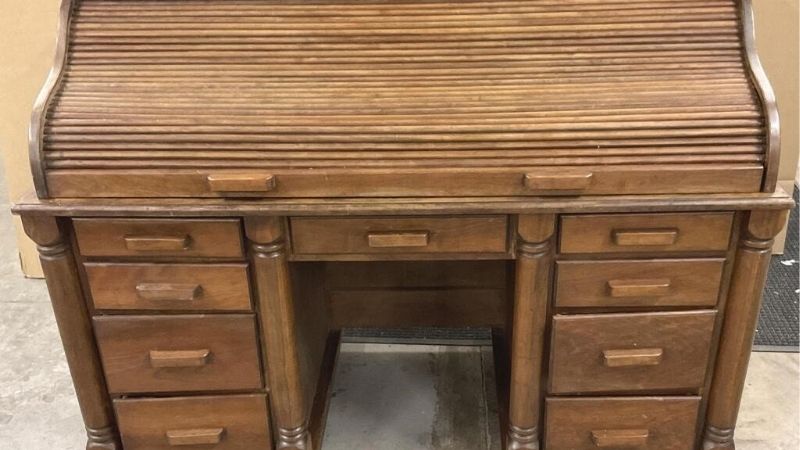
A true roll-top vs a lookalike
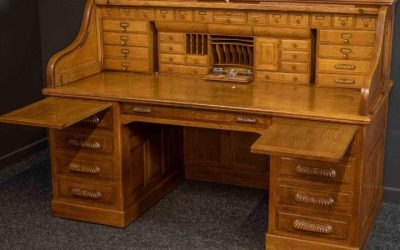
The defining feature is a working tambour — the slatted cover that rolls down to lock the desk away — so confirm the desk actually has one rather than a decorative panel. These four are true roll-tops in solid wood, but many cheaper roll-top desks fix the top or use a flimsy cover, so the mechanism is the first thing to verify.
A real tambour matters for both function and security: it hides clutter and papers in seconds and can often lock, which suits a shared or visible home office. Check that the cover rolls smoothly and fully, since a sticking or partial tambour defeats the point, and confirm whether it locks if security is part of why you want one.
The trade-off is that a tambour is a moving part that can stick or derail over years, especially in humid rooms where wood swells. Solid-wood desks like these are built to last, but confirm the maker services or sells parts for the tambour, since a jammed cover on a lookalike is harder to fix than on a quality solid-wood desk.
Dimensions and footprint
Roll-top desks run large, so footprint is a real constraint. These range from the Countryside Franklin at 42 by 24 inches — about 7 square feet of floor — up to the Publisher’s Computer Roll Top at 60 by 32 inches, roughly 13.33 square feet, about 1.9 times the Franklin’s floor space, a big difference in a home office.
Measure your room and the desk’s depth, not just its width, since a 32-inch-deep desk projects far into a room and needs clearance for a chair behind it. The tall roll-top also needs height clearance under a sloped ceiling or shelf. Map the full footprint plus chair space before choosing the largest desk your wall can take.
Footprint also affects delivery and permanence: a large solid-wood desk is heavy and hard to move once placed, so it suits a dedicated office rather than a room you rearrange. The Franklin’s smaller 7-square-foot footprint fits tighter spaces, while the Publisher’s needs a room that can give up nearly twice the floor area to the desk.
Storage and computer usability
Traditional roll-tops were built for paper, so computer usability varies. The Publisher’s Computer Roll Top is designed around a monitor and cables, with the height and openings to suit a screen under the tambour, while a classic roll-top like the Franklin may not close over a tall monitor or route cables as cleanly for a modern setup.
Match the desk to how you work. If you use a laptop you tuck away, most roll-tops suit you; if you run a large monitor and peripherals, confirm the monitor fits under the closed tambour and that there are cable openings, since a classic desk can force you to disconnect gear each time you close it, which defeats the convenience.
Storage is a strength across these desks — pigeonholes, drawers and compartments organize a workspace — but confirm the drawer sizes and whether they suit files or a printer. Over time, the cubbies that make a roll-top appealing can also trap clutter, so weigh how the storage layout matches what you actually need to keep at the desk.
Build, lead time and delivery
These are solid-wood, often made-to-order desks, so build quality is high but lead time and delivery are real factors. The Countryside desks, for example, carry a 12-to-18-week lead time, and freight delivery for a heavy solid-wood desk is a separate consideration from the purchase, so plan the timeline and the delivery before ordering.
Solid-wood construction means the desk should last decades and can be refinished, unlike veneered particleboard that chips and swells, which is part of what the premium tier buys. But confirm the wood species and joinery, and plan for the long lead time, since a made-to-order desk is not a next-week purchase and cannot be rushed easily.
Delivery is the hidden step: a large, heavy desk needs freight and often in-home placement, so confirm whether delivery includes carrying it to the room and any setup. Factor the lead time and delivery into your plans rather than the desk price alone, since a quality roll-top is a long-term, deliberate purchase rather than an impulse one.
Top Picks
These four cover the range of roll top desks, from a compact classic to a large computer-ready model, all true solid-wood tambour desks in the premium tier. They differ most in footprint and computer usability, so match the size to your room and the design to whether you work on paper or a screen before choosing.
| Product | Best For | Key Spec | Watch Out For |
|---|---|---|---|
| Countryside Franklin | Best compact roll-top | 42 x 24 x 47 in; about 7.0 sq ft footprint; 12-18 week lead time | Premium tier; freight delivery; classic paper layout |
| E-Amish Classic Farmer’s | Best classic mid-size | 56 x 25 x 48.5 in; about 9.72 sq ft footprint; solid wood | Premium tier; confirm monitor clearance |
| Martin’s 62 | Best large traditional | 62 x 28 x 48.5 in; about 12.06 sq ft footprint; solid wood | Premium tier; large footprint |
| Countryside Publisher’s Computer Roll Top | Best for a computer setup | 60 x 32 x 57 in; about 13.33 sq ft; built for a monitor | Premium tier; ~1.9x the Franklin’s floor space |
Countryside Franklin — Best Compact Roll-Top
The Countryside Franklin is the compact pick: at 42 by 24 by 47 inches it occupies about 7 square feet, the smallest footprint here, which suits a tighter home office or a corner. It is a true solid-wood tambour desk with a classic layout, carrying a 12-to-18-week lead time. It sits in the premium tier for roll-top desks.
The small footprint makes it the easiest of these to place in a normal room, and the solid-wood build and working tambour deliver the hide-away tidiness roll-tops are bought for. Its classic layout suits paper and a laptop, so confirm a large monitor fits under the closed cover if you plan a full computer setup at it.
The drawbacks are the premium cost, the long lead time and the classic layout: expect a 12-to-18-week wait and freight delivery, and confirm the desk closes over your gear if you run a monitor. For a compact, traditional roll-top it is the natural pick, but a computer-heavy user may prefer the purpose-built Publisher’s model.
E-Amish Classic Farmer’s — Best Classic Mid-Size
The E-Amish Classic Farmer’s desk is the mid-size classic: at 56 by 25 by 48.5 inches it occupies about 9.72 square feet, a step up from the Franklin in presence without the largest footprint. It is a solid-wood tambour desk with a traditional feel. It sits in the premium tier for roll-top desks, above the compact Franklin.
The larger work surface suits someone who spreads out on paper or wants more storage, while keeping a classic look. The solid-wood build should last decades and can be refinished. Confirm the monitor clearance under the tambour and the drawer sizes, since a traditional layout may not suit a large screen or a printer as cleanly.
The drawbacks are the premium price and the classic layout’s computer limits: verify a monitor fits under the closed cover and that cables can route out. As a solid-wood made-to-order piece, plan for lead time and freight delivery, and measure the 25-inch depth plus chair space so the desk does not crowd the room once placed.
Martin’s 62 — Best Large Traditional
Martin’s 62 is the large traditional pick: at 62 by 28 by 48.5 inches it occupies about 12.06 square feet, a substantial desk for a dedicated office. It is a solid-wood tambour desk with generous surface and storage. It sits in the premium tier for roll-top desks, among the larger and costlier options in this comparison.
The wide surface and deep 28-inch footprint suit someone who wants a commanding, traditional workspace with room to spread out and ample storage. The solid-wood construction is built to last and refinish. Because it is large and deep, measure the room and chair clearance carefully, and plan freight delivery for a heavy, made-to-order piece.
The drawbacks are footprint and cost: at over 12 square feet it needs a room that can give up the space, and as a premium solid-wood desk it carries a high price and likely lead time. Confirm monitor clearance if you run a screen, since its traditional layout, like the other classics here, is built more for paper than a computer.
Countryside Publisher’s Computer Roll Top — Best for a Computer Setup
The Countryside Publisher’s Computer Roll Top is the pick for a modern computer setup: at 60 by 32 by 57 inches it occupies about 13.33 square feet — roughly 1.9 times the Franklin’s floor space — and is designed around a monitor and cables rather than only paper. It carries a 12-to-18-week lead time and sits firmly in the premium tier.
Being built for a computer is the key difference: it is designed so a monitor fits under the tambour and cables route cleanly, so you can close the desk without disconnecting your gear. The large surface and storage suit a full home-office setup, making it the natural pick if you want a roll-top that works for a screen.
The drawbacks are size and cost: at over 13 square feet it is the largest footprint here and needs a room to match, and as a premium made-to-order desk it is the costliest, with a 12-to-18-week lead time and freight delivery. Measure the 32-inch depth plus chair space carefully, since it projects far into a room once placed.
Frequently Asked Questions
A few questions come up about roll-top desks, usually about whether the cover is real, how much space they need, and whether they work for a computer. The answers below use each desk’s published dimensions and footprint and flag where a classic layout may not suit a modern screen setup.
What makes a real roll-top desk?
A working tambour — the slatted cover that rolls down to close the desk — is what defines a true roll-top, as opposed to a decorative or fixed top. All four desks here are solid-wood tambour desks, but many cheaper roll-top desks use a flimsy or fixed cover, so confirm the mechanism rolls fully and smoothly before buying.
The tambour matters for function and often security: it hides clutter in seconds and can sometimes lock, which suits a visible or shared office. Check whether it locks if that is part of the appeal, and that it rolls completely closed over your gear, since a cover that only partly closes or sticks defeats the point of the desk.
Because the tambour is a moving part, build quality affects how it ages: a quality solid-wood desk’s cover rolls for decades, while a cheap one can stick or derail, especially in humid rooms where wood swells. Confirm the maker services or sells tambour parts, since the cover is the one part most likely to need attention over years.
How much space does a roll-top desk need?
More than a flat desk, because they run large and deep. These range from the Franklin’s roughly 7 square feet (42 by 24 inches) to the Publisher’s roughly 13.33 square feet (60 by 32 inches), about 1.9 times the floor space, so measure your room against the full footprint, not just the width, before choosing a size.
Account for depth and chair clearance: a 28- or 32-inch-deep desk projects well into a room and needs space for a chair behind it, plus room to roll the tambour and open drawers. Map the desk’s footprint plus a few feet of working space, and check height clearance if a shelf or sloped ceiling sits above where it will go.
Also plan for permanence: a large solid-wood desk is heavy and hard to move once placed, so it suits a dedicated office rather than a room you rearrange. If space is tight, the compact Franklin fits where the larger desks will not, so match the footprint to the room rather than buying more desk than the space can hold.
Can you use a roll-top desk with a computer?
Some are built for it and some are not, so check the design. The Publisher’s Computer Roll Top is made around a monitor and cables, so it closes over a screen and routes cords cleanly, while classic roll-tops like the Franklin were built for paper and may not close over a tall monitor or manage cables as well for a modern setup.
Match the desk to your gear. A laptop you tuck away fits almost any roll-top, but a large monitor and peripherals need a desk whose tambour clears the screen and whose openings route cables, or you will disconnect gear each time you close it. Confirm the monitor clearance and cable routing before buying if a computer is central to use.
If you want both the classic look and a computer, measure your monitor against the desk’s interior height before ordering, since a traditional model may suit a compact screen but not a large one. Otherwise a purpose-built computer roll-top avoids the compromise, letting you keep the hide-away tidiness without rearranging your setup each day.
Why do quality roll-top desks cost and take so long?
Because they are solid-wood, often made-to-order pieces rather than flat-pack furniture. Solid wood and real joinery cost more than veneered particleboard and are built to last decades and be refinished, which is what the premium tier buys. The Countryside desks, for instance, carry a 12-to-18-week lead time as they are built to order.
The lead time reflects craftsmanship and customization, so plan for a wait rather than a next-week delivery, and factor freight for a heavy desk. That timeline is the trade for a desk that should outlast cheaper furniture, so weigh whether you need it quickly, since these are deliberate, long-term purchases rather than impulse buys.
Delivery adds to the commitment: a large, heavy solid-wood desk needs freight and often in-home placement, so confirm whether delivery carries it to the room. Factor the lead time and delivery alongside the desk itself, since the full cost and timeline of a quality roll-top are about more than the price on the product page.
Final Thoughts
The right roll-top desk is the one whose true tambour, footprint and layout match your room and how you work, from the compact Franklin at about 7 square feet to the computer-ready Publisher’s at over 13. Confirm the cover is real, measure the full footprint plus chair space, and plan for the lead time and freight before you order.