Key takeaways
- Under 36 inches wide entryway: Choose a rack no wider than 20-24 inches and no deeper than 10 inches. A slim, vertical 3-tier or wall-leaning ladder style works best.
- 36-48 inches wide entryway: You can fit a standard small shoe rack at 26-30 inches wide and 11-12 inches deep. You will still have 24-30 inches of walkway left.
- Over 48 inches wide or small mudroom (approx. 5×5 ft): You can use a wider 2-tier bench-style rack at 32-36 inches wide, which also provides a seat.
What's inside
A small shoe rack for a tight entryway should be no wider than 26-30 inches, no deeper than 12 inches, and matched to your household size: a 2-tier rack holds 4-6 pairs and fits under a 10-inch clearance, while a 3-tier rack holds 6-9 pairs but needs at least 28 inches of vertical space and may block narrow hallways.
Match The Rack Size To Your Entryway Size
Before looking at styles, measure three numbers: wall width available, depth from wall to door swing, and height to any light switch, thermostat, or coat hook above. Most apartments and small homes have entryways between 36 and 48 inches wide, and building codes require at least 32 inches of clear passage for safe movement. That leaves very little room for furniture.

YATINEY 5-Tier Narrow Shoe Rack, Tall Shoe Rack for 5-10 Pairs, Slim Shoe Storage Organizer with Wooden Top, Space Saving, Metal Frame, for Entryway, Rustic Brown and Black SS65BR
Included for 'Small Shoe Rack Ideas for Tight Entryways and Apartments' because the listing specifies Tall Shoe Rack for 5-10 Pairs and Slim Shoe Storage Organizer with Wooden Top, details this guide uses to compare options.
View on Amazon
Vertical Shoe Rack - Tall Narrow Shoe Rack Organizer for Small Spaces,5 Tier Bamboo Shoen Shelf for Entryway,Closet,Corner,Doorway,Skinny Shoe Shelf Space Saving Shoe Storage,Free Stackable DIY
Included for 'Small Shoe Rack Ideas for Tight Entryways and Apartments' because the listing specifies Tall Narrow Shoe Rack Organizer for Small Spaces and 5 Tier Bamboo Shoen Shelf for Entryway, details this guide uses to compare options.
View on Amazon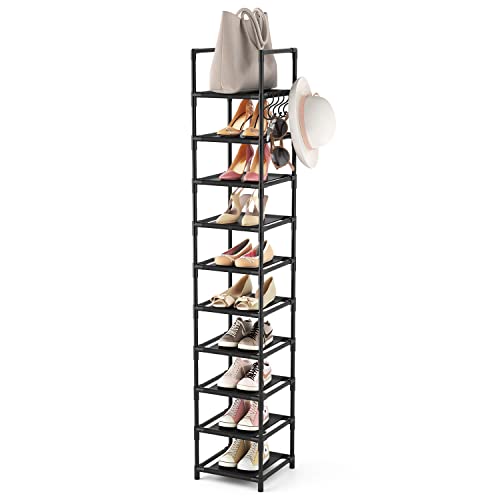
LANTEFUL Tall Narrow Shoe Rack for Entryway, 10-Tier Sturdy Metal Shoe Shelf Storage 10-15 Pairs of Shoes and Boots, Space Saving Corner Shoe Rack Organizer for Closet,Doorway,Garage,Living Room
Included for 'Small Shoe Rack Ideas for Tight Entryways and Apartments' because the listing specifies Space Saving Corner Shoe Rack Organizer for Closet and Doorway, details this guide uses to compare options.
View on Amazon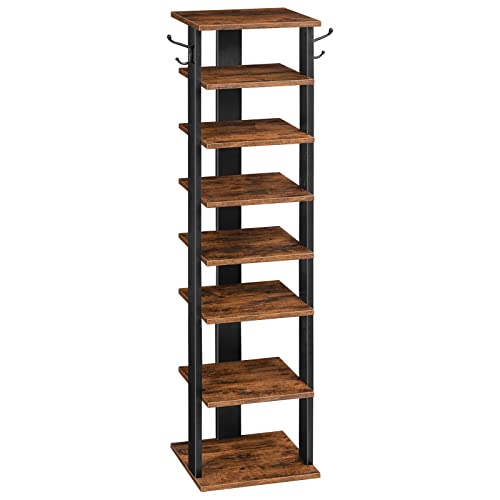
HOOBRO 8 Tiers Vertical Shoe Rack, Wooden Shoe Storage Organizer with Hooks, Narrow Shoe Tower for 8 Pairs, Space Saving, for Entryway, Living Room, Bedroom, Rustic Brown BF07XJ01G1
Included for 'Small Shoe Rack Ideas for Tight Entryways and Apartments' because the listing specifies Wooden Shoe Storage Organizer with Hooks and Narrow Shoe Tower for 8 Pairs, details this guide uses to compare options.
View on AmazonUse this quick sizing rule:
- Under 36 inches wide entryway: Choose a rack no wider than 20-24 inches and no deeper than 10 inches. A slim, vertical 3-tier or wall-leaning ladder style works best.
- 36-48 inches wide entryway: You can fit a standard small shoe rack at 26-30 inches wide and 11-12 inches deep. You will still have 24-30 inches of walkway left.
- Over 48 inches wide or small mudroom (approx. 5×5 ft): You can use a wider 2-tier bench-style rack at 32-36 inches wide, which also provides a seat.
Depth is more critical than width. In a rental hallway where the front door opens inward, anything deeper than 12 inches will be hit by the door or force you to step around it daily. If your door swing leaves less than 14 inches to the wall, look for a flat-pack foldable rack that is 4-6 inches deep when expanded and can be collapsed to under 2 inches.
| Entryway Width | Max Rack Dimensions (W x D x H) | Clear Walkway Left | Best Rack Type |
|---|---|---|---|
| 32-36 in (tight apartment hall) | 20 x 10 x 28 in | 22-26 in | Slim 3-tier vertical or foldable bamboo rack |
| 36-44 in (standard apartment entry) | 26 x 12 x 18 in (2-tier) / 26 x 12 x 28 in (3-tier) | 24-32 in | 2-tier for 2 people, 3-tier for 3-4 people |
| 44-60 in (small house entry / alcove) | 32 x 14 x 20 in | 30-46 in | 2-tier bench with seating (250 lb weight limit) |
| Under 30 in (doorway nook only) | 18 x 10 x 32 in | 20 in+ | Wall-mounted floating 2-tier or over-door rack |
2-Tier vs 3-Tier: Capacity Is Not What Listings Claim
Product listings count pairs by placing flat sandals tightly together. Real-world capacity is lower, especially with sneakers, boots, or men’s size 10-12 shoes.
| Rack Type | Typical Dimensions | Listed Capacity | Real-World Capacity | Best For |
|---|---|---|---|---|
| 2-Tier Small Shoe Rack | 26 x 12 x 16-18 in | 6-8 pairs | 4-6 pairs (2-3 per tier with sneakers) | 1-2 people, keeps entryway airy, top can hold keys/bag |
| 3-Tier Small Shoe Rack | 26 x 12 x 26-30 in | 9-12 pairs | 6-9 pairs (2-3 per tier, top tier often shorter) | 3-4 people, families, need vertical storage in narrow hall |
| 2-Tier Bench | 32 x 14 x 18 in (seat height 17-18 in) | 6-8 pairs | 4-6 pairs plus seated changing | Anyone who needs to sit; check 220-300 lb weight limit |
Height between tiers matters more than total height. You need at least 5-6 inches of clearance per tier for flat shoes and sneakers, and 7-8 inches if you wear boots or high-tops. Many budget 3-tier racks have only 5 inches between the middle tiers, which means winter boots will not fit upright and will have to lie flat, cutting capacity in half. Look for adjustable-height tiers or an open top tier where you can stand taller shoes.
Weight is another hidden limit. A bamboo or metal wire 3-tier rack usually supports 25-35 lbs total (about 8-10 lbs per tier). That is enough for everyday shoes but will sag under heavy work boots or if kids climb it. A solid wood or steel-frame rack typically supports 50-80 lbs.
Best Small Shoe Rack Picks By Situation
Instead of choosing by looks alone, match the rack to your living situation:
1. For Rentals And Frequent Moves: Foldable Bamboo or Steel Rack
If you cannot drill into walls or need to take furniture when you move, a foldable small shoe rack is the most practical. It arrives as a single folding frame with fabric or bamboo slats, requires no tools, and folds flat to 24 x 12 x 2 inches for storage or moving through a 28-30 inch apartment doorway. General market range is usually $25-$55 for a 3-tier foldable model. The trade-off is stability — it can wobble on uneven floors and is not designed for sitting. Place it against a wall and avoid stacking more than 6 pairs of heavy shoes.
2. For Very Tight Entryways (Under 12 Inches of Depth): Slim Stackable or Wall-Leaning Rack
Look for a rack that is 10 inches deep with angled tiers. The angle lets a size 12 shoe overhang slightly without protruding into the walkway, and you keep a full 24 inches of passage in a 34-inch hall. A narrow metal mesh tower at 18-20 inches wide is a common solution; it holds 4 pairs vertically and costs usually $30-$70. For zero floor space, consider a wall-mounted floating rack with two rails at 8 and 16 inches off the floor — you need a drill and wall anchors rated for 15-20 lbs per rail, and it leaves floor cleaning easy.
3. For 2 People In an Apartment: Low 2-Tier Rack With Drop Zone
A 2-tier rack at 16-18 inches high leaves space above for a small tray or wall shelf at 36-42 inches for keys, mail, and sunglasses. This keeps shoes low and sightlines open, so the entryway does not feel boxed in. If your entryway is also your living room entrance, choose a closed-front design like a slatted wood box or fabric shoe cabinet at 24-28 inches high; it hides clutter and doubles as a narrow console table.
4. For Families (3+ People): 3-Tier Plus Overflow Strategy
One small shoe rack rarely holds shoes for four people in all seasons. Use the 3-tier rack for daily pairs only (one pair per person), and store off-season shoes in a closed bin or closet. Place a durable boot tray (usually $15-$30) underneath to contain water and dirt — make sure the tray is 2 inches larger than the rack footprint on all sides to catch drips.
Material And Construction Trade-Offs
The material determines weight, assembly time, and how it handles wet shoes.
| Material | Weight (3-tier size) | Assembly & Moving | Durability Reality | Price Range (Small Size) |
|---|---|---|---|---|
| Solid Bamboo / Solid Wood | 8-12 lbs | 15-30 min, 6-12 screws; flat-pack box approx. 28 x 14 x 5 in, 10-14 lbs | Handles moisture well if sealed; can crack if left wet. Most stable for tiered use. | Usually $40-$90 |
| Engineered Wood (MDF/Particleboard) | 12-18 lbs | 20-40 min, 12-20 screws + dowels; heaviest box, sensitive to humidity | Swells and peels if wet shoes sit without a tray. Wears first at screw holes and laminate edges. | Usually $35-$75 |
| Metal (Steel Frame + Wire/Mesh) | 6-10 lbs | 10-20 min, tool-free or 4-8 screws; lightest to carry through doorways | Best for wet/muddy shoes, rust-resistant if powder-coated. Can bend if overloaded or used as seat. | Usually $30-$80 |
| Fabric/Foldable (Metal Frame + Fabric Shelves) | 4-7 lbs | No assembly, folds flat in seconds | Lightest and most renter-friendly; fabric sags after 12-18 months under heavy shoes. | Usually $25-$55 |
If your building has narrow doorways (common 28-30 inch interior doors in pre-1980s apartments), check the box dimensions before ordering. Engineered wood racks often ship in one long box that will not turn a tight hallway corner. Bamboo and metal racks usually ship in smaller, lighter cartons that are easier to carry up stairs.
Assembly, Placement, And Durability Tips Listings Skip
A small shoe rack fails not because of style but because of daily friction. Plan for these realities:
- Leave breathing room: Keep at least 4-6 inches between the rack top and any coat or wall hook, and 2-3 inches away from the wall for baseboards and airflow. This prevents mildew under wet shoes.
- Anchor if tall: Any rack taller than 30 inches in a home with kids or pets should be anchored with a wall strap or placed against a corner. A loaded 3-tier rack is top-heavy.
- Protect floors: Add felt pads under legs. Metal wire legs dent vinyl and scratch hardwood, and trapped dirt under a rack grinds into flooring over time.
- What wears first: On bamboo, the string or elastic holding slats loosens first. On metal, welds at the tier corners. On MDF, the bottom shelf where water pools. Wipe shoes before storing and empty the tray weekly.
- Clearance for boots: If you wear ankle boots daily, measure your tallest pair. Most need at least 10-12 inches of vertical space. A 2-tier rack with one tall side is more useful than a tight 3-tier in that case.
Frequently Asked Questions
How deep should a small shoe rack be for a narrow hallway?
10 to 12 inches deep is ideal. That leaves 24 inches of clear walkway in a 36-inch hallway, which is the minimum for comfortable passing with grocery bags or a stroller. If your hallway is under 34 inches, stay at 10 inches deep or choose a wall-mounted option.
Can I put a shoe rack behind the front door?
Only if you have at least 4 inches between the door handle and the wall when the door is open at 90 degrees. Measure the door swing arc. A foldable rack that you can collapse when guests arrive is safer than a fixed rack that blocks the door.
Is a 3-tier rack too tall for a small entryway?
Not if your ceilings are standard 8 feet, but it can feel visually heavy in a 3×4 ft entry. Keep the rack under 30 inches high if you want to place decor or mail on top, or choose a lower 2-tier if the space feels crowded.