Key takeaways
- Measure the lowest route under a sofa, including rails and floor coverings, before deciding whether a robot vacuum can fit. Includes a clearance map.
What's inside
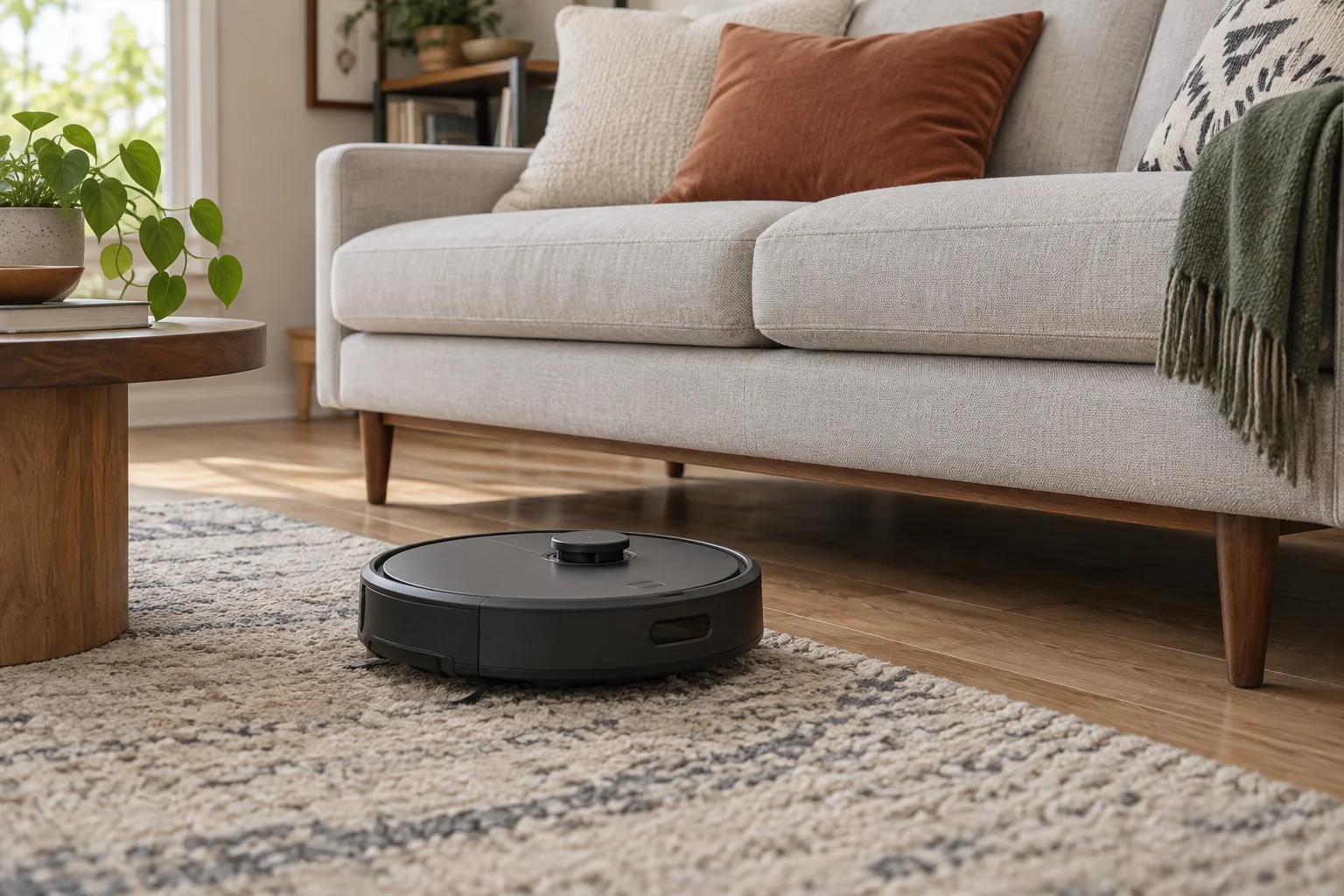
Measure the lowest point along the whole route
To check whether a robot vacuum can clean under a sofa, compare the robot’s model-specific clearance guidance with the lowest usable space beneath the furniture. The height of the sofa’s legs is not necessarily the available clearance. Rails, center supports, fabric and floor coverings can reduce it.
Measure the entrance and the interior path separately. A robot may fit through the front opening but encounter a lower brace farther inside. This is a furniture-access check, not a guarantee that the robot will navigate or clean every reachable area.
Find guidance for the exact robot
Use the manufacturer’s dimensions and any specific under-furniture requirements. Body height alone may not fully describe the conditions for a model with a moving sensor assembly or another changing feature. Record the operating configuration to which a stated clearance applies.
For example, Dreame’s X60 Pro Ultra Complete support page gives an approximate minimum furniture clearance of 89 mm for that model and discusses protrusions beneath furniture. This is a model-specific example, not a universal 89 mm allowance or a recommendation to buy the robot.
Do not transfer an instruction for retractable radar to a machine without that feature. If the maker states a required clearance greater than its published body height, use the clearance requirement when evaluating the sofa.
Inspect the sofa without altering its structure
Look beneath the sofa from a safe position using a light. Identify the front rail, side rails, center supports and any loose upholstery fabric. Measure accessible points without crawling under unstable furniture or lifting a heavy sofa alone.
Keep the normal legs and supports installed as intended. Do not remove a center leg, cut the dust cover or add improvised risers to create space for a vacuum. If another leg option is offered, ask the furniture manufacturer whether it is approved for your exact sofa.
Account for the floor under the route. A rug edge, uneven surface or object can change the robot’s approach. Measure from the actual floor covering at the relevant point rather than from an exposed floor area beside it.
Use a clearance map
| Location | Measurement or observation | Decision |
|---|---|---|
| Front entrance | Lowest height and available width | Can the model approach as instructed? |
| Side entrance | Alternative opening, if usable | Does it avoid a blocked front route? |
| Interior rails | Lowest accessible obstruction | Is there a hidden low point? |
| Center supports | Position and spaces between them | What area remains reachable? |
| Floor covering | Rug, transition or uneven area | Does the approach change? |
| Loose items | Cables, fabric and stored objects | Must the area be excluded or cleared? |
Draw a top view beside the table and mark the low points. This prevents one generous front measurement from standing in for the entire underside. Use the same units for the robot requirement and all furniture measurements.
A worked example: the legs are not the limit
Illustrative sofa and robot, not real product measurements: the sofa legs are 120 mm tall, and the front opening is 112 mm high. An interior rail leaves only 94 mm. The chosen robot’s instructions require 100 mm of under-furniture clearance.
The front opening exceeds the stated requirement by 12 mm, but the interior rail falls short by 6 mm. The sofa therefore does not pass the whole-route check. Quoting the 120 mm leg height would hide the actual obstruction.
The next step is to plan cleaning access around that limitation, such as an appropriate no-go area or a separate cleaning method following the relevant instructions. It is not to push the robot beneath the rail or assume its sensors will always rescue it.
Separate dimensional fit from navigation behavior
Even when measurements satisfy the published guidance, navigation can still depend on the actual layout and robot settings. Follow the model’s setup instructions and observe an initial permitted run. Keep the area clear of loose cables and objects that the maker identifies as hazards.
Do not reach beneath moving furniture or a running robot to free it. Follow the robot’s stopping and retrieval instructions if it becomes stuck. If the manufacturer provides no-go mapping, apply it as directed to an unsuitable area rather than repeatedly testing a tight gap.
Keep the sofa purchase decision broader than vacuum access
Under-sofa clearance is one useful specification, alongside seat comfort, footprint and construction. Do not choose unsupported replacement legs merely because a vacuum fits afterward. A cleaning convenience should not require changing the furniture beyond its approved configuration.
Save the underside drawing, lowest measured clearance and robot model with your room plan. Recheck them after changing a rug, rearranging cables or replacing the robot. The result should identify which areas are accessible and which need another approach, without promising complete cleaning from a single height number.