Key takeaways
- The right storage boxes for clothes plastic is judged by the interior you can actually fill, not the quart number on the label. This guide compares usable interior dimensions, the latch, and stackability across a set of Sterilite totes, and…
The right storage boxes for clothes plastic is judged by the interior you can actually fill, not the quart number on the label. This guide compares usable interior dimensions, the latch, and stackability across a set of Sterilite totes, and it does not call a latching box airtight or treat a bigger quart rating as more room.
As an Amazon Associate we earn from qualifying purchases.
By KK Home Furnishings Editorial Team
How to Choose Plastic Storage Boxes for Clothes
A quart rating gives a rough size, but clothes fit into the interior shape, not the nominal number. The usable length, width and depth, the latch and how boxes stack all decide real value. Four things decide the buy: interior dimensions versus the rating, the latch and seal, stackability, and what you are storing.
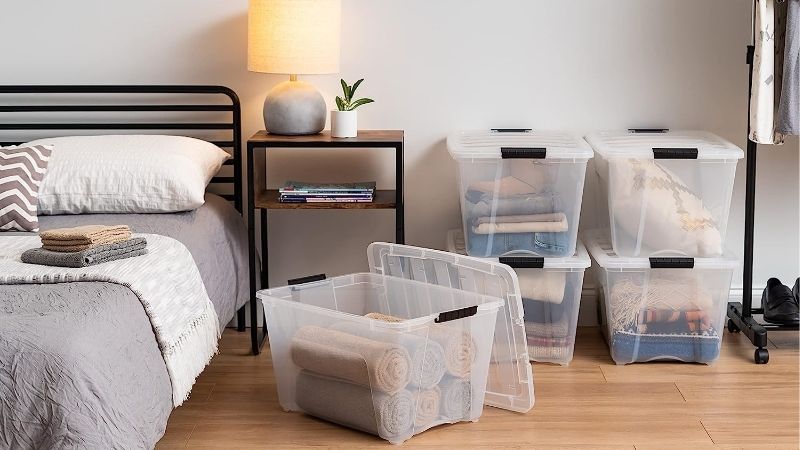
Interior Dimensions, Not the Quart Rating
The quart label is nominal; the interior is what holds clothes. A Sterilite 66-quart box has an exterior of 24 by 16 by 13⅞ inches but an interior nearer 19½ by 13⅛ by 13⅛, since the walls and taper take space. Read the interior figure, which is smaller than the outside, to know what actually fits inside the box.
Compare interiors, not ratings, especially between close sizes. A 105-quart box lists an interior around 27⅛ by 16⅛ by 12⅞ inches, and a 116-quart around 26¾ by 17½ by 12⅛ — their usable volumes work out within about one percent, so they are effectively the same despite the different quart numbers. The shape differs more than the size.
Shape decides fit as much as volume. The 105 is a little longer, the 116 a little wider, so one suits long folded stacks and the other wider items, even though their volumes match. Match the interior shape to your clothes — folded sweaters, bedding, boots — rather than chasing the higher quart number, which does not mean more room here.
The Latch and the Seal
Latching boxes hold the lid down, which matters for stacking and carrying, but a latch is not a seal. A Sterilite Latch and Carry box clamps the lid and adds handles, yet unless a maker states a gasket and an airtight or weathertight rating, treat it as latching, not airtight. Do not assume it keeps out all moisture, dust or pests.
Match the closure to where the box lives. A simple latch is fine for indoor closet or under-bed storage; for a damp basement, garage or attic, you want a stated gasket seal to resist moisture and pests, which plain latching boxes do not provide. Confirm any airtight claim in the specs rather than inferring it from the latch.
For clothes specifically, some airflow can be better than a full seal, since a truly airtight box can trap humidity against fabric. For long-term storage, add a moisture absorber or a breathable garment bag inside rather than relying on the lid. The latch mainly secures the lid for stacking and carrying, so judge it on that, not sealing.
Stackability and Handling
Clothes storage usually means stacking, so a box has to stack securely and be easy to move. Latching lids and a flat top let boxes stack without sliding, and built-in handles, as on the Latch and Carry line, make a loaded box manageable. Check that the lids interlock or sit flat, since a domed or loose lid makes a stack unstable.
Match the box size to how high you will stack and how often you access it. Larger boxes hold more but are heavier and harder to lift down from a tall stack, while smaller ones are easier to handle but multiply. For a closet shelf or under-bed, pick a height that fits the space and a weight you can actually move when full.
Over time, the lid clips and handles are the wear points on plastic totes, and brittleness from cold or UV can crack thin boxes. Store them out of harsh sun and avoid overfilling, which stresses the latches. Favor a sturdy box with replaceable or robust clips, since a cracked lid or snapped handle is what usually retires a tote.
Match the Box to What You Store
Different clothes want different interiors. Bulky sweaters and bedding need depth and width, so a deep 105- or 116-quart box suits them; flatter items or a shallow shelf suit a lower box like the 12-gallon Latch and Carry at about 18 by 16 by 8¾ inches interior. Measure your folded stacks against the interior before buying.
Think about where the box lives and how often you open it. Off-season clothes in a deep box can sit on a high shelf; current items want a shallower, accessible box. A clear box lets you see contents without opening, while an opaque one protects from light. Match the size, depth and opacity to the clothes and the spot.
For long-term clothing storage, clean and fully dry items first, since damp clothes mildew in any box, and add a moisture absorber in humid spaces. Avoid cramming, which wrinkles clothes and strains the lid. The right box is the one whose interior fits your stacks with room to close easily, stored where cold and sun will not embrittle it.
Top Picks
Four Sterilite boxes cover the range, from a shallow latch-and-carry tote to deep off-season boxes, separated by interior shape more than the quart label. The 105 and 116 are effectively the same volume, so shape and use decide between them. Each leans on manufacturer-stated specs and a tier, not a fixed price — confirm it.
| Product | Best For | Key Spec | Watch Out For |
|---|---|---|---|
| Sterilite 12 Gal Latch & Carry | Best for a shallow shelf | 18×16⅛×8¾ in interior; handles | Latch is not airtight |
| Sterilite 66 Qt | Best for a deep single box | ~19½×13⅛×13⅛ in interior | Interior smaller than exterior |
| Sterilite 105 Qt | Best for long folded stacks | 27⅛×16⅛×12⅞ in interior | Same volume as the 116 |
| Sterilite 116 Qt | Best for wider items | 26¾×17½×12⅛ in interior | Same volume as the 105 |
Sterilite 12 Gal Latch and Carry: Best for a Shallow Shelf
For a closet shelf or under-bed use, the Sterilite 12-gallon Latch and Carry has an interior around 18 by 16⅛ by 8¾ inches with a latching lid and handles. It reads budget tier; prices move, so confirm the current price and measure your folded items against that shallow interior, since this box is for flatter stacks, not bulky bedding.
Its low profile suits a shelf or sliding under a bed, and the handles make a loaded box easy to carry. The latch secures the lid for stacking, but it is not a seal, so treat it as closet storage rather than damp-proof. Its shallow depth is the limit: it holds folded clothes well but not deep piles or bulky duvets.
As a lighter tote, the lid clips and handles are the wear points, and cold can make thin plastic brittle, so store it out of harsh conditions. Avoid overfilling, which stresses the latches and the lid. For long-term clothes, add a moisture absorber, since even a latched box is not sealed against the humidity that mildews fabric.
Sterilite 66 Qt: Best for a Deep Single Box
The Sterilite 66-quart box offers more depth, with an interior around 19½ by 13⅛ by 13⅛ inches inside a 24 by 16 by 13⅞ exterior. It reads budget tier; verify the current price, and note the interior is noticeably smaller than the outside, so measure your items against the inside figure, not the box’s external footprint.
Its depth suits boots, bulkier folded clothes or a mix, and the taller shape stacks on a shelf or in a closet. Measure the exterior against your shelf height and the interior against your contents, since the wall thickness takes real space. A clear version lets you see what is inside without unstacking and opening it each time.
Treat its lid as latching, not airtight, and add a moisture absorber for long-term or damp-area storage. The clips and corners are the wear points, and overfilling stresses them, so leave room to close easily. Store it out of freezing or baking spots that embrittle plastic, and it will serve as a sturdy single clothes box.
Sterilite 105 Qt: Best for Long Folded Stacks
For off-season bulk, the Sterilite 105-quart box has a long interior around 27⅛ by 16⅛ by 12⅞ inches. It reads budget-to-mid tier; confirm the current price. Its length suits long folded stacks, sweaters and bedding, and it holds effectively the same volume as the 116-quart despite the lower quart number, so choose by shape.
The 105 is the one to pick when your items are long rather than wide, since its extra length over the 116 suits stacked folded clothes laid out. Measure your shelf and the box’s footprint, since a long box needs the run. As a large box, it is heavy when full, so plan where it sits and how you will lift it down.
Being large, it suits a closet top shelf or under a bed for clothes you access seasonally. Treat the lid as latching, not sealed, and add a moisture absorber for long storage. Store out of harsh cold or sun, and do not overfill, since a packed large box is heavy and strains the lid clips that are the usual failure point.
Sterilite 116 Qt: Best for Wider Items
The Sterilite 116-quart box matches the 105 in usable volume but in a wider shape, with an interior around 26¾ by 17½ by 12⅛ inches. It reads budget-to-mid tier; verify the current price. Despite the higher quart number, it holds effectively the same as the 105 — within about one percent — so it is the shape you are choosing.
Its extra width suits wider items or side-by-side stacks, where the 105’s length suits long ones. Pick the 116 when your contents are broad rather than long, and measure your shelf for the wider footprint. As with the 105, it is heavy when full, so place it where you can access and lift it without unstacking a tall pile.
The same care applies: the lid is latching, not airtight, so use a moisture absorber for long-term clothes and do not assume it is sealed. Store out of temperature extremes that crack plastic, avoid overfilling, and favor its sturdy clips. Choose between it and the 105 purely on whether your items are wider or longer, since volume is a tie.
Frequently Asked Questions
Clothes-storage shoppers ask the same things: whether plastic boxes are airtight, how many clothes a box holds, whether bigger quart numbers mean more room, and how to store clothes long-term. The answers below use the interior dimensions above and avoid treating a latch as a seal or a quart rating as usable volume.
Are Plastic Clothing Boxes Airtight?
Usually not. A latching box clamps the lid for stacking and carrying, but a latch is not a seal, so standard totes are not airtight unless the maker states a gasket and an airtight or weathertight rating. Treat latching boxes as closet storage, not moisture-proof, and confirm any airtight claim in the specs before relying on it.
If you need real moisture protection, look for a box the maker rates as gasketed or weathertight, and test the seal before trusting valuables to it. Otherwise, pair a standard latching box with a moisture absorber, since adding protection inside is cheaper and more reliable than assuming the lid keeps damp out.
For clothes, a full seal is not always desirable anyway, since an airtight box can trap humidity against fabric. In a damp garage, basement or attic, choose a stated gasketed box or add a moisture absorber and a breathable garment bag inside. The latch secures the lid; protecting against moisture is a separate feature to confirm.
How Many Clothes Fit in a Box?
It depends on the interior and the clothes, not the quart number. A deep 105- or 116-quart box holds far more bulky sweaters than a shallow 12-gallon tote, but thin folded items pack differently than duvets. Picture your folded stacks against the interior dimensions rather than translating a quart rating into a fixed garment count.
Leave room to close the lid without cramming, since overpacking wrinkles clothes and strains the latches. For a rough plan, measure a folded stack and compare it to the interior depth and footprint. Bulk and compression vary, so the interior size plus your specific clothes set the real capacity, not a number printed on the box.
If you need a set number, standardize on one box size and count how many folded items fit one, then multiply, but keep it approximate. The practical approach is to buy a size whose interior matches your stacks with room to spare, rather than filling to the brim, since overpacked boxes wrinkle clothes and strain the latches.
Does a Bigger Quart Number Mean More Room?
Not always. The 105-quart and 116-quart boxes here hold effectively the same usable volume — within about one percent — despite the different ratings, because the quart number is nominal and the interior shape differs. So a higher quart rating does not reliably mean more room; the interior dimensions are what you compare.
Compare the interior length, width and depth between sizes rather than the quart labels, and choose by shape for your items: longer for folded stacks, wider for broad ones. When two boxes are this close, treat them as equal in capacity and decide on footprint and fit, not on the larger-sounding number on the label.
The lesson generalizes: whenever two boxes have close quart ratings, measure both interiors before deciding, since nominal and usable volume diverge. Pick the shape that matches your items and the footprint that fits your shelf, and let the quart number be a rough starting point, not the deciding figure.
How Do I Store Clothes Long-Term?
Clean and fully dry clothes first, since damp fabric mildews in any box. Fold loosely to limit creasing, and avoid cramming, which strains the lid. In humid spaces, add a moisture absorber and consider a breathable garment bag inside, since a plain latching box is not airtight and can let humidity reach the clothes over months.
Store boxes out of temperature extremes that embrittle plastic, and keep them off a damp floor. Label and stack them with the least-used at the bottom. For valuable items, cedar blocks deter moths. These habits keep clothes fresh across seasons better than relying on the box’s lid alone, whatever its quart rating or latch.
Rotate stored boxes so the current season is accessible and off-season items sit deeper, and re-check them when you swap, airing anything that smells shut-in. These habits, not the box alone, keep long-stored clothes wearable, since even the best tote only holds what you put away clean, dry and loosely folded.
Final Thoughts
The right storage boxes for clothes plastic are the ones whose interior dimensions fit your folded stacks, not the ones with the biggest quart number. Measure your clothes against the interior before buying, treat the latch as a lid lock, not an airtight seal, and add a moisture absorber for the long term.