
Key takeaways
- Shopping for one of the many tv stands for 40 inch tv setups goes wrong when people match the stand to the screen’s diagonal instead of the TV’s actual feet. This guide compares four current stands by top width against…
Shopping for one of the many tv stands for 40 inch tv setups goes wrong when people match the stand to the screen’s diagonal instead of the TV’s actual feet. This guide compares four current stands by top width against real foot span, weight limit and tip-over safety, so a 40-inch TV sits stable and centered.
As an Amazon Associate we earn from qualifying purchases.
By KK Home Furnishings Editorial Team
How to Choose a TV Stand for a 40-Inch TV
A 40-inch TV is defined by its diagonal, but what sits on the stand is its feet and its weight, so choose around those. Weigh four things: the stand’s top width against your TV’s actual foot span, the published weight limit, whether it anchors against tipping, and the storage and height that suit your room.
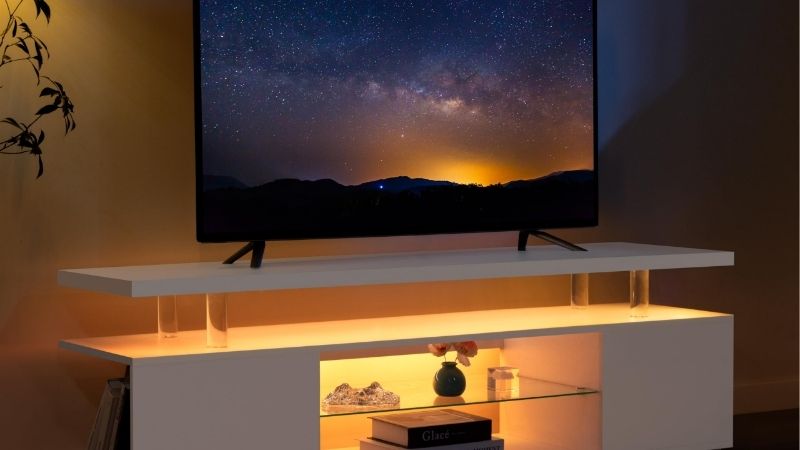
Top width vs the TV’s foot span
The number that matters is not the 40-inch diagonal but the distance between the TV’s feet, which is usually far narrower. A simple check is side margin: subtract the actual foot span from the stand’s top width and halve it. With a 30-inch foot span on a 47.25-inch stand like IKEA’s LACK, that leaves roughly 8.6 inches a side.
Measure your TV’s feet before buying, since foot span varies widely between 40-inch models and some use a center pedestal instead. A pedestal needs enough solid top, not just width, while wide-set feet need the stand wider than the span with margin on each side so the set does not overhang or perch near an edge.
Width also affects stability and looks: a stand only as wide as the feet leaves the TV looking perched and risks a knock tipping it, while a wider stand centers the screen and leaves room for a soundbar. Aim for margin on each side rather than a flush fit, and center the TV over the base, not one end of it.
Weight limit
A stand’s weight rating covers the TV plus anything on top, and it is a real spec, not a formality. IKEA’s LACK, for example, lists a 35-pound TV maximum and a 33-pound shelf maximum, which comfortably clears most 40-inch TVs but leaves less room if you stack a heavy soundbar or console on the same surface.
Most 40-inch TVs are light, often well under 25 pounds without the stand, so the limit is rarely the problem for the screen alone. The figure matters more for the shelves below, where a receiver, console and discs add up, so match what you will actually store to each shelf’s rating rather than the headline TV number.
Over time, overloading a shelf is what sags or cracks a budget stand, usually at the particleboard shelf centers rather than the frame. Keep heavy items low and centered over supports, and confirm whether the maker rates each shelf separately, since a total rating split across thin shelves is weaker than one solid loaded deck.
Anti-tip and anchoring
A TV on a stand is a tip-over risk, especially with children or pets, so anchoring is part of choosing well, not an afterthought. IKEA’s LACK ships with tip-over anchoring instructions, and furniture-and-TV tip-over standards exist precisely because freestanding setups fall; treat a wall anchor or TV strap as mandatory rather than optional.
Whether you need it is not really in question with a top-heavy screen and a lightweight stand. Anchor the stand to the wall and strap the TV to the stand, since a curious child pulling on an open shelf is the classic failure. The US has safety standards for furniture and TV tip-over through the CPSC, worth noting for any home with kids.
Anchoring also lets you use a narrower or lighter stand safely, widening your options. Check that the stand has a solid back rail or frame to screw into, since a flimsy particleboard back holds an anchor poorly. A stand you cannot anchor securely is the wrong pick for a home where the TV could be bumped or pulled.
Storage and height
Beyond fit and safety, the stand’s storage and height shape daily use. Open-shelf stands like the Furinno designs keep consoles visible and ventilated, while enclosed cabinets like the Sauder North Avenue hide clutter but can trap heat around a receiver, so match the style to your gear and how tidy you want the setup to look.
Height matters for viewing: the screen’s center should sit near seated eye level, roughly 40 to 48 inches off the floor for most sofas, which usually means a lower stand for a tall TV or a taller console for a low sofa. Measure your seated eye height before choosing a tall media cabinet over a low one.
Storage also drives longevity cost: enclosed cabinets need ventilation for electronics, and cable management keeps a setup usable as you add devices. A stand with a cord cutout and adjustable or removable shelves adapts as your gear changes, which matters more over years than the exact shelf count you start with today.
Top Picks
These four cover the useful range of tv stands for 40 inch tv setups, from a documented open table to enclosed and budget options. IKEA’s LACK publishes its width and limits; the others are shown with manufacturer-stated details, so measure your TV’s foot span and confirm each stand’s width and load before buying.
| Product | Best For | Key Spec | Watch Out For |
|---|---|---|---|
| IKEA LACK 47.25 in | Best documented fit | 47.25-in top width; TV max 35 lb; shelf max 33 lb; tip-over anchoring instruction | Open shelf; anchor to the wall |
| Sauder North Avenue | Best for enclosed storage | Manufacturer-stated width and TV limit; enclosed cabinet | Specs not confirmed here — verify width and load |
| Furinno Turn-S-Tube Wide | Best budget open stand | Manufacturer-stated wide open-shelf design | Dimensions not confirmed here — verify foot-span fit |
| Furinno Romain | Best simple low stand | Manufacturer-stated compact stand | Dimensions not confirmed here — verify load and width |
IKEA LACK 47.25 in — Best Documented Fit
IKEA’s LACK takes the top spot because its numbers are published and easy to check: a 47.25-inch top width, a 35-pound TV maximum and a 33-pound shelf maximum, with tip-over anchoring instructions in the box. That width centers a 40-inch TV with margin to spare. It sits in the budget tier for TV stands.
The generous width leaves room for a soundbar beside the TV’s feet and centers the screen on most sofas, and the open shelf keeps a console ventilated. It assembles quickly with basic tools, and the clean low profile suits a modern room, while the published limits make it easy to confirm your gear fits before buying.
The honest drawbacks are the open shelf and the material: there is no door to hide clutter, and like most budget stands it is particleboard, so keep heavy items centered over supports and anchor it to the wall. Confirm your TV’s foot span fits within the 47.25-inch width with margin rather than trusting the diagonal.
Sauder North Avenue — Best for Enclosed Storage
The Sauder North Avenue is the pick when you want to hide clutter: it is an enclosed credenza-style cabinet rather than an open table. We could not confirm its exact width and TV limit here, so treat the specs as manufacturer-stated and verify them, using the manufacturer’s TV weight limit rather than a shelf or Q&A figure for fit.
An enclosed cabinet keeps consoles, discs and cables out of sight, which suits a tidy living room, and its industrial-farmhouse look reads more like furniture than a budget stand. Confirm the interior and top width against your TV’s foot span, and plan for ventilation, since enclosed cabinets can trap heat around a receiver or console.
The drawbacks are unconfirmed specs and the heat question: verify the width, the TV weight limit and whether the doors have airflow before buying. As a taller, heavier cabinet it is more stable than a light open table but still benefits from anchoring, and its enclosed shelves suit gear you do not aim a remote through a door at.
Furinno Turn-S-Tube Wide — Best Budget Open Stand
The Furinno Turn-S-Tube Wide is the budget open-shelf choice: a wide, simple stand designed to center a TV with open storage below. Its exact dimensions were not confirmed here, so treat them as manufacturer-stated and measure your TV’s foot span against the listing before buying, rather than assuming the width clears your feet with margin.
Its appeal is a low price and a wide, airy design that ventilates consoles and keeps the look light, which suits a first apartment or a secondary room. Confirm the top width against your foot span and the shelf load against your gear, since budget open stands prioritize price and can run lighter on weight capacity than they look.
The drawbacks are the unconfirmed specs and budget build: verify the width and load, and expect particleboard shelves that need heavy items kept centered. As a light open stand it should be anchored, especially with children around, and the open design means no way to hide cables, so plan cord management from the start.
Furinno Romain — Best Simple Low Stand
The Furinno Romain is the pick for a simple, low-profile stand where space is tight: a compact design meant for smaller rooms and lighter setups. Its exact dimensions were not confirmed here, so treat them as manufacturer-stated and confirm the width and weight limit against your 40-inch TV and its foot span before ordering it.
Its strength is a small footprint and low cost for a bedroom, dorm or guest room where a full media console would overwhelm the space. Because 40-inch TVs are light, a compact stand can handle the screen, but confirm the top width centers the feet with margin, since a narrow stand leaves the TV looking perched and less stable.
The drawbacks are the unconfirmed specs and limited storage: verify the dimensions and load, and expect minimal shelf space for gear. As a small, light stand it should be anchored, and its lower height suits a low bed or sofa; measure your seated eye line so the screen does not sit too low once the TV is on it.
Frequently Asked Questions
A few questions decide whether a stand suits a 40-inch TV, usually about width, weight and safety. The answers below use the one stand with published figures and stress measuring your TV’s feet, since the 40-inch diagonal tells you nothing about how wide the stand actually needs to be for a stable fit.
How wide should a stand be for a 40-inch TV?
Wider than the TV’s feet, not the 40-inch diagonal. Measure the distance between the TV’s feet — the foot span — and choose a stand wider than that with margin on each side. A simple check: subtract the foot span from the stand width and halve it, so a 30-inch span on a 47.25-inch stand leaves about 8.6 inches a side.
What changes the number is your TV’s foot design and your plans for the top. Wide-set feet need a wider stand than a center pedestal, and a soundbar beside the TV needs extra width. Aim for margin rather than a flush fit, since a stand only as wide as the feet looks perched and tips more easily if the TV is bumped.
If your foot span is wide, a longer stand or a pedestal-friendly top solves it better than forcing a narrow stand. Center the TV over the base rather than one end, and if you must use a stand close to the foot span, anchor both the stand and the TV so the tighter margin does not become a stability problem later.
How much weight can these stands hold?
It varies, so check each stand’s rating; most 40-inch TVs are light enough that the screen is rarely the limit. IKEA’s LACK lists a 35-pound TV maximum and a 33-pound shelf maximum, which clears a typical 40-inch TV easily, but the shelves below matter more once a receiver and console are added to the unit.
Match what you store to each shelf, not just the top. A 40-inch TV often weighs under 25 pounds, but a stacked soundbar, console and discs add up fast, and budget shelves sag at the center first. Keep heavy items low and centered over supports, and confirm whether the maker rates shelves individually or as a total.
If your gear is heavy, a stand with a solid top deck and rated shelves beats a thin open design. For an enclosed cabinet, verify the manufacturer’s TV weight limit rather than a shelf or Q&A figure, since those can differ, and never assume a wide stand is also a strong one without checking the published numbers first.
Do I need to anchor a 40-inch TV stand?
Yes, especially with children or pets. A TV on a stand is top-heavy, and furniture-and-TV tip-overs are common enough that US safety standards exist through the CPSC. Anchoring the stand to the wall and strapping the TV to the stand is the single most effective step, and some stands, like IKEA’s LACK, include anchoring instructions.
Whether it is strictly required depends on your home, but the risk is real wherever a child could pull on a shelf or the TV. A light stand under a top-heavy screen tips easily, so anchor both the furniture and the TV rather than relying on weight alone. Check that the stand has a solid rail or frame to screw an anchor into.
Anchoring also lets you safely use a narrower or lighter stand, widening your choices. If a stand’s back is flimsy particleboard, an anchor holds poorly, so for a home with kids choose one with a solid back or frame. A stand you cannot anchor securely is the wrong pick where the TV could be bumped, climbed on or pulled.
Open shelves or an enclosed cabinet — which is better?
It depends on your gear and how tidy you want the room. Open stands like the Furinno designs ventilate consoles and keep remotes working without opening a door, while enclosed cabinets like the Sauder North Avenue hide clutter and cables but can trap heat around a receiver, which shortens electronics’ life if airflow is poor.
The deciding factors are heat, remotes and clutter. If you run a game console or receiver that gets warm, favor open shelves or a cabinet with ventilated doors and a cord cutout; if you mainly want a clean look, an enclosed cabinet wins. Infrared remotes also need line of sight unless the cabinet has an open or glass front.
Either way, plan cable management and ventilation from the start, since a setup grows over years. A stand with a cord cutout and removable or adjustable shelves adapts as you add devices, which matters more long term than the door style, so choose for how your gear will change rather than only how it looks on day one.
Final Thoughts
The right pick among tv stands for 40 inch tv setups is the one whose top width clears your TV’s actual foot span with margin, holds your gear, and anchors safely to the wall. Measure the feet rather than trusting the diagonal, confirm each shelf’s weight limit for the gear you store, and strap both the stand and the TV before use.
