Key takeaways
- The load rating on wall mounted shelves for kitchen use — like 49 pounds on an IKEA KUNGSFORS or 35 on a TORNVIKEN — only holds if the shelf is anchored correctly for your wall. This guide compares shelves by…
The load rating on wall mounted shelves for kitchen use — like 49 pounds on an IKEA KUNGSFORS or 35 on a TORNVIKEN — only holds if the shelf is anchored correctly for your wall. This guide compares shelves by load, depth and mounting, and treats the anchors your wall type needs as the real safety spec.
As an Amazon Associate we earn from qualifying purchases.
By KK Home Furnishings Editorial Team
How to Choose Wall-Mounted Kitchen Shelves
A kitchen shelf is judged by what it safely holds, which depends as much on the wall and the anchors as on the shelf itself. Load rating, depth and wall compatibility decide the buy, with correct mounting underpinning all of it. Four things decide the choice: the load rating, shelf depth, wall-material compatibility, and safe mounting.
Load Rating and What It Assumes
The load rating tells you what a shelf holds, but only as mounted correctly. An IKEA KUNGSFORS shelf is rated about 49 pounds and a TORNVIKEN about 35 pounds, both when properly mounted with weight evenly distributed. Those figures assume the right fasteners in a sound wall, so the rating is a ceiling, not a guarantee by itself.
Match the rating to what you will store. Kitchen items add up fast — stacked plates, jars, small appliances — so count the real load against the shelf’s figure with margin, and spread weight evenly rather than loading one end. A shelf near its rating with a point load or poor mounting can fail, even within the stated number.
Treat the rating as conditional, not absolute, since it depends on the mounting holding. Ratings are also not standardized between makers, so compare like with like and favor even loading. The shelf’s number is a starting point; the wall, the anchors and how you distribute weight decide whether it actually carries that load safely over time.
Shelf Depth for the Kitchen
Depth sets what fits and how far the shelf projects. KUNGSFORS and TORNVIKEN shelves run about 11¾ inches deep, enough for plates, jars and small items without jutting too far into a galley kitchen. Measure the wall space and the clearance below, since a deep shelf over a counter or stove needs room to work underneath.
Match the depth to the items and the spot. About 12 inches suits most kitchen storage; a deeper shelf holds more but crowds a narrow kitchen and makes back items hard to reach. Over a counter, leave headroom for appliances and tasks; above a stove, keep flammable items off and mind heat. Depth is a trade between capacity and clearance.
Deeper shelves also leverage the wall fixings more, since weight sits further from the wall, which matters for the anchors and the rating. A shelf loaded at its front edge stresses the mounting more than one loaded near the wall. Favor a depth that fits your items without overhang, and load heavier things toward the back, nearer the wall.
Wall-Material Compatibility
The wall decides the anchors, and the anchors decide whether the rating holds. Drywall, brick, tile over backer, wood studs and concrete each need different fixings, and a shelf’s load rating assumes the correct ones for a sound wall. The same KUNGSFORS at 49 pounds is only safe if mounted with fasteners rated for your wall type.
Identify your wall before buying fixings: screw into studs where possible for the most strength, or use heavy-duty anchors rated for the load in drywall, and masonry anchors in brick or concrete. The included hardware may suit only one wall type, so plan to buy the right anchors for yours, since the wrong fixing is the usual failure.
A shelf is only as strong as its weakest fixing, so matching anchors to the wall is not optional — it is the safety spec. Hitting a stud carries far more than drywall anchors alone, and masonry needs its own plugs. Confirm the fixings before loading the shelf, since a pull-out in the kitchen drops breakables and can injure someone below.
Single Shelf, Rail System or Wide Shelf
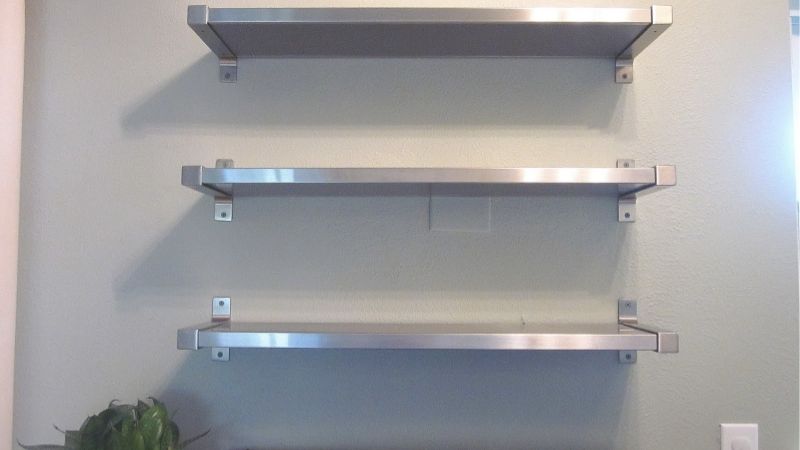
The format changes capacity and flexibility. A single KUNGSFORS shelf suits one span; a KUNGSFORS three-shelf rail system hangs multiple shelves on suspension rails for a full wall of storage; a wider TORNVIKEN at about 47 inches spans more in one piece. Choose the format for how much wall and storage you want to commit.
Match the format to the kitchen. A rail system is flexible and adds a lot of storage but needs secure top anchoring to carry the hanging load; a single or wide shelf is simpler. A wide 47-inch shelf spreads load across more fixings but must be mounted into studs or strong anchors along its length to carry evenly without sagging.
More shelves or width means more total load on the wall, so the fixings and distribution matter more, not less. A rail system concentrates load at the rail anchors; a long shelf needs support along its span. Favor the format whose mounting you can do correctly for your wall, since capacity is only real if the fixings hold it.
Top Picks
Three IKEA kitchen shelf options cover the common needs — a single shelf, a wide shelf and a rail system — plus a row on matching anchors to your wall, since that is what makes any rating real. Load, depth and format separate them. Each leans on manufacturer-stated specs and a tier, not a fixed price — confirm it first.
| Product | Best For | Key Spec | Watch Out For |
|---|---|---|---|
| KUNGSFORS shelf (stainless or ash) | Best overall single shelf | 23⅝×11¾ in; 49 lb mounted | Rating needs correct anchors |
| IKEA TORNVIKEN | Best for a wide single span | 47¼×11¾×9½ in; 35 lb | Lower rating; spread the load |
| KUNGSFORS 3-shelf rail system | Best for a full wall of storage | 23⅝ in shelves on rails | Secure the rail anchors well |
| Any kitchen wall shelf | Match anchors to your wall | Drywall, brick, wood, concrete | Rating only holds if mounted right |
KUNGSFORS Shelf (Stainless or Ash): Best Overall Single Shelf
For a single span, the IKEA KUNGSFORS shelf — in stainless steel or ash veneer — measures about 23⅝ by 11¾ inches and is rated around 49 pounds when properly mounted. It reads mid tier; prices move, so confirm the current price and the finish, and remember the 49-pound rating assumes the correct anchors for your wall.
Its 11¾-inch depth suits plates, jars and small items without jutting into a galley kitchen, and the 49-pound rating handles a sensible load spread evenly. Stainless suits a utilitarian or wet area; ash veneer suits a warmer look. Measure the wall span and clearance below, and plan the fixings for your wall before mounting it.
The rating holds only with the right anchors into a sound wall, so hit studs or use heavy-duty fixings rated for the load. Distribute weight evenly and keep heavy items toward the back. Favor secure mounting over maximizing the load, since a shelf pulled from drywall drops breakables and can injure anyone below it in the kitchen.
IKEA TORNVIKEN: Best for a Wide Single Span
When you want a wide shelf in one piece, the IKEA TORNVIKEN spans about 47¼ by 11¾ by 9½ inches with a rating around 35 pounds, weight evenly distributed. It reads mid tier; verify the current price, and note the lower rating relative to its size means spreading the load along its length, not concentrating it in one spot.
The wide span suits a long wall over a counter, holding a row of items in one clean line. Its 35-pound rating is modest for its width, so keep the load light and even, and mount it into studs or strong anchors along its length. Measure the wall and the clearance below, since a long shelf needs support across the whole span.
A wide shelf leverages its fixings more, so correct mounting matters even more than on a short one, and uneven or point loads risk sagging or pull-out. Spread weight, favor lighter items, and anchor along the length for your wall type. Confirm the fixings before loading, since the rating assumes even distribution on a soundly mounted shelf.
KUNGSFORS 3-Shelf Rail System: Best for a Full Wall of Storage
For maximum storage, the KUNGSFORS three-shelf rail system hangs multiple shelves — about 23⅝ inches wide — on suspension rails for a full wall. It reads mid-to-premium tier; confirm the current price and the configuration, since a rail system carries the combined load of several shelves through its top anchoring into the wall.
A rail system is the flexible pick, letting you add shelves and accessories and adjust their height, which suits a busy kitchen wall. The trade is that it concentrates the total load at the rail’s anchor points, so those fixings must be secure for your wall type. Plan the mounting for the full loaded weight, not one shelf alone.
Because it carries several shelves’ worth of load through the rails, the anchoring is the critical safety point, more so than on a single shelf. Mount the rails into studs or strong anchors rated for the combined load, and distribute weight across the shelves. A rail system done right adds a lot of storage; done poorly, it fails as one.
Match the Anchors to Your Wall
Whatever shelf you choose, the anchors make the rating real, so identify your wall first. Drywall, brick, tile over backer, wood studs and concrete each need different fixings, and a shelf’s stated load assumes the correct ones. Find the studs or the wall material before buying hardware, since the included fasteners may suit only one type.
Screw into studs where you can for the most strength, use heavy-duty anchors rated for the load in drywall, and masonry plugs in brick or concrete. Match every fixing to both the wall and the shelf’s weight, with margin. A shelf is only as strong as its weakest anchor, so do not rely on light drywall plugs for a loaded kitchen shelf.
Confirm the fixings before loading, and load heavy items toward the wall and spread evenly. In a kitchen, a pulled-out shelf drops plates and jars and can injure someone below, so correct mounting is the safety spec, not an afterthought. These checks turn a shelf’s rating into real, safe capacity rather than a number on the box.
Frequently Asked Questions
Kitchen-shelf shoppers ask the same things: how much a shelf really holds, how to mount it in drywall or brick, how deep to go, and whether a rail system or single shelf is better. The answers below treat the load rating as conditional on correct mounting for your wall type throughout the comparison.
How Much Weight Can a Kitchen Wall Shelf Hold?
Up to its rating, but only when mounted correctly. A KUNGSFORS is rated about 49 pounds and a TORNVIKEN about 35, with weight evenly distributed, and those figures assume the right anchors in a sound wall. Count your real kitchen load against the rating with margin, since dishes and jars add up faster than you expect.
The rating is a ceiling that depends on the mounting holding, not an absolute. A shelf anchored into studs carries far more reliably than one on light drywall plugs, and a point load or uneven weight can fail it below the rating. Spread weight, keep heavy items near the wall, and mount for the real load, not just the number.
Because ratings are not standardized and depend on the wall, treat them as a guide and err toward secure mounting and even loading. If you need to hold a lot, hit studs or use anchors rated well above your load. The safe capacity of a kitchen shelf is set by the weakest fixing, so the anchors decide what it really holds.
How Do I Mount a Shelf in Drywall or Brick?
Match the fixing to the wall. In drywall, screw into studs where possible for the most strength, or use heavy-duty anchors rated for the shelf’s load where studs are not aligned. In brick or concrete, use masonry plugs and screws rated for the weight. The right fixing for the wall type is what makes the shelf’s rating safe.
Find the studs with a detector, or the mortar joints and solid brick, before drilling, and use the correct drill bit for the material. Do not rely on light plugs for a loaded kitchen shelf. If you are unsure of the wall or the load, a stud mount or a professional is safer than guessing, since a kitchen pull-out is dangerous.
Whatever the wall, anchor for more than the load you plan, distribute weight evenly, and confirm the fixings are tight before loading. A shelf is only as strong as its mounting, so the anchors, not the shelf, are where kitchen-shelf safety is won. Matching them to drywall, brick, wood or concrete is the step you cannot skip.
How Deep Should a Kitchen Shelf Be?
About 12 inches suits most kitchen items — plates, jars, small appliances — without jutting too far into the room, which is why common shelves run near 11¾ inches deep. A deeper shelf holds more but crowds a narrow kitchen and buries back items, while a shallower one keeps a galley clear but limits what fits on it.
Match the depth to the items and the spot. Over a counter, leave headroom for tasks and appliances; in a tight galley, favor a shallower shelf that does not catch you as you pass. Deeper shelves also leverage the fixings more, since weight sits further from the wall, so load heavier items toward the back near the wall.
Measure the wall space and the clearance below before choosing a depth, and above a stove keep flammable items off and mind the heat. The right depth balances capacity against clearance for your kitchen, and loading near the wall keeps the stress on the fixings lower, which matters for both the rating and the shelf over time.
Rail System or Single Shelf?
A single shelf is simpler and suits one span; a rail system hangs several shelves for a full wall of flexible, adjustable storage. Choose the single shelf for a focused spot and easy mounting, and the rail system when you want more storage and the ability to add or move shelves on a busy kitchen wall over time.
The rail system holds more but concentrates the combined load at its anchor points, so the mounting must be secure for your wall and the full loaded weight. A single or wide shelf spreads load across its own fixings. Match the format to how much you will store and whether you can anchor it correctly for your wall type.
Either way, the anchors decide safety: a rail system’s top fixings and a shelf’s brackets both must be rated for the load in your wall. Favor the format whose mounting you can do right, since capacity is only real if the fixings hold. For a lot of storage, a well-anchored rail system wins; for simplicity, a single shelf does.
Final Thoughts
The right wall mounted shelves for kitchen use are the ones whose load rating and depth fit your items and whose anchors match your wall, since a 49- or 35-pound rating only holds when mounted correctly. Measure the wall space and your load, identify the wall type, buy the right fixings, and anchor into studs or strong plugs.