Key takeaways
- Manual-closing doors: Both doors must latch with a three-point latch system and stay closed. OSHA allows them, but they rely on workers to close the doors every time. They are usually $150-$300 less expensive than self-closing models.
- Self-closing doors: Doors are held open with a fusible link that melts at 165°F (74°C), allowing the doors to automatically close and latch. This is required in many facilities under NFPA 1 Fire Code and is strongly recommended if the cabinet is accessed frequently or left open during dispensing.
- Self-closing with keep-open hold: Same mechanism, but allows hands-free operation until the fusible link releases.
What's inside
- What Makes a Flammable Storage Cabinet OSHA and NFPA Compliant
- Flammable Storage Cabinet Sizes and Gallon Capacity
- Decision Matrix: Which Cabinet Do You Actually Need?
- Placement, Clearance, and Moving Realities
- Material and Construction Trade-Offs
- Common OSHA Violations to Avoid
- Frequently Asked Questions
A flammable storage cabinet is a code-rated, double-wall steel enclosure built to protect flammable liquids from fire for at least 10 minutes, and OSHA requires one whenever you store more than 25 gallons of Category 1-4 flammable liquids outside an approved inside storage room or flammable liquids storage locker.
- What Makes a Flammable Storage Cabinet OSHA and NFPA Compliant
- Flammable Storage Cabinet Sizes and Gallon Capacity
- Decision Matrix: Which Cabinet Do You Actually Need?
- Placement, Clearance, and Moving Realities
- Material and Construction Trade-Offs
- Common OSHA Violations to Avoid
- Frequently Asked Questions
What Makes a Flammable Storage Cabinet OSHA and NFPA Compliant
OSHA 29 CFR 1910.106 and NFPA Code 30 set the construction standard that every compliant cabinet must meet. If a cabinet does not meet all of these points, it is not a legal flammable storage cabinet, regardless of how it is marketed.
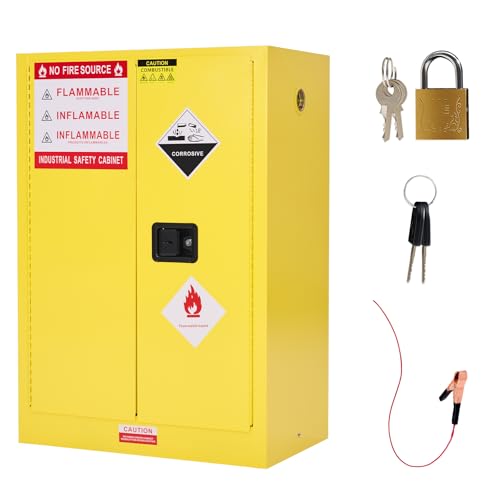
SPECRAFT Flammable Cabinet, 30 Gal, 44x31x18 Inch, Cold-Rolled Steel, Adjustable Shelves, OSHA & CE Certified for Industrial, Commercial, Laboratory, and Institutional Use, Yellow
Included for 'Flammable Storage Cabinets: Safety Features, Sizes and OSHA Requirements' because the listing specifies 30 Gal and 44x31x18 Inch, details this guide uses to compare options.
View on Amazon
VEVOR Flammable Cabinet 18" x 43" x 50", Cold-Rolled Steel Flammable Liquid Storage Cabinet 34 Gal with 2 Adjustable Shelves/2 Manual Closing Doors for Industrial Use, Yellow
Included for 'Flammable Storage Cabinets: Safety Features, Sizes and OSHA Requirements' because the listing specifies Yellow, details this guide uses to compare options.
View on Amazon
VEVOR Flammable Cabinet 18" x 23" x 65", 23 Gallon Flammable Storage Cabinet with Adjustable Shelf, Cold-Rolled and Galvanized Steel Fire Cabinets, for Commercial Industrial Home Use, Yellow
Included for 'Flammable Storage Cabinets: Safety Features, Sizes and OSHA Requirements' because the listing specifies 23 Gallon Flammable Storage Cabinet with Adjustable Shelf and Cold-Rolled and Galvanized Steel Fire Cabinets, details this guide uses to compare options.
View on Amazon
SPECRAFT 45 Gallon Flammable Liquid Storage Cabinet
Included for 'Flammable Storage Cabinets: Safety Features, Sizes and OSHA Requirements' as a relevant option in this category; details come from the product listing.
View on Amazon1. Double-Wall 18-Gauge Steel With 1.5-Inch Air Space
The cabinet must be constructed of at least 18-gauge sheet steel with a 1.5-inch air gap between the inner and outer walls. This air gap acts as insulation. The bottom, top, sides, doors and back must be double-walled. Welded or riveted joints are both acceptable, but the unit must be able to pass a 10-minute fire test without failure of the internal temperature. Single-wall sheet metal lockers, job boxes, and standard garage cabinets do not qualify.
2. Doors: Self-Closing, Self-Latching, and Flush
Compliant cabinets use one of three door systems, and the choice matters for code compliance:
- Manual-closing doors: Both doors must latch with a three-point latch system and stay closed. OSHA allows them, but they rely on workers to close the doors every time. They are usually $150-$300 less expensive than self-closing models.
- Self-closing doors: Doors are held open with a fusible link that melts at 165°F (74°C), allowing the doors to automatically close and latch. This is required in many facilities under NFPA 1 Fire Code and is strongly recommended if the cabinet is accessed frequently or left open during dispensing.
- Self-closing with keep-open hold: Same mechanism, but allows hands-free operation until the fusible link releases.
All compliant doors must have a raised sill of at least 2 inches on the bottom to contain spills, and a three-point latching system that engages the top, bottom and side.
3. Venting: Do Not Vent Unless Required
This is the most misunderstood feature. NFPA 30 does not require venting for flammable storage cabinets. Each cabinet has two 2-inch capped bung openings on opposite walls (one high, one low) with flame arresters.
Leave both caps in place unless your facility is required to vent by a fire marshal, EH&S plan, or state mechanical code. If you do vent, it must be with approved rigid steel piping directly to the exterior of the building, not into a wall, attic, or HVAC return. Improper venting defeats the fire protection by creating a chimney that can draw fire into the cabinet.
4. Grounding, Labeling, and Hardware
A compliant cabinet includes:
- A grounding lug or built-in grounding wire to bond the cabinet when dispensing liquids
- An adjustable leveling foot and at least one adjustable spill-catcher shelf that can hold 350 lbs or more and is perforated to allow drainage to the 2-inch leak-proof sump
- Continuous piano hinges or 3-point flush hinges rated for fire
- Permanent, highly visible lettering: “FLAMMABLE – KEEP FIRE AWAY” in red on yellow
Flammable Storage Cabinet Sizes and Gallon Capacity
Size is dictated by the maximum allowable gallons per cabinet and the footprint you can accommodate. Under OSHA and NFPA 30, no more than 60 gallons of Category 1, 2, or 3 flammable liquids and no more than 120 gallons of Category 4 combustible liquids may be stored in a single cabinet. You may have up to three cabinets per fire area; more requires an additional inside storage room.
Cabinets are measured by nominal gallon capacity, not exact liquid volume. Exterior dimensions are standardized across manufacturers like Justrite, Eagle, and Jamco to fit through a standard 34-inch commercial doorway and 80-inch door height.
| Cabinet Size (Nominal) | Typical Exterior Dimensions (W x D x H) | Interior Sump Capacity | Empty Weight | Best For |
|---|---|---|---|---|
| 4 – 12 Gallon (Countertop / Wall-Mount) | 23″ x 18″ x 22″ to 23″ x 18″ x 35″ | 3 – 6 gallons | 90 – 150 lbs | Labs, small maintenance closets, under-fume hood storage |
| 30 Gallon | 43″ x 18″ x 44″ | 7 – 9 gallons | 235 – 285 lbs | Workshops, garages, 10×12 ft rooms where floor space is limited |
| 45 Gallon | 43″ x 18″ x 65″ | 10 – 12 gallons | 305 – 355 lbs | Most common size for auto shops and makerspaces |
| 60 Gallon | 34″ x 34″ x 65″ | 12 – 15 gallons | 380 – 420 lbs | High-volume storage, 55-gallon drum compatible (vertical drum support) |
| 90 Gallon (Combustibles Only) | 43″ x 34″ x 65″ | 15 – 18 gallons | 450 – 520 lbs | Only for Category 4 liquids, not for gasoline or ethanol |
Interior depth on a standard 18-inch deep cabinet is about 15.5 inches usable after accounting for double walls. If you store 1-gallon safety cans or 5-gallon jerricans, measure can diameter plus 2 inches for air flow. A 12-inch diameter 5-gallon can will not fit two deep in an 18-inch cabinet.
Decision Matrix: Which Cabinet Do You Actually Need?
Price typically ranges from usually $400-$700 for a 30-gallon manual-close model to usually $900-$1,600 for a 60-gallon self-closing model in 2026. Choose by situation, not just gallon count:
| Your Situation | Recommended Cabinet | Why |
|---|---|---|
| Small apartment workshop, home garage, or renter (limited space, occasional solvents/paints) | 30-gallon, manual-close, 43″ wide | Fits against one wall of a 10×12 ft room with 36″ aisle clearance, holds up to six 5-gallon cans, easiest to move through a 30″ residential doorway |
| Frequent access, employees, or OSHA-inspected workplace | 45-gallon or 60-gallon, self-closing doors | Eliminates human error, satisfies fire marshal requirements for self-closing in occupied shops |
| Need to store a 55-gallon drum | 60-gallon vertical drum cabinet (34″ x 34″) | Only square-depth model accepts a drum plus a shelf for smaller containers |
| Chemical segregation (acids vs. flammables vs. pesticides) | Two smaller cabinets (e.g., 30-gal yellow for flammables + 30-gal blue for corrosives) | OSHA and NFPA prohibit storing acids and flammables in the same cabinet; two 30-gallon units provide separation and flexibility |
| Lab with bench-top dispensing | 12-gallon countertop or 4-gallon wall-mount under-counter | Keeps daily-use quantity within arm’s reach, wall-mount frees floor space, complies with NFPA 45 lab limits |
Placement, Clearance, and Moving Realities
A cabinet only protects if it can be placed and accessed correctly. Plan for these real measurements before buying:
- Clearance: Keep 36 inches of clear aisle space in front of the doors for full 180-degree opening. Side clearance of 6 inches is enough for the bung caps, but leave 12 inches if you intend to vent. Do not place within 3 feet of an open flame, furnace, or electrical panel.
- Room fit: In a 10×12 ft room, a 43-inch wide cabinet occupies about one-third of a 12-foot wall. You still have 101 inches remaining for a workbench, but a 34×34 inch 60-gallon drum cabinet will block walkways if centered. Measure doorway swing and any turns in hallways; a 65-inch tall cabinet cannot be tilted in an 80-inch hallway with low sprinkler heads.
- Floor load: A loaded 45-gallon cabinet can exceed 800 lbs (355 lbs empty + 45 gallons x ~6.5 lbs/gal for solvents + cans). Confirm floor rating, especially on mezzanines or residential wood floors rated at 40 lbs per sq ft. Spread load with a 3/4-inch plywood base if needed.
- Moving weight: Cabinets ship fully assembled on a pallet, usually 250-520 lbs boxed. Delivery requires a liftgate and pallet jack. Two people with an appliance dolly can move a 30-gallon unit, but a 45-gallon and larger needs three people or a powered dolly. Box width is typically 48 inches, which will not fit through a 29-inch interior door.
- What wears first: The fusible link, door latch pins, and shelf clips. Inspect the self-closing mechanism monthly, ensure shelves are not bowed beyond 1/4 inch, and check the sump for corrosion or pooled liquid. Polyethylene liners or trays extend life when storing corrosive vapors.
Material and Construction Trade-Offs
All code-compliant flammable cabinets are steel. The comparison that matters is steel finish and shelf type:
| Feature | Powder-Coat Yellow Steel (Standard) | Galvanized Steel / Stainless Trim | Polyethylene-Lined Steel |
|---|---|---|---|
| Best for | General solvents, paints, gasoline | Damp environments, coastal shops | Mixed flammable + corrosive vapors |
| Corrosion resistance | Good, wash and dry spills quickly | Very good | Excellent, liner protects sump and shelves |
| Durability | 10-15 years with routine care | 12-18 years | Liner may need replacement after 5-7 years |
| Cost | Lowest, usually $400-$1,200 | 10-20% higher | 20-35% higher |
| Limitation | Can rust if sump holds water/acid | Heavier, fewer color options | Lower shelf weight limit (usually 250 lbs) |
Avoid wooden or plastic cabinets for flammable storage; they offer no fire rating and will not pass an OSHA inspection. Blue cabinets are for corrosives, red for combustibles, and yellow is the universal standard for flammables, which helps emergency responders identify contents quickly.
Common OSHA Violations to Avoid
- Storing more than 60 gallons per cabinet or more than 25 gallons outside a cabinet without an approved room.
- Removing the 2-inch bung caps and leaving open vent holes with no piping, or venting with plastic PVC instead of steel.
- Blocking the cabinet door so it cannot fully close and latch, or storing cardboard and rags on top of the cabinet.
- Failing to ground and bond during dispensing. Use the factory grounding screw and a bonding wire between drum and safety can.
- Storing incompatible materials together, such as oxidizers or acids with flammables. Use separate, color-coded cabinets.
For home and small-business buyers on the-dreamhome.com, the practical choice is usually a 30-gallon or 45-gallon yellow, double-wall steel cabinet with self-closing doors if the budget allows. Confirm the gallon total you plan to store, measure your doorway and aisle clearance, and keep both vent caps closed unless your local authority having jurisdiction requires active venting. That combination satisfies OSHA 1910.106, meets NFPA 30, and provides the 10-minute fire protection window the standard is designed to give for safe evacuation.
Frequently Asked Questions
Do I need a flammable storage cabinet for a few cans of paint and gasoline at home?
OSHA rules legally apply to workplaces, not private homes, but NFPA and fire codes are often adopted into residential fire codes. For a home garage, a listed cabinet is recommended if you keep more than 10 gallons combined or store gasoline. Even below that amount, a cabinet prevents vapor accumulation and contains spills.
Can I vent my cabinet through the wall with a dryer hose?
No. Any vent must be rigid steel pipe, continuous to outdoors, with no plastic or flexible hose. Most inspectors will tell you to keep the bungs capped, which is compliant.
What is the difference between flammable and combustible storage cabinets?
Construction is identical. The difference is the liquid classification and gallon limit: flammable cabinets (yellow) rated for Category 1-3 liquids up to 60 gallons, combustible cabinets (often red) for Category 4 liquids up to 120 gallons. A 60-gallon yellow cabinet can hold either, but you cannot exceed 60 gallons of flammables in it.