Key takeaways
- 5.5 – 6 inches of clearance per tier: Fits flats, sandals, canvas sneakers. Heels and high-top sneakers will not fit.
- 6.5 – 7.5 inches per tier: Standard for most vertical shoe racks. Fits most men’s size 12 sneakers and women’s ankle boots laid flat.
- 7.5 – 9 inches per tier: Needed for boots, high-tops, and men’s winter boots. Look for adjustable or staggered racks if you own these.
What's inside
- How Much Space a Vertical Shoe Rack Actually Saves
- Pair Capacity Is Not Just Tier Count
- Stability: Why Tall, Slim Frames Tip and How to Prevent It
- Material and Construction Trade-Offs
- Choose the Right Vertical Rack for Your Situation
- Assembly, Moving and What Wears Out First
- Placement Tips for Narrow Entryways
A vertical shoe rack saves floor space by stacking 10 to 20 pairs on a footprint of just 10 to 14 inches deep and 20 to 30 inches wide, making it the best solution for entryways narrower than 42 inches where a traditional wide rack would block traffic flow.
- How Much Space a Vertical Shoe Rack Actually Saves
- Pair Capacity Is Not Just Tier Count
- Stability: Why Tall, Slim Frames Tip and How to Prevent It
- Material and Construction Trade-Offs
- Choose the Right Vertical Rack for Your Situation
- Assembly, Moving and What Wears Out First
- Placement Tips for Narrow Entryways
How Much Space a Vertical Shoe Rack Actually Saves
The advantage is height, not width. Most vertical designs are 48 to 72 inches tall with 5 to 10 tiers, while occupying less floor area than a standard doormat. For comparison, a conventional 2-tier floor rack holds 6 pairs but spreads across 30+ inches of width. A vertical rack holds double that in the same or smaller footprint because it uses vertical clearance you already have.
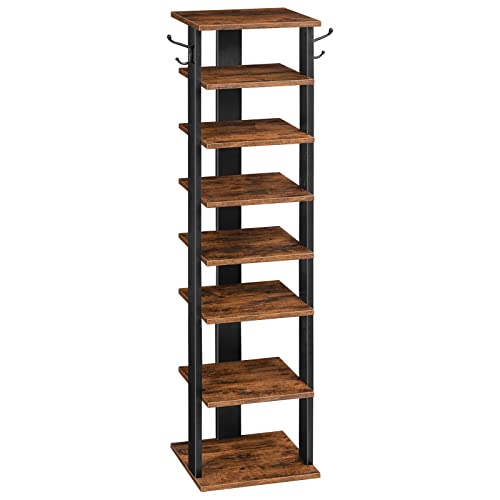
HOOBRO 8 Tiers Vertical Shoe Rack, Wooden Shoe Storage Organizer with Hooks, Narrow Shoe Tower for 8 Pairs, Space Saving, for Entryway, Living Room, Bedroom, Rustic Brown BF07XJ01G1
Included for 'Vertical Shoe Rack to Save Floor Space and Organize More Pairs' because the listing specifies Wooden Shoe Storage Organizer with Hooks and Narrow Shoe Tower for 8 Pairs, details this guide uses to compare options.
View on Amazon
Altdnmaf 6 Tier Vertical Narrow Shoe Rack, Stackable Tall Skinny Shoerack, Compact Single Shoes Storage Tower for Slim Space, Corner Plastic Shelves, for Hallways, Entryway, Bedrooms Organizer, Black
Included for 'Vertical Shoe Rack to Save Floor Space and Organize More Pairs' because the listing specifies Stackable Tall Skinny Shoerack and Compact Single Shoes Storage Tower for Slim Space, details this guide uses to compare options.
View on Amazon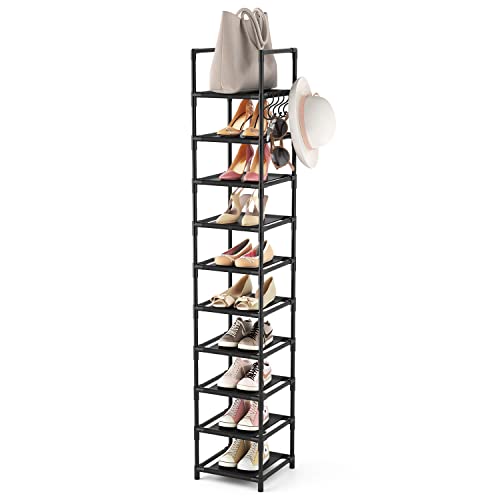
LANTEFUL Tall Narrow Shoe Rack for Entryway, 10-Tier Sturdy Metal Shoe Shelf Storage 10-15 Pairs of Shoes and Boots, Space Saving Corner Shoe Rack Organizer for Closet,Doorway,Garage,Living Room
Included for 'Vertical Shoe Rack to Save Floor Space and Organize More Pairs' because the listing specifies Space Saving Corner Shoe Rack Organizer for Closet and Doorway, details this guide uses to compare options.
View on Amazon
FIDUCIAL HOME 10 Tiers Vertical Shoe Rack 10 Pairs Skinny Shoe Shelf
Included for 'Vertical Shoe Rack to Save Floor Space and Organize More Pairs' as a relevant option in this category; details come from the product listing.
View on Amazon| Rack Type | Typical Footprint (W x D) | Height | Pair Capacity | Best For |
|---|---|---|---|---|
| Slim 5-Tier Vertical (10 pairs) | 20″ x 11″ | 52″ – 55″ | 8 – 10 pairs | Narrow apartment entry, 1-2 people |
| Standard 7-Tier Vertical (14 pairs) | 22″ x 12″ | 60″ – 65″ | 12 – 14 pairs | Family of 3-4, hallway closet overflow |
| Tall 10-Tier Tower (20 pairs) | 28″ x 12″ | 68″ – 72″ | 18 – 20 pairs | Large collection, rental closet replacement |
| 2-Tier Horizontal Bench Rack | 32″ x 14″ | 18″ – 20″ | 4 – 6 pairs | Seating needed, wide foyer only |
To fit correctly in a narrow entryway, measure first. You need at least 36 inches of clear walkway for code and comfort, 42 inches if two people need to pass. In a 36-inch wide hallway, choose a rack no deeper than 11 inches. Leave 4 to 6 inches of clearance between the rack and the wall or door swing, and at least 24 inches in front of the rack to tilt and pull shoes out without hitting the opposite wall.
Ceiling height also matters. With standard 8-foot (96-inch) ceilings, a 68-inch tower still leaves 28 inches of visual breathing room and won’t feel top-heavy. In apartments with lower lighting or bulkheads, stay at 60 inches or below to avoid blocking sightlines.
Pair Capacity Is Not Just Tier Count
Listed capacity assumes low-profile shoes like flats, loafers, and sneakers. The real number depends on tier clearance:
- 5.5 – 6 inches of clearance per tier: Fits flats, sandals, canvas sneakers. Heels and high-top sneakers will not fit.
- 6.5 – 7.5 inches per tier: Standard for most vertical shoe racks. Fits most men’s size 12 sneakers and women’s ankle boots laid flat.
- 7.5 – 9 inches per tier: Needed for boots, high-tops, and men’s winter boots. Look for adjustable or staggered racks if you own these.
If you wear mostly bulky footwear, divide the advertised capacity by 1.5. A “10-pair” rack with 6-inch spacing realistically holds 6 to 7 pairs of boots or chunky sneakers. Look for racks with alternating or angled tiers — they offset left and right shoes to reduce width and increase vertical clearance without making the frame taller.
Stability: Why Tall, Slim Frames Tip and How to Prevent It
Any rack taller than 50 inches with a depth under 12 inches has a high center of gravity. Without anti-tip measures, a loaded 65-inch rack can wobble when you pull shoes from the top tier, especially on carpet or uneven entryway tile.
What Makes a Vertical Rack Stable
- Base width vs. height ratio: A stable tower should have a base width at least 40% of its height. For a 60-inch rack, that means a base at least 24 inches wide if freestanding without wall support.
- Weight distribution: Place heaviest shoes (boots, sneakers) on the bottom two tiers and lightest on top. This lowers the center of gravity significantly.
- Wall anchoring: The most secure tall frames include an anti-tip strap or L-bracket. If you are a renter who cannot drill, choose a model with a wide, weighted base or an X-brace on the back.
- Leveling feet: Essential for entryways where tile meets hardwood. Adjustable feet prevent rocking that loosens joints over time.
- Weight limits: Most metal wire vertical racks are usually rated for 20 to 35 lbs total, or 4 to 7 lbs per tier. Bamboo and engineered wood shelves typically support 8 to 12 lbs per tier. Exceeding this causes sagging in the middle tiers first.
Avoid placing a tall vertical rack unanchored next to an exterior door that gets strong drafts or where kids might climb. If your hallway gets direct bumps from bags and strollers, choose a frame with vertical side supports rather than single center-pole designs, which flex more laterally.
Material and Construction Trade-Offs
| Material | Weight & Durability | Pros | Cons | Price Range (2026) |
|---|---|---|---|---|
| Powder-Coated Steel Wire / Metal | Light (8-15 lbs empty), rust resistant, highest weight tolerance | Strongest for narrow footprint, easy to clean, breathable for wet shoes | Can scratch floors, shoes may slip between wires without fabric liner | Usually $35 – $90 |
| Bamboo | Medium (12-20 lbs), naturally moisture resistant | More stable feel, warmer look, slatted shelves allow airflow | Heavier to move, needs oiling occasionally, less adjustable | Usually $50 – $130 |
| Engineered Wood (MDF/Particleboard) with Laminate | Heavy (18-30 lbs), prone to swelling if wet | Solid shelf surface, looks like furniture, hides shoe clutter | Weakens with moisture from wet shoes, difficult to move, assembly more complex | Usually $60 – $150 |
| Fabric + Metal Frame (Non-woven tiers) | Lightest (6-10 lbs), least durable | Cheapest, ultra-slim, folds for moving | Fabric sags under heavy shoes, wears first at corners, not for boots | Usually $25 – $55 |
For narrow, high-traffic entryways, powder-coated steel or bamboo offers the best balance of slim profile and long-term durability. Engineered wood looks premium but retains moisture and will swell at the edges within a year if used for wet winter shoes without a drip tray. Fabric tiers are best as a temporary or closet-interior solution.
Choose the Right Vertical Rack for Your Situation
| Your Situation | Recommended Height / Type | Why It Fits |
|---|---|---|
| Small studio / 32-36″ wide entry | 5-tier, 50-55″ tall, 10″ deep wire tower | Leaves 24″+ walkway clearance, holds 8-10 pairs without crowding |
| Renter who cannot drill into walls | Bamboo 6-7 tier with wide base and X-brace, no anchor needed | Wider base and heavier weight prevents tipping without wall hardware |
| Family with kids and pets | Low 4-5 tier (40-45″) metal frame + wall strap | Lower height is climb-resistant, easy for kids to reach, strap prevents pull-over |
| Large sneaker / boot collection (men’s size 11+) | 7-10 tier with adjustable 7.5″+ clearance or angled shelves | Accommodates bulky shoes without crushing toes or heels |
| Need entryway seating too | Hybrid: 3-tier bench base (18″ high) + vertical tower beside it | Separates seating from storage, avoids unstable tall-bench combos |
Assembly, Moving and What Wears Out First
Box weight tells you a lot before you buy. A steel wire tower usually ships at 8 to 14 lbs in a narrow 30 x 14 x 6 inch box that fits through any 28-inch interior doorway and up tight stairwells easily. Bamboo and engineered wood models ship at 18 to 32 lbs in larger flat packs and often require two people to maneuver into an apartment elevator.
Assembly time for most vertical racks is 15 to 30 minutes with an included Allen key. Single-pole stacking racks are fastest (no screws, just push-pole connections) but loosen fastest. Look for double-lock connectors or side screws at each joint — they prevent the sway that develops after 3 to 6 months of daily use.
What wears first depends on material. On metal racks, the plastic connectors and joint caps crack before the metal does. On bamboo, the finish at the bottom slats peels from water exposure. On engineered wood, the cam locks loosen and the laminate bubbles near the floor. On fabric racks, the stitching at the shelf corners tears under weight. To extend life, add adhesive felt pads under the legs to protect entryway flooring, tighten all connectors after the first two weeks of use as the frame settles, and place a small rubber tray or mat under the bottom tier for wet shoes.
If you move frequently, avoid engineered wood vertical racks. They do not survive disassembly well — particleboard screw holes strip on the second build. Metal and bamboo frames with bolt-through hardware reassemble cleanly multiple times.
Placement Tips for Narrow Entryways
- Place the rack on the wall opposite the door hinge, not behind the door, so the open door does not block access.
- If your entryway is also your main hallway, keep the rack within the first 36 inches inside the door to avoid carrying dirt further.
- Leave 2 inches between the top of the rack and any wall art or thermostat.
- For airflow and odor control, avoid pushing a solid-backed engineered wood rack flush against the wall. Leave a 1-inch gap or choose open wire/bamboo.