Key takeaways
- Sneakers/low shoes: Need 5 – 6 inches of vertical clearance. Standard 10-tier towers provide 6.5 – 7.2 inches between tiers, which is sufficient.
- High-tops and ankle boots: Need 8 – 10 inches. You will need to remove one shelf layer to create a double-height slot, dropping a 10-tier to 9 usable levels.
- Tall boots (14 – 18 inches shaft): Need 15 – 19 inches. No 10-tier tower fits these upright. Store tall boots on the top tier standing, on the floor beside the tower, or use a boot shaper and lay them flat across two wire shelves.
- Heels and wedges: Need 7 – 8 inches and benefit from deeper shelves (12 inches+) so the heel does not hang off.
What's inside
- How Tall Is a Tall Shoe Rack Really?
- Shelf Spacing: The Boot vs. Sneaker Problem
- Weight Limits and What Sags First
- Material and Construction Trade-Offs
- Tipping Prevention Is Non-Negotiable Above 60 Inches
- Decision Matrix: Which Tall Rack Fits Your Situation?
- Assembly, Moving, and Durability Realities
- How to Choose Between 10-Tier and Slim Lower Towers
- FAQ
A tall shoe rack with 10 tiers holds 20 to 30 pairs in a footprint of about 11 x 11 inches to 28 x 11 inches, but the right pick depends on your shoe mix, wall support, and weight limit — slim fabric towers maximize pair count in closets and rentals, while narrow metal towers handle heavier shoes and boots more securely.
- How Tall Is a Tall Shoe Rack Really?
- Shelf Spacing: The Boot vs. Sneaker Problem
- Weight Limits and What Sags First
- Material and Construction Trade-Offs
- Tipping Prevention Is Non-Negotiable Above 60 Inches
- Decision Matrix: Which Tall Rack Fits Your Situation?
- Assembly, Moving, and Durability Realities
- How to Choose Between 10-Tier and Slim Lower Towers
- FAQ
How Tall Is a Tall Shoe Rack Really?
Most racks marketed as “tall” fall into two distinct height bands. Understanding the band helps you check ceiling clearance, closet fit, and tipping risk before you buy.
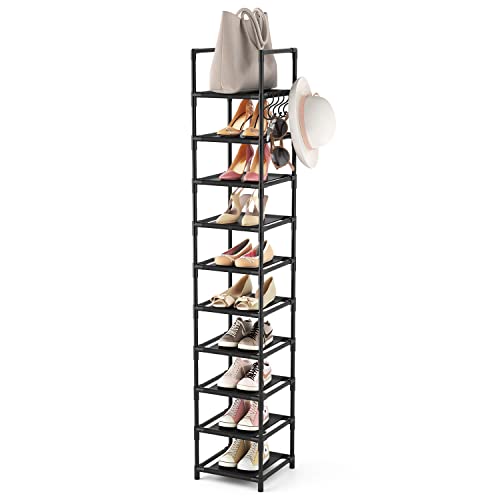
LANTEFUL Tall Narrow Shoe Rack for Entryway, 10-Tier Sturdy Metal Shoe Shelf Storage 10-15 Pairs of Shoes and Boots, Space Saving Corner Shoe Rack Organizer for Closet,Doorway,Garage,Living Room
Included for 'Tall Shoe Rack: 10-Tier and Slim Tower Picks for Big Collections' because the listing specifies Space Saving Corner Shoe Rack Organizer for Closet and Doorway, details this guide uses to compare options.
View on Amazon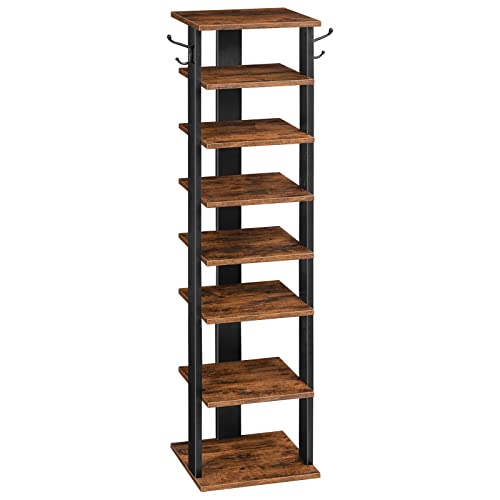
HOOBRO 8 Tiers Vertical Shoe Rack, Wooden Shoe Storage Organizer with Hooks, Narrow Shoe Tower for 8 Pairs, Space Saving, for Entryway, Living Room, Bedroom, Rustic Brown BF07XJ01G1
Included for 'Tall Shoe Rack: 10-Tier and Slim Tower Picks for Big Collections' because the listing specifies Wooden Shoe Storage Organizer with Hooks and Narrow Shoe Tower for 8 Pairs, details this guide uses to compare options.
View on Amazon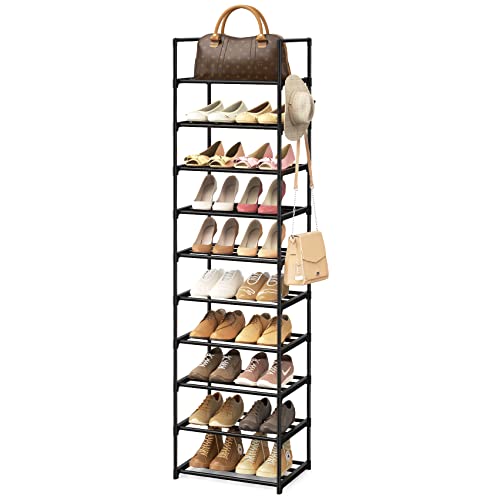
WEXCISE Narrow Shoe Rack 10 Tiers Tall Shoe Rack for Entryway Closet 20 24 Pairs Shoe & Boots Organizer Storage Shelf Durable Black Metal Stackable Shoe Cabinet with Hooks, 17.1D x 11.8W x 78.7H in
Included for 'Tall Shoe Rack: 10-Tier and Slim Tower Picks for Big Collections' because the listing specifies 17.1D x 11.8W x 78.7H in, details this guide uses to compare options.
View on Amazon
Nunsino Narrow Shoe Rack, 10-Tier Metal Shoe Organizer,Tall Shoe Shelf with Anti-Tip Strap, Max Holds 22 Pairs,Space Saving for Closet,Entryway,Black
Included for 'Tall Shoe Rack: 10-Tier and Slim Tower Picks for Big Collections' because the listing specifies 10-Tier Metal Shoe Organizer and Tall Shoe Shelf with Anti-Tip Strap, details this guide uses to compare options.
View on Amazon| Type | Typical Height | Tiers | Footprint (W x D) | Pairs Claimed | Realistic Capacity (Adult Shoes) |
|---|---|---|---|---|---|
| Slim 10-Tier Fabric Tower | 68 – 72 inches (173 – 183 cm) | 10 | 28 x 11 inches | 20 – 30 pairs | 20 pairs (2 per tier), 25-30 if mixing flats/kids shoes |
| Narrow 10-Tier Fabric Tower (Single Column) | 68 – 70 inches | 10 | 11 x 11 inches | 10 pairs | 10 pairs (1 per tier), best for entryway corners |
| Slim 10-Tier Metal Tower (Wire/Mesh) | 62 – 68 inches | 10 | 20 x 11 inches | 20 pairs | 18 – 20 pairs |
| Tall Metal Shoe Cabinet (Angled Shelves) | 50 – 64 inches | 6 – 8 angled tiers | 20 x 12 inches | 18 – 24 pairs | 12 – 16 pairs of sneakers, fewer boots |
In a standard 8-foot (96-inch) room, a 68-72 inch tower leaves 24-28 inches to the ceiling, which is enough to avoid a cramped look and to allow air circulation in a closet. In a closet with a hanging rod at 66 inches, a 68-inch tower will not fit upright underneath — measure from floor to the lowest shelf or rod, not just ceiling height. Allow at least 2 inches of clearance on top to avoid scuffing the ceiling when loading shoes, and 18-24 inches of open floor in front of the rack to step back and retrieve pairs.
For room fit, a 28-inch-wide tower occupies about 23% of the wall length in a 10×12 ft bedroom and about 35% of wall length in a 7×10 ft entryway. The 11-inch single-column version is the only option that reliably fits between a door frame and a closet wall or inside a 24-inch deep closet without blocking the door swing.
Shelf Spacing: The Boot vs. Sneaker Problem
Vertical clearance between tiers determines whether you can actually use all 10 levels. Fabric towers with non-woven shelves and metal wire racks often use fixed spacing, which creates problems for mixed collections.
- Sneakers/low shoes: Need 5 – 6 inches of vertical clearance. Standard 10-tier towers provide 6.5 – 7.2 inches between tiers, which is sufficient.
- High-tops and ankle boots: Need 8 – 10 inches. You will need to remove one shelf layer to create a double-height slot, dropping a 10-tier to 9 usable levels.
- Tall boots (14 – 18 inches shaft): Need 15 – 19 inches. No 10-tier tower fits these upright. Store tall boots on the top tier standing, on the floor beside the tower, or use a boot shaper and lay them flat across two wire shelves.
- Heels and wedges: Need 7 – 8 inches and benefit from deeper shelves (12 inches+) so the heel does not hang off.
If your collection is 50% boots or more, a 6- or 7-tier metal rack with 8-9 inch spacing is more usable than a 10-tier where you have to sacrifice multiple tiers. For sneaker-heavy collections, the full 10-tier layout is efficient and keeps each pair visible.
Tip for measuring: Take your tallest pair (usually a boot or high-top), stand it on a flat surface, and measure from sole to top. Add 1 inch for clearance. That number is your required tier height for that slot.
Weight Limits and What Sags First
Weight capacity is where fabric and metal towers diverge most. Listings often state total capacity, not per-tier limits, which masks the weak point.
| Spec | 10-Tier Fabric Tower (Steel Frame + Non-Woven Fabric) | 10-Tier Metal Wire Tower (Steel Tubes + Wire Shelves) |
|---|---|---|
| Total capacity claimed | Usually 150 – 200 lbs total | Usually 200 – 300 lbs total |
| Per-tier capacity | 7 – 10 lbs per shelf (2 pairs of sneakers = 3 – 5 lbs) | 15 – 25 lbs per shelf |
| What sags or bends first | Fabric shelf sags in center after 6-12 months under 8+ lbs; plastic connectors crack under lateral load | Wire mesh bows under heavy boots; weld points at frame joints |
| Weight of rack itself | 8 – 12 lbs (easy to move, easy to tip) | 14 – 22 lbs (more stable, harder to move) |
| Ideal load | Flats, canvas sneakers, kids shoes, sandals | Leather sneakers, hiking shoes, ankle boots, work shoes |
A practical test without “testing”: If you own mostly size 10+ men’s leather sneakers or boots (each pair 3.5 – 5 lbs), you will approach the per-tier limit of a fabric shelf with two pairs. Over time, the fabric will dip and shoes will slide toward the center. Reinforcing the shelf with a thin plywood or plastic board cut to 26 x 10 inches prevents sag and distributes weight.
Material and Construction Trade-Offs
| Material | Pros | Cons | Best For |
|---|---|---|---|
| Steel frame + non-woven fabric / polyester shelves | Lightest, cheapest (usually $25 – $50), tool-free assembly, narrowest footprint | Lowest weight limit, fabric tears, absorbs odor, not moisture resistant, wobbles side-to-side | Renters, closets, kids shoes, temporary storage, large sneaker/flat collections on a budget |
| Steel tube + metal wire/mesh shelves | Higher weight limit, better airflow, easy to wipe, more rigid | Heavier, requires wrench/allen key assembly, wire can leave marks on soft soles, can rust in damp entryways | Entryways, humid climates, heavy shoes, owners who want longevity |
| Steel frame + engineered wood (MDF/particleboard) shelves | Most stable, flat surface prevents sag, looks like furniture | Heaviest, usually $70 – $150, sensitive to water, hardware can loosen in MDF with moves | Living room / bedroom display, small apartments where rack doubles as console |
Fabric density matters: thinner non-woven fabric (70-80 GSM) will show wear and dust faster than 100+ GSM polyester or Oxford fabric. For metal, look for tube diameter of 16mm or more and powder coating rather than thin chrome plating if the rack will sit near a wet entryway mat.
Tipping Prevention Is Non-Negotiable Above 60 Inches
Any 10-tier tower over 60 inches tall with a depth of only 11 inches has a high center of gravity. Without wall anchoring, a child pulling on a shelf, a pet jumping, or simply loading the top tiers heavier than the bottom can topple it.
- Anchor to the wall: Use the included L-bracket or anti-tip strap into a wall stud or with a drywall anchor rated for 50+ lbs shear. If you are a renter who cannot drill, place the tower inside a closet against the back wall, or wedge it between two walls/furniture pieces so it cannot tip forward. Tension against the ceiling is not reliable for 11-inch deep towers.
- Load heaviest shoes on the bottom 3 tiers. This lowers the center of gravity significantly. Never store the heaviest boots on tier 9 or 10.
- Leave 36-42 inches of clear hallway width if the rack is in an entryway. Building codes and fire safety recommend this for main pathways. A 28-inch wide rack in a 48-inch wide hallway leaves only 20 inches if placed perpendicular — turn it parallel to the wall instead.
- Check doorway width for moves: Most interior doorways are 28-30 inches wide. A 28-inch wide tower will not pass through assembled. Both fabric and metal towers are designed to be assembled in place.
Decision Matrix: Which Tall Rack Fits Your Situation?
| Your Situation | Best Choice | Why |
|---|---|---|
| Small apartment, 15-25 pairs, mostly sneakers/flats | 28-inch wide 10-tier fabric tower | Highest pair-per-square-foot, fits in closet, budget-friendly, easy to disassemble when moving |
| Renter who cannot drill into walls | 10-tier fabric inside closet OR low 5-tier metal with wide base | Avoids unanchored 70-inch tower in open room; closet walls brace it |
| Kids and pets at home | 10-tier metal wire tower + wall anchor | Rigid frame resists climbing/pulling, anchor prevents tip, metal wipes clean |
| Collection includes 5+ pairs of boots or heavy hiking shoes | 6-8 tier metal or engineered wood tower with 8+ inch spacing | Fewer but taller tiers prevent crushing boots and avoid sagging fabric |
| Narrow entryway corner (under 15 inches of wall space) | 11 x 11 inch single-column 10-tier fabric tower | Only slim footprint that leaves hallway clearance; store 1 pair per tier |
| Want rack to look like furniture in bedroom | Tall engineered wood + steel frame shoe cabinet | Flat shelves, enclosed sides, stable for decor on top (limit top to 20-30 lbs) |
Assembly, Moving, and Durability Realities
Box weight and assembly time are often underestimated. A 10-tier fabric tower ships at 8-10 lbs in a box about 30 x 12 x 5 inches and takes 20-35 minutes with no tools — you connect steel tubes and slip fabric shelves over them. A 10-tier metal wire tower ships at 15-20 lbs in a box about 40 x 13 x 6 inches and takes 40-70 minutes with an included Allen key and wrench; aligning 40+ screws is the slow part.
What wears first: On fabric towers, the non-woven shelves develop sag lines and small tears at the corner sleeves within 12-24 months if overloaded or exposed to sunlight. The plastic corner connectors are the failure point if you move the rack loaded. On metal towers, the welded wire joints and the feet levelers loosen first; tighten hardware every 6 months, especially if you slide the rack to clean.
Moving tips: Always empty the rack completely before moving. Fabric frames can be carried assembled through hallways, but metal frames should be partially disassembled (remove shelves, keep frame as two halves) to avoid bending wire welds by twisting. Both types fit in a car trunk when boxed, but an assembled 70-inch tower will not fit upright in an elevator under 80 inches — lay it diagonally.
Odor and moisture: Fabric shelves trap odor and should be vacuumed monthly; they cannot be soaked. Metal wire allows airflow and can be sprayed with a shoe disinfectant, but wipe dry to prevent rust at joints. In both cases, leave at least 1 inch behind the rack for wall ventilation to prevent mildew.
How to Choose Between 10-Tier and Slim Lower Towers
Choose the full 10-tier tower if you have 18 or more pairs of low-profile shoes, have a closet or wall over 28 inches wide, and can anchor it. It is the only format that stores more than 20 pairs vertically without stacking shoes on top of each other, which damages shape and leather.
Choose an 8-tier or 6-tier slim tower if you have boots, size 11+ men’s shoes, or need stability without a wall anchor. You will store slightly fewer pairs, but each pair will be easier to grab and the rack will survive daily use longer. For mixed households, many owners place a 10-tier fabric tower inside the bedroom closet for seasonal/flat shoes and a 4-6 tier metal rack by the front door for daily rotation — this splits weight, reduces tipping risk, and keeps the entryway clear.
FAQ
Can a 10-tier shoe rack hold winter boots?
Only ankle boots fit on standard tiers. For knee-high or tall winter boots, remove one shelf to create a 14-16 inch gap for 1-2 pairs, or store those boots on the floor beside the rack with boot shapers. Do not force tall boots upright — they will crease and strain the shelf above.
Do I need to anchor a tall shoe rack if it’s in a closet?
If the rack fits snugly between closet walls with less than 2 inches of play on each side, the walls act as bracing and anchoring is less critical. If there is open space around it or if children have access to the closet, anchoring is still recommended. A freestanding 70-inch tower in an open room should always be anchored.
How much weight can the top shelf hold if I want to use it for boxes or bags?
Keep added top storage under 10 lbs for fabric towers and under 20 lbs for metal towers, and only if the rack is anchored. Top-heavy loads are the leading cause of tipping, and fabric top shelves are not reinforced for box storage. For heavier storage, use the floor in front of the rack or a separate shelf.