Key takeaways
- Floor depth needed: 15 to 18 inches from the wall to the front of the feet, even though the bottom shelf may only be 12 to 14 inches deep. The extra depth is the lean angle.
- Wall contact point: Usually 67 to 71 inches high, often with rubber bumpers or a wall anchor bracket at the top rail.
- Shelf taper: Bottom shelf 12 to 14 inches deep, middle shelves 9 to 10 inches, top shelf 7 to 8 inches deep. This taper is intentional for stability and sightlines.
- Width: Most single ladder shelves are 22 to 26 inches wide. Wide or double ladder units are 38 to 48 inches but are essentially two ladders with shared supports.
What's inside
A ladder shelf for living room use is a lean-to shelving unit that leans against the wall at a 5 to 7-degree angle, giving you vertical storage with a smaller floor footprint than a traditional bookcase but requiring wall clearance and anti-tip anchoring to be safe.
If you are choosing between a ladder shelf and a standard bookshelf, the decision comes down to this: ladder shelves are better for display, light storage, and small rooms where floor space is tight, while traditional bookcases are better for heavy books and fully enclosed storage. Understanding the geometry, weight limits, and anchoring requirements before you buy will prevent wobble, wall damage, and overloading.

VASAGLE Ladder Shelf, Bookcase Book Shelf, Storage Shelves, 4-Tier, 22In
Included for 'Ladder Shelves for the Living Room: Sizing, Styling, and Safety' because the listing specifies Bookcase Book Shelf and Storage Shelves, details this guide uses to compare options.
View on Amazon
VASAGLE Ladder Shelf, Bookcase Book Shelf, Storage Shelves, 4-Tier, 22In
Included for 'Ladder Shelves for the Living Room: Sizing, Styling, and Safety' because the listing specifies Bookcase Book Shelf and Storage Shelves, details this guide uses to compare options.
View on Amazon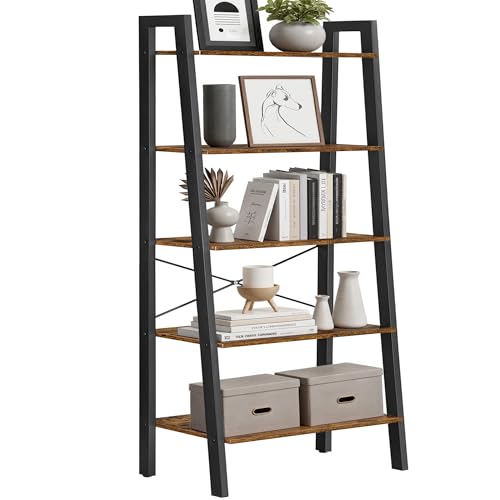
VASAGLE Ladder Shelf, Bookcase Book Shelf, Storage Shelves, 5-Tier, 22In
Included for 'Ladder Shelves for the Living Room: Sizing, Styling, and Safety' because the listing specifies Bookcase Book Shelf and Storage Shelves, details this guide uses to compare options.
View on Amazon
VASAGLE Ladder Shelf, Bookcase Book Shelf, Storage Shelves, 4-Tier, 22In
Included for 'Ladder Shelves for the Living Room: Sizing, Styling, and Safety' because the listing specifies Bookcase Book Shelf and Storage Shelves, details this guide uses to compare options.
View on AmazonThe Leaning Geometry: Why Measurements Matter More Than Height
Unlike a vertical bookcase, a ladder shelf does not sit flush against the wall. The top rests against or within an inch of the wall, while the feet sit out into the room. This creates a triangular footprint that affects placement, traffic flow, and what you can store on each tier.
For a common 70 to 72-inch tall ladder shelf with 4 to 5 tiers:
- Floor depth needed: 15 to 18 inches from the wall to the front of the feet, even though the bottom shelf may only be 12 to 14 inches deep. The extra depth is the lean angle.
- Wall contact point: Usually 67 to 71 inches high, often with rubber bumpers or a wall anchor bracket at the top rail.
- Shelf taper: Bottom shelf 12 to 14 inches deep, middle shelves 9 to 10 inches, top shelf 7 to 8 inches deep. This taper is intentional for stability and sightlines.
- Width: Most single ladder shelves are 22 to 26 inches wide. Wide or double ladder units are 38 to 48 inches but are essentially two ladders with shared supports.
That taper directly limits what fits where. A 12-inch deep bottom shelf will hold standard hardcovers, large baskets, and a 10-inch storage bin. A 7-inch top shelf will only hold paperbacks spine-out, small plants in 4-inch pots, or framed 5×7 photos — not a large vase or stack of books.
How Much Room Does It Actually Need in a Living Room?
Plan for more than the unit’s footprint. You need clearance for safety and visual balance.
| Shelf Height | Floor Depth (Feet to Wall) | Bottom Shelf Depth | Top Shelf Depth | Recommended Clearance |
|---|---|---|---|---|
| 58-60 inches (3-4 tier) | 12-14 inches | 11-12 inches | 7-7.5 inches | Leave 30 inches for walkways; 14-18 inches between shelf side and sofa arm |
| 70-72 inches (5 tier) | 15-18 inches | 12-14 inches | 7-8 inches | Leave 36 inches if opposite a TV; keep 4-6 inches of wall visible on each side |
| 78-84 inches (5-6 tier) | 18-22 inches | 13-15 inches | 7.5-8.5 inches | Needs 9 ft ceiling; avoid placing under low window trim or near ceiling fans |
In a typical 10×12 ft living room, a single 24-inch wide ladder shelf works well on the narrow wall beside a 78 to 84-inch sofa without crowding. Place it so the bottom front foot is at least 18 inches from a doorway swing and not directly behind a door. If your sofa is 34 to 38 inches deep, the ladder shelf’s 15-inch footprint will still allow a 30-inch passage between the sofa’s front and a coffee table opposite.
Renters should also measure baseboards and molding. Thick baseboards (over 0.75 inches) can prevent the top from sitting close to the wall, increasing the lean and the floor depth by another inch. A thin felt spacer behind the top rail solves this without stressing the frame.
Weight Limits: The Top Shelves Hold Less Than You Think
Ladder shelves are display shelves, not library shelves. Weight capacity decreases significantly as you go up, because upper tiers are shallower, cantilevered farther from the vertical supports, and bear more leverage on the lean.
Typical weight ratings for a well-built ladder shelf in 2026:
- Bottom shelf: 30 to 50 lbs total, can hold a basket of throws, 12 to 15 books, or a 15-lb ceramic stool.
- Middle shelves (2nd and 3rd): 20 to 30 lbs per shelf. Suitable for 8 to 10 books, a small speaker, or a medium plant.
- Top two shelves: 10 to 15 lbs per shelf. Limit to 3 to 5 books, one small plant, or decor under 8 lbs. Never place a heavy potted plant or stack of hardcovers here.
- Total unit capacity: Usually 90 to 150 lbs across all shelves combined, depending on material.
Exceeding upper-tier limits is the most common cause of tipping forward and joint failure. Wood screws and dowels on tapered shelves pull out faster under load than the dado joints used in boxed bookcases. If you need to store a full book collection, choose a 4-sided bookcase with a 40+ lb per-shelf rating instead.
Material and Construction Trade-Offs
| Construction Type | Typical Price Range | Weight Limit Per Shelf | Pros | Cons |
|---|---|---|---|---|
| Solid wood (rubberwood, acacia, oak) | usually $180–$400 | 25–40 lbs | Strong joints, can be refinished, holds screws well for anchoring | Heavier to move (35–55 lbs boxed), can warp in dry or humid rooms |
| Engineered wood (MDF/particleboard with veneer) | usually $70–$180 | 15–25 lbs | Lightweight, affordable, smooth finish | Sags under books over time, vulnerable to moisture, anchoring screws strip easily |
| Metal frame with wood or MDF shelves | usually $120–$300 | 20–35 lbs | Most stable lean, slimmest profile, best for modern/industrial rooms | Visible welds, can scratch floors if feet lack pads, shelves may rattle |
| Bamboo | usually $100–$250 | 20–30 lbs | Light and sustainable, good for plants due to moisture resistance | Joint cracking if over-tightened, limited color options |
For living rooms with kids, pets, or daily use, a metal frame with solid wood shelves offers the best balance of stability and durability. Engineered wood is fine for light decor in a low-traffic corner, but avoid placing it near a humidifier, radiator, or sunny window where veneer can peel.
Safety: Why Every Lean-To Needs an Anchor
A ladder shelf relies on gravity and friction. Without a wall anchor, a climb, a pull, or an uneven load on the top shelf can make it slide or tip forward. This is a higher risk than with a freestanding bookcase because the center of gravity is intentionally off the wall line.
Anti-tip anchoring is not optional, even for light use:
- Always use the included L-bracket or strap. Secure it into a wall stud or use a proper drywall anchor rated for 50+ lbs shear. The anchor point should be in the top third of the unit, not at the feet.
- Renters: If you cannot drill, choose a ladder shelf with a weighted base or place a 10 to 15-lb weight (like a covered storage bin with blankets) on the bottom shelf to lower the center of gravity, and use removable anti-slip furniture straps rated for bookcases. Do not rely on leaning alone.
- On carpet or rugs: Add non-slip rubber pads under the front feet. Plush carpet increases the lean angle and makes sliding more likely.
- Level the feet. If the floor is uneven, one foot will rock. Use adhesive leveling shims rather than folding paper, which compresses.
Assembly and moving realities: Most ladder shelves ship flat in one box weighing 28 to 45 lbs and require 30 to 60 minutes of assembly with a hex key and Phillips screwdriver. Box dimensions are typically 55 to 75 inches long, so measure doorways (standard interior is 30 inches) and elevator depth before delivery. The weak points over time are the side-rail bolts and the shelf pins — retighten them after the first month as wood settles.
Styling a Ladder Shelf So It Looks Built-In
The tapered shape is visually lighter than a bookcase, which makes it ideal for living rooms where you want storage without blocking light. Style by weight, not just by object.
- Bottom shelf: Heaviest visual weight. Use a closed basket (13 x 11 inches fits most units) for throws or toys, or a stack of 3 large coffee table books.
- Eye-level shelves (usually the 2nd or 3rd): Place what you see most. One framed photo, one vertical object like a vase, and one small horizontal stack. Leave 30 to 40% of the shelf empty so the wall shows through.
- Top shelf: Lightest and smallest. A single trailing pothos or a small ceramic object is enough. Avoid a row of tiny items that looks cluttered from below.
- Color: In a light living room, a walnut or black metal ladder adds contrast without visual bulk. In a small room with a light sofa, match the shelf to the wall color (white, natural oak) to make it recede.
Keep ladder shelves 4 to 6 inches away from floor lamps and 12 inches from radiators or fireplace surrounds. The open back means cords show — run a cable clip down the rear leg if you place a lamp on a shelf.
Which Ladder Shelf Is Right for Your Situation?
| Your Situation | Best Choice | Why |
|---|---|---|
| Small apartment / 10×12 ft living room | Single 70-inch, 24-inch wide metal + wood ladder shelf | 15-inch footprint preserves walkway; vertical storage without bulk |
| Need book storage for 50+ books | Skip ladder shelf, choose 5-shelf vertical bookcase | Ladder shelf top tiers cannot safely hold book weight; sag risk |
| Kids and pets at home | Metal frame, solid wood shelves, wall-anchored | Most tip-resistant; metal resists chewing/scratching; anchoring is essential |
| Renter who cannot drill | Shorter 58-inch ladder shelf with weighted bottom or freestanding etagere | Lower height lowers tipping leverage; weight on bottom compensates for no anchor |
| Display for plants and decor only | Taller 72-78 inch bamboo or wood ladder shelf | Shallow top shelves ideal for small pots; tarp or tray needed for watering |
Before you order, check three numbers on the listing: total height, bottom shelf depth, and per-shelf weight limit. If a listing does not show per-shelf limits and only shows total capacity, assume the top two shelves are rated at half the bottom shelf rating and plan accordingly.
FAQ
Can a ladder shelf hold a TV?
No. Ladder shelves are not rated for TVs. The shallow depth and lean create an unstable base, and the weight is concentrated on the front edge. Use a low media console 18 to 22 inches high instead.
Do ladder shelves damage walls?
They can leave scuffs or two small screw holes from the anti-tip bracket at the top. Rubber bumpers prevent most scuffs. Filling two screw holes with spackle is standard when you move, and is far less costly than repairing damage from a tip-over.
How do I keep it from looking cluttered?
Limit each shelf to 3 to 5 objects and vary height. Use one closed basket on the bottom to hide clutter, and keep book stacks to fewer than 6 inches high on tapered shelves so they don’t overhang the edge.