Key takeaways
- The right storage boxes for under bed come down to one subtraction: your bed’s clearance minus the box’s exterior height equals the room you have to spare. Get the exterior height wrong and the lid jams, so measure the lowest…
The right storage boxes for under bed come down to one subtraction: your bed’s clearance minus the box’s exterior height equals the room you have to spare. Get the exterior height wrong and the lid jams, so measure the lowest point under your bed first.
How to Choose Under-Bed Boxes
Pick under-bed boxes by their exterior height against your real clearance, not by the capacity on the label. Measure the lowest point beneath the frame, subtract the box height, and you know whether a box slides in and the lid closes, which is the test wheels, lids, and capacity all come second to.
Measure the Lowest Point
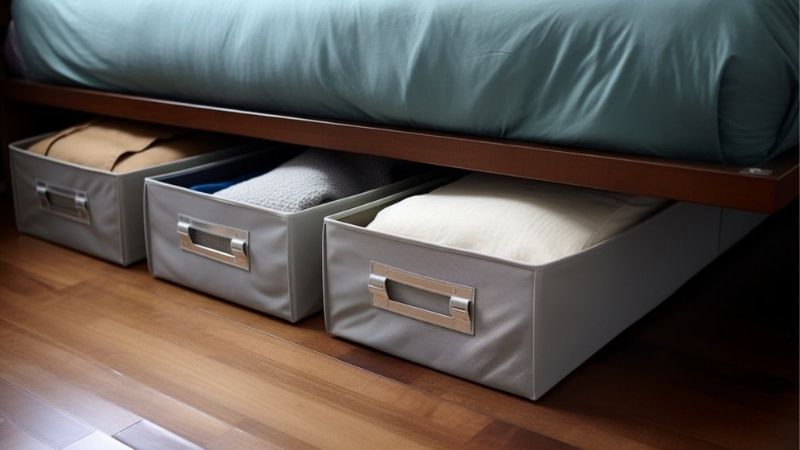
Start by measuring the clearance at the lowest point under your bed, which is often a center rail or slat rather than the side you can see. That lowest obstruction, not the gap at the edge, sets your real ceiling, so measuring only the side of the frame is the mistake that leaves a box stuck halfway.
Use the smallest clearance you find as your limit, because a box that clears the edge can still hit a center support partway in. For example, at a 7-inch clearance a 5.875-inch box like the Sterilite leaves about 1.125 inches to spare, while a 7.5-inch box simply will not fit, so the measured number decides everything.
Write the clearance down and subtract a small buffer for carpet, casters, or an uneven floor before you shop. Treating the measured low point as a hard ceiling, rather than rounding up optimistically, is what keeps the box sliding smoothly under the bed instead of scraping or refusing to go in at all.
Exterior Height
Exterior height is the spec that defines this category, and the figures here spread enough to matter. Sterilite lists the 28-quart 4246 at 5.875 inches tall, IRIS lists the 40-quart 170291 at 6.3 inches, Target lists the Brightroom 60-quart wheeled at 7 inches, and IKEA lists the SOCKERBIT at 7.5 inches, all exterior.
That roughly 1.6-inch range is the difference between fitting and not fitting under a low frame, so match the exterior height to your measured clearance rather than the capacity. A taller box holds more but needs more clearance, which is why the shortest box is not automatically the best, nor is the biggest capacity.
Always use the exterior height with the lid installed, since a lid can add height a bare-bin figure hides. The quoted figures here are exterior with the lid on where stated, so compare like for like and confirm whether a listing’s height includes the lid before you trust it against your clearance.
Wheels Versus a Flat Base
Wheels change both access and height, so weigh them against your clearance budget. The Brightroom 60-quart rolls on wheels at a 7-inch exterior height, which makes a full, heavy box easy to pull out, but those wheels are part of that height and eat into a low clearance a flat-based box would clear.
Wheels suit deep storage you retrieve often or heavy contents you would rather roll than drag, and they help on carpet where a flat box snags. The trade-off is that the wheel height counts against your clearance, so a wheeled box needs a taller gap than a flat box of the same body to slide underneath.
If your clearance is tight, a flat-based box like the Sterilite or IRIS uses every inch for storage rather than for casters. Decide whether easy rolling or maximum body height matters more for your bed, since both are valid depending on how low the frame sits and how often you pull the box out.
Lid and Dust Protection
A lid keeps dust off stored items, which matters under a bed where airflow is low and dust gathers. The boxes here with installed lids, like the Sterilite and the IKEA SOCKERBIT, seal contents from the dust that settles in that space, protecting linens and clothing you may not touch for months at a time.
Weigh lid type against access, since a fully sealing lid protects best but a flip or partial lid is faster to open for things you reach often. For seasonal storage you rarely disturb, a secure lid is the priority; for items you grab weekly, an easier-opening lid can be worth a small trade in dust sealing.
Remember the lid is part of the exterior height, so a sealed box may sit taller than a lidless bin of the same body. Confirm the quoted height includes the lid, because a dust-tight seal is only useful if the closed box still clears your bed, which brings the decision back to that measured low point.
Best Under-Bed Storage Boxes
Each pick below leads with its exterior height, the spec that decides whether it fits your clearance, alongside capacity and base type. Match the height to the low point you measured; the prices vary by retailer, so check the current price and confirm the fit before you buy these storage boxes for under bed.
| Product | Best For | Key Spec | Watch Out For |
|---|---|---|---|
| Sterilite 28 Qt 4246 | Best for low clearance | 5.875 in tall; 28 qt; flat base; lid on | Lowest capacity of the four |
| IRIS 40 Qt 170291 | Best height-to-capacity balance | 6.3 in tall; 40 qt; 28.5×18 in footprint | Needs ~6.3 in-plus clearance |
| Brightroom 60 Qt Wheeled | Best capacity with wheels | 7 in tall; 60 qt; wheeled base | Wheels add to the height budget |
| IKEA SOCKERBIT | Best for higher beds | 7.5 in tall; 30.25×19.75 in; lid on | Too tall for low 7-in clearance |
Sterilite 28 Qt 4246 – Best for Low Clearance
The Sterilite 28-quart 4246 is the pick for tight gaps, at 5.875 inches tall with the lid installed, measuring 23.125 by 16.625 inches on the floor. At a 7-inch clearance it leaves about 1.125 inches to spare, the most breathing room of any box here, which makes it the safest choice under a low frame.
Its low profile and flat base use the clearance for storage rather than casters, and the 28-quart capacity suits linens, out-of-season clothing, or shoes. For beds that sit close to the floor, this is the box most likely to slide in and let the lid close without scraping the frame above it.
The trade-off is capacity: at 28 quarts it holds the least of the four, so you may need more boxes to store the same volume as a taller bin. Confirm its height against your measured low point, decide whether you want more smaller boxes, and check the current price at the retailer before buying.
IRIS 40 Qt 170291 – Best Height-to-Capacity Balance
The IRIS 40-quart 170291 strikes the balance between fitting and holding a lot, at 6.3 inches tall with a 28.5 by 18-inch footprint and 40-quart capacity. It needs a bit more clearance than the Sterilite but rewards it with meaningfully more storage, which suits most standard bed frames well.
At a 7-inch clearance it leaves about 0.7 inches of margin, enough to slide in on a flat base while carrying far more than the shorter box. For a frame with average clearance, the IRIS is often the sweet spot, giving usable capacity without demanding the extra height a wheeled or taller bin requires.
The caveat is that its 6.3-inch height needs a frame with a bit over that to clear comfortably, so very low beds should step down to the Sterilite. Measure your low point against the 6.3-inch figure, leave a small clearance buffer, and check the current price at the retailer before you decide.
Brightroom 60 Qt Wheeled – Best Capacity With Wheels
The Target Brightroom 60-quart wheeled box is the capacity champion, at 7 inches tall on a wheeled base holding 60 quarts. The wheels make a full, heavy box easy to pull out from under the bed, which is a real advantage for deep storage you retrieve occasionally but do not want to drag.
That 60-quart volume swallows bulky bedding or a season’s worth of clothing in a single box, and the casters earn their keep on carpet where a flat box would snag. For a bed with generous clearance, the combination of big capacity and easy rolling access is hard to beat among these options.
The catch is the height budget: at a 7-inch clearance it leaves essentially no margin, because the wheels are part of that 7-inch figure, so it needs more than 7 inches to roll freely. Confirm your clearance comfortably exceeds 7 inches, and check the current price at the retailer before buying.
IKEA SOCKERBIT – Best for Higher Beds
The IKEA SOCKERBIT is the pick for beds with ample clearance, at 7.5 inches tall with the lid on and a 30.25 by 19.75-inch footprint. Its larger body and generous floor dimensions make it a roomy choice when height is not your constraint and you want a clean, lidded look under the bed.
The sizable footprint stores wide, flat items like folded bedding well, and the installed lid keeps dust off contents in that low-airflow space. For platform beds on risers or taller frames, the extra body height translates into real storage you cannot get from the shorter boxes meant for low clearances.
The clear limitation is height: at 7.5 inches it will not fit a 7-inch clearance, so it is strictly for higher beds and should be matched carefully to your gap. Confirm your clearance exceeds 7.5 inches with a buffer, verify the height includes the lid, and check the current price at the retailer before buying.
Get More From Under-Bed Storage
Choosing the right box is step one; using the space well is the rest. Thinking about footprint, matching the box to its contents, weighing plastic against fabric, and considering bed risers all stretch what under-bed storage can do once you have the exterior height matched to your clearance.
Footprint
Beyond height, the floor footprint decides how much of the under-bed space you actually use. A box like the IKEA SOCKERBIT at 30.25 by 19.75 inches covers a lot of ground, while a smaller footprint leaves gaps, so plan how your chosen boxes tile the rectangle under the bed to avoid wasted space.
Measure the length and width of the usable area, not just the clearance, and check that your box footprints fit around center legs or supports. A couple of well-sized boxes often use the space better than several small ones, since fewer gaps mean more of the floor under the bed turns into real storage.
Also leave room to slide boxes in and out without catching on the frame, which the footprint affects. A box that fills the space edge to edge can be awkward to retrieve, so balance maximizing the footprint against keeping access easy, especially for boxes you expect to pull out with any regularity.
Shoes Versus Linens
Match the box to what you are storing, because shoes and linens want different things. Flat, wide boxes suit folded linens and clothing, spreading them without crushing, while a slightly deeper box handles shoes or bulkier items better, so the contents can point you toward height and footprint as much as the clearance does.
For linens you rarely touch, a sealed, lidded box like the Sterilite or SOCKERBIT keeps dust off over long storage, which matters for bedding you only swap seasonally. For shoes you reach often, an easier-opening or wheeled box makes retrieval less of a chore, so weigh access against protection for each type of item.
Grouping contents by how often you need them also helps: everyday items in the easiest-access box, seasonal items in the sealed one pushed furthest back. Sorting this way before you buy tells you how many boxes of which type you need, rather than buying identical bins and sorting it out later.
Plastic Versus Fabric
Plastic and fabric under-bed boxes each have a place, so choose by durability and contents. The rigid plastic bins here, from Sterilite, IRIS, Brightroom, and IKEA, hold their shape, stack, and seal against dust, which suits long-term storage and anything you want protected from moisture and crushing under the bed.
Fabric boxes are lighter and can flex into odd spaces, but they offer less structure and dust protection, and they can sag under weight, so they suit light, soft contents more than heavy or delicate ones. For most under-bed storage where dust and stackability matter, a rigid plastic box is the more dependable choice.
If you do use fabric for lightness, keep it to clothing or linens rather than heavy or sharp items that can distort it. Matching the material to the contents and the conditions under the bed, where dust and low airflow are the norm, keeps your stored items in better shape over the long term.
Bed Risers
If your clearance is simply too low for the boxes you want, bed risers add height and open up taller options. Lifting the frame a few inches can turn a bed that only fits the 5.875-inch Sterilite into one that accepts the 7.5-inch SOCKERBIT, effectively buying you more storage without changing the bed.
Choose risers rated for your bed and total weight, and confirm they add enough height for the box you have in mind plus a buffer. Remember that raising the bed also raises the sleeping surface, which may affect how easy the bed is to get into, so weigh the extra storage against that change in height.
Risers are the practical workaround when the clearance, not the room, is your limit, and they let you use taller, higher-capacity boxes. Re-measure the new clearance after installing them, since the whole point is to match the gap to the exterior height of the storage boxes for under bed you actually want.
Final Thoughts
The best storage boxes for under bed are the ones whose exterior height clears your measured low point with a little to spare, matched to the contents you need to store. Compare the Sterilite, IRIS, Brightroom, and SOCKERBIT on height and capacity, subtract the box height from your clearance, add risers if the gap is tight, and check the current price.