Key takeaways
- Before buying more bins, the best storage ideas for stuffed animals often start with fewer animals — rotating or thinning the collection solves half the clutter for free. For what stays, this guide picks storage a child can reach and…
Before buying more bins, the best storage ideas for stuffed animals often start with fewer animals — rotating or thinning the collection solves half the clutter for free. For what stays, this guide picks storage a child can reach and that cannot tip, judged by accessibility per floor footprint and safety.
As an Amazon Associate we earn from qualifying purchases.
By KK Home Furnishings Editorial Team
Easy Stuffed Animal Storage Ideas
The simplest fixes keep favorites within a child’s reach and off the floor without a big footprint. Each idea here balances accessibility against the space it takes, and keeps safety in mind, since a kid’s room is no place for a tip-over risk. The table lists size, cost tier and effort to match an idea to your room.
| Idea | Space or Size Needed | Cost Tier | Effort and Time |
|---|---|---|---|
| Low open bins at kid height | ~39 in wide; low | Budget–mid | Under an hour |
| Toy hammock in a corner | Corner; wall anchors | Budget | Under an hour; drilling |
| Wall ledges or picture rails | Wall; shallow | Budget | Under an hour; drilling |
| A narrow floor unit | ~12 in wide spot | Budget | Minutes to assemble |
| Tall bin unit, wall-anchored | ~39 in wide; 37 in tall | Mid | An hour; anchor to wall |
| Under-bed roll-out bins | Under-bed clearance | Budget | Minutes |
| Bean-bag storage cover | One floor spot; seat too | Budget–mid | Minutes |
| Rotation bin in the closet | Shelf or closet space | Budget | Minutes |
Keep Favorites in Low Open Bins
Open bins at a child’s height make tidying something kids can actually do. A low TROFAST unit, about 39 inches wide and 22 inches tall with six boxes, puts storage at reach so animals get put away instead of piled. Open bins beat lidded ones here, since a lid is one more step a young child skips.
Place it along a wall where it does not block play space, and let the child own a bin or two. The low height keeps it stable and reachable, which is the point for a kid’s room. For the biggest collections, pair open bins with a rotation habit so the bins hold the current favorites, not every animal at once.
Hang a Toy Hammock in a Corner
A corner hammock or net lifts soft toys off the floor into dead space. Strung across a corner at a height a child can still reach the lower part, it holds a surprising number of plush animals while clearing the floor for play. It uses no footprint at all, just two walls and the corner between them.
Anchor the hooks into studs or with proper wall anchors, since a loaded net pulls harder than it looks. Keep it low enough that a child is not climbing to reach it, which avoids falls and loosened anchors. A hammock suits lightweight plush, not heavy toys, so keep hard items out of it.
Line Up Favorites on Wall Ledges
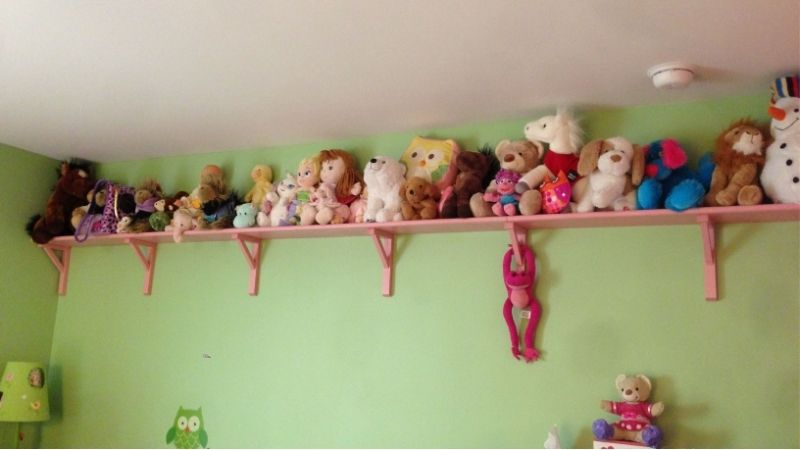
Narrow wall ledges or picture rails turn a blank wall into a display shelf for favorites. A shallow ledge holds a row of stuffed animals at a height that clears the floor and the furniture, doubling as decor. It keeps the most-loved animals visible and off the bed without claiming any floor space in the room.
Mount ledges into studs and keep them above a toddler’s climbing reach but low enough for an older child to use. Keep the load light and the ledge shallow so animals do not topple onto the floor or a child below. This suits display of a chosen few, not bulk storage, so pair it with bins for the rest.
Corral Them in a Narrow Floor Unit
A slim floor unit fits where a wide one cannot. A narrow TROFAST in pine, about 12⅝ inches wide and 20½ tall, tucks beside a bed or in a corner and holds a focused set of animals in a small footprint. Its low, narrow build keeps it stable and within a young child’s reach for independent tidying.
Use it where floor space is scarce, giving each child or each type of toy its own slim column. Keep heavier items low for stability. As with any kid’s storage, open or easy-lid bins get used more than fussy closures, so match the unit to how your child actually puts things away rather than how it looks arranged.
Higher-Capacity Stuffed Animal Storage Ideas
When the collection is large, these ideas hold more — but capacity brings a safety duty, since taller and fuller storage must not tip. Each still aims to keep animals accessible, and anchoring is non-negotiable on anything tall in a child’s room. Match the capacity to the collection you keep after a rotation.
Add a Tall Bin Unit, Anchored to the Wall
For a big collection, a tall bin unit multiplies storage on a modest footprint. A tall-wide TROFAST, about 39 inches wide and 37 inches tall, holds far more than a low unit while keeping the bins sorted by type. The higher boxes suit an adult or older child; keep the lowest for the youngest to reach.
A unit this tall must be anchored to the wall. Free-standing storage 27 inches or taller falls under tip-over safety guidance [CPSC, 2023], and a child climbing the bins to reach the top is exactly the hazard it addresses, so use the included strap into a stud and keep the heaviest bins at the bottom.
Slide Bins Under the Bed
Under-bed space is ideal for off-rotation animals. Low roll-out bins use the clearance beneath a bed — often 6 to 12 inches — to store the toys not in current use, out of sight but easy to swap in. It adds real capacity without any new footprint, using space the room already has going spare underneath.
Measure the under-bed clearance against the bin height first, since a tall tote will not slide under a low frame. Lidded bins keep dust off stored plush, and labeling helps with rotation. This pairs perfectly with thinning the active set: favorites stay out, the rest wait underneath, and the floor stays clear.
Use a Bean-Bag Storage Cover
A stuffed-animal bean-bag cover turns the collection into a seat. You fill an empty bean-bag shell with soft toys, which stores a large number in one floor spot while doubling as a kid-sized chair. It is a clever use of bulky plush, though it only works for soft items, not hard toys that would be uncomfortable.
It suits a big, soft collection and a child who will sit on it, keeping animals contained and usable at once. Check the zipper is child-safe and the cover is a sturdy fabric, since it takes sitting. It is storage and seating in one footprint, so it suits the overflow more than daily favorites.
Rotate the Collection Through a Closet Bin
The most space-saving idea is to store most of the collection out of the room entirely. A single bin on a closet shelf holds the off-duty animals, and you swap a few in and out every week or two. This keeps the room’s open storage small, since it only ever holds the current favorites, not the whole menagerie.
Rotation also renews interest, since a returning animal feels new, which can reduce the urge to acquire more. Keep the stored bin breathable and labeled, and involve the child in choosing what comes out. Before buying any more storage, try rotation first, since it often solves the clutter without a single new organizer.
Frequently Asked Questions
Parents ask the same things about stuffed-animal storage: how to make kids actually use it, whether open or lidded is better, how to keep tall units safe, and what to do about an ever-growing pile. The answers below use the sizes above and lean on rotation as much as on buying more bins.
How Do I Get Kids to Put Animals Away?
Make it a one-step job at their height. Low, open bins a child can reach and toss animals into get used; lidded, high or fiddly storage does not. Give each bin a simple purpose a child understands, and keep the active collection small enough to fit easily, since an overflowing bin discourages tidying more than it helps.
Keep the number of animals in the room manageable through rotation, so putting away is quick. Involve the child in sorting and labeling, which builds the habit. The storage that works is matched to a child’s reach and attention span, not the one that looks neatest arranged for a photo.
Open Bins or Lidded Boxes?
For daily use by children, open bins win. A child drops an animal into an open bin in one motion, while a lid adds a step that young kids skip, so the floor stays cluttered. Reserve lidded boxes for off-rotation animals stored under the bed or in a closet, where dust protection matters more than access.
If you want a tidier look with lids, choose easy, soft-close or handled lids a child can manage, and keep them for the overflow rather than daily favorites. Match the closure to who uses it: open for the child’s active set, lidded for the stored rest, to suit how often each is reached.
How Do I Keep Tall Toy Storage Safe?
Anchor anything tall to the wall. Free-standing storage 27 inches or taller can tip if a child climbs it, so units like a tall bin tower need the included strap into a stud, with the heaviest bins kept low. A child reaching for a top bin is the exact scenario tip-over safety guidance addresses, so never skip the anchor.
Keep frequently used animals in the lower, reachable bins so a child has no reason to climb, and reserve high bins for adult-access overflow. Check the anchor after moves and as the child grows. Favor lower, wider units in a young child’s room, since a low footprint avoids the climbing-and-tipping risk.
What If There Are Just Too Many?
Thin the collection before adding storage. Rotation — keeping a few out and the rest boxed away — solves most plush overload without another bin, and it renews interest in the ones that return. Involve the child in choosing keepers and donating duplicates, which handles the root cause rather than just containing it.
If the pile is still large after rotating, add capacity that stays safe: under-bed bins for the off-duty set, an anchored tall unit, or a bean-bag cover for soft overflow. But try reduction first, since the cheapest and tidiest storage is the animals that are not in the room at all.
Final Thoughts
The best storage ideas for stuffed animals start with fewer animals: rotate or thin the collection first, then store what stays where a child can reach it and nothing can tip. Keep daily favorites in low open bins, send the overflow under the bed or into a closet rotation, and anchor anything tall to the wall.