Key takeaways
- A desk chair with leg rest needs floor space most buyers forget: the reclined footprint, which can run close to double the upright depth. This guide compares chairs by that upright-to-reclined depth, plans the full reclined envelope, and treats recline…
A desk chair with leg rest needs floor space most buyers forget: the reclined footprint, which can run close to double the upright depth. This guide compares chairs by that upright-to-reclined depth, plans the full reclined envelope, and treats recline angle and footrest as fit features, not ergonomic guarantees.
As an Amazon Associate we earn from qualifying purchases.
By KK Home Furnishings Editorial Team
How to Choose a Desk Chair with Leg Rest
A reclining desk chair is judged less by its seat than by the room it needs when you lean back. The footrest and recline turn a compact chair into a long one, so the reclined depth is the decisive measurement. Four things decide the buy: upright-to-reclined depth, the footrest, recline and adjustment, and support claims.
Plan the Reclined Depth, Not Just Upright
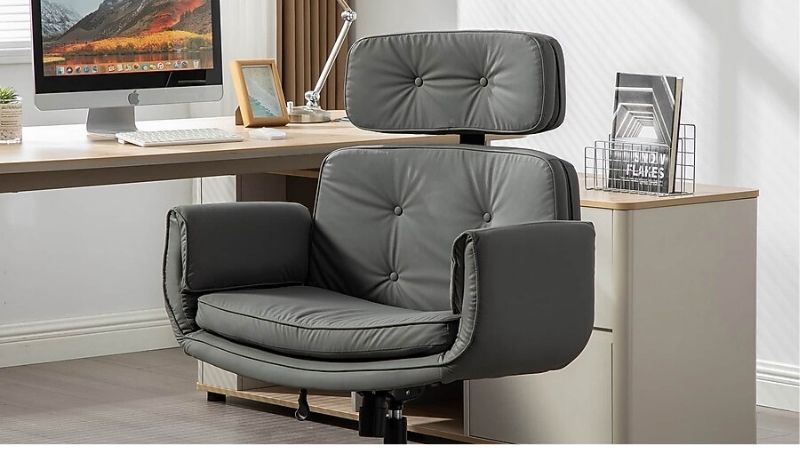
The number buyers miss is how far the chair reaches when reclined. A Latitude Run reclining chair, for example, extends from about 28.3 inches deep upright to 57.75 inches reclined — roughly double. That reclined figure, not the upright one, is what has to clear the wall, a bed or a sofa behind the desk when you lean back.
Measure the space behind the chair before buying. If the desk sits against a wall, the reclined depth has to fit between the seat and that wall; in a room, it needs clearance so the footrest does not hit furniture. Map the full reclined envelope, since a chair that fits upright can be unusable once it actually reclines.
This clearance also affects how the chair ages and how you use it. A reclined chair jammed against a wall gets stopped short or knocks the wall, straining the mechanism over time. Leaving room for the full recline protects both the chair and the wall, so treat the reclined depth as the real footprint when you plan the room.
Check the Footrest Type
Leg rests differ, so confirm what you are getting. Some chairs have a built-in footrest that extends with the recline, like a Latitude Run model that reclines and raises a leg rest together, while others use a separate pull-out ottoman. A built-in rest keeps the footprint predictable; a separate ottoman adds its own floor space.
Match the footrest to how you will use the chair. A built-in rest that moves with the recline suits quick breaks at the desk; a separate ottoman suits longer lounging but must be stored under or beside the desk. Check whether the footrest locks at positions or only when fully reclined, since that changes its everyday usefulness.
The footrest and its mechanism are common wear points on a reclining chair. A built-in leg rest adds linkages that can loosen or stick over time, so favor a model whose mechanism feels solid and whose maker offers parts. A separate ottoman has nothing to fail but is easy to misplace, so weigh simplicity against the comfort.
Recline Angle and Adjustment
Recline range sets how far back you can go, but more is not automatically better. A chair listing around a 155-degree recline lies nearly flat, which suits a nap but is not more ergonomic for working. Seat height adjustment — a range like roughly 19.7 to 22.8 inches — matters more for day-to-day desk posture than the maximum angle.
Match the adjustments to your desk and your use. Set the seat height so your forearms rest level at the desk, and use the deep recline for breaks rather than typing. A chair that only reclines far but does not adjust seat height well can force a poor working posture, so prioritize the adjustments you will use while actually working.
Adjustment hardware is where reclining chairs fail quietly. A recline lock that slips, a tilt that creeps, or a leg-rest that will not stay are common long-term complaints and are hard to repair. Favor a model with solid, lockable adjustments and available parts, since a reclining chair has more moving parts to wear than a basic one.
Judge Support Claims Carefully
Capacity and comfort claims on reclining chairs are often inconsistent, so treat them with care. Some listings state conflicting weight capacities — one Latitude Run model shows both 250 and 265 pounds, and an Inbox Zero listing shows figures from 277 up to 400 — so an unresolved number should not be the spec you rely on.
Where a capacity figure conflicts within a listing, treat it as unverified and judge sturdiness by the frame, base and mechanism instead, or confirm the figure with the seller. Count your real load against the lower figure if you must, not the highest. A conflicting number is a reason to verify, not to assume the best case.
Avoid reading comfort into a recline angle or a plush look, and skip any health claim. A chair may suit long sitting, but that depends on fit and adjustment, not a big angle, and no desk chair cures back trouble — see a professional for that. Favor verifiable build and adjustment over marketing about ergonomics or wellness.
Top Picks
Four reclining desk chairs show the trade-offs, led by models with the clearest footprint and footrest data. Reclined depth and the footrest separate them; conflicting capacity figures do not drive the ranking. Each leans on manufacturer-stated specs and a tier, not a fixed price, and recline angle is read as fit, not ergonomics.
| Product | Best For | Key Spec | Watch Out For |
|---|---|---|---|
| Latitude Run W117060096 | Best overall for a planned footprint | 28.3 in upright; 57.75 in reclined | Reclined depth ~2× upright |
| Latitude Run W117260278 | Best for a built-in footrest | 155° recline; 19.7–22.8 in seat | Deep recline is not more ergonomic |
| Latitude Run W115728644 | Best for a simple reclining pick | Reclining with leg rest | Capacity listed 250 vs 265; verify |
| Inbox Zero W116602360 | Best for an adjustable option | Reclining desk chair | Capacity figures conflict; confirm |
Latitude Run W117060096: Best Overall for a Planned Footprint
For buyers who will actually plan the space, this Latitude Run chair publishes the number that matters: about 28.3 inches deep upright and 57.75 inches reclined. It reads mid tier for a reclining desk chair; prices move, so confirm the current price and map the reclined depth against the wall or furniture behind your desk.
Its strength is predictability: with the reclined depth stated, you can clear the full envelope before it arrives, which is exactly what a leg rest makes easy to underestimate. The near-doubling from upright to reclined is normal for the category, so reserve the floor for it rather than being surprised when you first lean back.
As with any reclining chair, the mechanism and leg rest are the wear points, so favor solid adjustments and available parts. Treat any capacity figure as manufacturer-stated and verify it if it conflicts. Keep the recline clear of the wall so the chair reaches its full travel without straining, which extends the mechanism’s life.
Latitude Run W117260278: Best for a Built-In Footrest
This Latitude Run model centers on a built-in leg rest, reclining up to about 155 degrees with a seat height adjustable from roughly 19.7 to 22.8 inches. It reads mid tier; verify the current price and the exact recline and footrest behavior, since how far the leg rest extends shapes the reclined footprint you must clear.
The built-in footrest suits quick reclined breaks without a separate ottoman, keeping the footprint contained, and the seat-height range is what you will use for working posture. Set the seat so your forearms rest level at the desk, and treat the 155-degree recline as a break position, not a working or inherently ergonomic one.
A built-in leg rest adds linkages that can loosen or stick over time, so favor a solid-feeling mechanism and check for replacement parts. Use the recline within the room’s clearance so the footrest does not hit furniture, which strains the linkage. Judge the chair by fit and adjustment, not the headline recline angle alone.
Latitude Run W115728644: Best for a Simple Reclining Pick
For a straightforward reclining desk chair with a leg rest, this Latitude Run model covers the basics. It reads budget-to-mid tier; confirm the current price and the dimensions, and note its listing shows conflicting weight capacities — 250 and 265 pounds — so treat the capacity as unverified rather than a figure to rely on.
It suits a buyer who wants recline and a footrest without complex adjustments, provided the reclined depth fits the room. Map that envelope before buying, since any reclining chair nearly doubles its depth. Where the capacity conflicts, judge sturdiness by the frame and base, and confirm the real figure with the seller if it matters.
With a simpler chair, the recline and leg-rest mechanism are still the parts to watch over time. Favor solid adjustments and available parts, and avoid loading it near the disputed capacity until confirmed. Keep the recline clear of the wall for full travel, and judge comfort by fit and adjustment rather than the look of the seat.
Inbox Zero W116602360: Best for an Adjustable Option
The Inbox Zero W116602360 is a reclining desk chair with a leg rest for buyers wanting adjustability. It reads mid tier; verify the current price, and note its listing shows capacity figures ranging from 277 to 400 pounds, which conflict, so do not rely on the highest number — confirm the real rating before trusting it.
It suits someone who wants recline, a footrest and adjustment in one chair, as long as the reclined footprint fits. Plan that envelope first, since the chair extends well beyond its upright depth. Given the conflicting capacity, count your real load against the lower figure or verify with the seller rather than assuming the top number.
As a more adjustable chair, it has more mechanisms to wear, so favor solid, lockable adjustments and check for parts. Keep the recline clear of furniture so the leg rest reaches full travel. Treat any ergonomic or comfort claim as marketing, judge the chair by verifiable build and fit, and see a professional for any back concern.
Frequently Asked Questions
Reclining-chair shoppers ask the same practical things: how much room a leg rest needs, whether a deep recline is more comfortable, how to read conflicting capacity figures, and whether a footrest hurts desk posture. The answers below use the stated depths and ranges above rather than comfort marketing on the listings.
How Much Space Does a Reclining Chair Need?
Plan for the reclined depth, which can be nearly double the upright figure. A chair about 28 inches deep upright can reach close to 58 inches reclined, so that extended number is what must clear the wall or furniture behind the desk. Measure the space behind the chair, not just under the desk, before buying a reclining model.
If the desk sits against a wall, confirm the reclined chair fits between the seat and the wall; in an open room, leave room for the footrest to extend without hitting furniture. A chair that fits upright but cannot fully recline in the space defeats the point of a leg rest, so reserve the full envelope from the start.
Remember the footrest or a separate ottoman adds to the footprint too. A built-in rest keeps it contained; a pull-out ottoman needs its own floor and storage. Map the whole reclined setup against the room, since the leg rest is exactly the feature that makes a compact-looking chair claim far more space than expected.
Is a Deeper Recline More Comfortable?
Not necessarily. A deeper recline, such as around 155 degrees, is good for a near-flat break but is not more ergonomic for working, and it demands more floor space. Comfort at the desk comes from seat-height adjustment and fit, not from the maximum angle, so do not choose a chair for the biggest recline number alone.
Use the deep recline for breaks and set the seat height for working posture, with your forearms level at the desk. A chair that reclines far but adjusts poorly can encourage a worse working position. Match the recline to how you will actually use it, and prioritize the everyday adjustments over the headline lie-flat angle.
No desk chair, however it reclines, fixes back trouble — that is a question for a professional, not a product spec. Treat recline and footrest as comfort-for-breaks features, judge working support by fit and adjustment, and avoid reading health benefits into a plush look or a big angle, since those claims are marketing, not evidence.
How Do I Read Conflicting Capacity Numbers?
Treat a conflicting figure as unverified. When a listing shows two or more capacities — say 250 and 265 pounds, or figures up to 400 — do not rely on the highest. Either confirm the real rating with the seller or judge sturdiness by the frame, base and mechanism, and count your load against the lower number if you must choose.
Capacity ratings are not standardized between makers anyway, so a big number is not proof of strength. Look at the base type, the cylinder and the frame for real durability signals. A chair with a clear, consistent rating and solid build is a safer bet than one quoting an impressive but contradictory figure you cannot verify.
If capacity genuinely matters for you, prioritize a model with a single, consistent, clearly stated rating over one with a disputed one, even if the disputed one looks higher. The conflict itself is a quality signal worth weighing, since a listing that cannot state its own capacity consistently is one to approach with extra caution.
Does a Footrest Hurt Desk Posture?
Not if you use it for breaks rather than working. A leg rest is for reclining away from the desk; for typing, set the seat height so your forearms rest level and your feet reach the floor. The footrest does not harm posture by existing — using the chair fully reclined while trying to work is what encourages a poor position.
Keep the working setup and the reclining setup separate in your mind: upright and adjusted for the desk, reclined with the leg rest for rest. A chair that supports both, with good seat-height adjustment and a stable recline, serves both uses. If back comfort is a real concern, prioritize adjustment and fit, and consult a professional.
Watch that the reclined position has room, since a footrest that cannot fully extend tempts awkward half-reclined working. Give the chair its full envelope so recline is a genuine break, not a cramped compromise. Used that way, a desk chair with a leg rest adds rest without costing you a sound working posture at the desk.
Final Thoughts
The right desk chair with leg rest is the one whose reclined depth fits the space behind your desk, not the one with the biggest recline angle. Measure the full reclined envelope before buying, set the seat for working and the recline for breaks, and treat conflicting capacity figures as unverified.