Key takeaways
- Most roll-top desks online are vintage or discontinued, so the real question is which ones you can actually buy new today and what that niche costs. This guide to a roll top desk for sale compares four current, buyable models…
Most roll-top desks online are vintage or discontinued, so the real question is which ones you can actually buy new today and what that niche costs. This guide to a roll top desk for sale compares four current, buyable models on genuine tambour construction, size, lead time and price, which runs from about $2,415 upward.
As an Amazon Associate we earn from qualifying purchases.
By KK Home Furnishings Editorial Team
What to Check Before Buying a Roll-Top Desk
The four checks below keep a roll-top purchase grounded: confirm it has a real tambour top, measure the writing surface and knee space, consider file storage and computer fit, and account for made-to-order lead time and delivery. This is a niche category, so these four examples illustrate the segment rather than the entire U.S. roll-top price range.
Verify that it has a real tambour/roll top
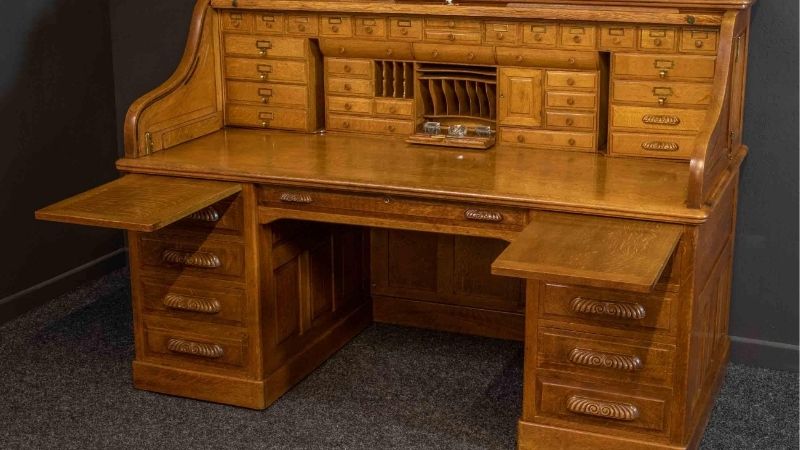
The defining feature is a working tambour, the slatted panel that rolls down to cover the desk, so confirm the listing shows a genuine roll top rather than a cabinet styled to look like one. All four picks here are real roll-tops, from the compact Franklin to the computer-oriented Publisher’s #2142 with its locking sliding tambour.
A true tambour lets you close the whole work surface in one motion, hiding clutter and, on locking models, securing it. The Publisher’s #2142 adds a lock to its sliding tambour, useful in a shared space, while simpler models roll closed without locking, so decide whether security or just concealment is the point before you choose.
Because many marketplace listings mix antique and reproduction pieces, verify the maker and construction rather than trusting a photo. These picks come from makers like Countryside Amish Furniture and DutchCrafters that build solid-hardwood roll-tops to order, a clear signal of a genuine new tambour desk.
Check writing-surface and knee-space dimensions
A roll-top’s usable work area is the writing surface and the knee space beneath, not just the overall footprint. The two Mission models both list a 30-inch writing surface, a comfortable depth for paperwork, while overall sizes run from the 42-by-22-inch single pedestal up to the 60-by-32-inch Publisher’s.
Measure the writing-surface depth against how you work: a 30-inch surface suits laptops, paperwork and a monitor, while a narrower one can feel cramped once the tambour pigeonholes take some depth. Knee space matters for comfort, so confirm the clearance under the desk fits your chair and legs before committing to a made-to-order piece.
Exact dimensions were not published for every model, so the Franklin’s footprint is not fully specified in the retrieved data, which means overall size cannot be ranked cleanly across all four. For the three with complete figures, floor footprints range widely, so measure your room and the delivery path for a large, heavy hardwood desk.
File storage and computer accommodation
Storage layout varies, so match it to your work. The Mission roll-tops offer drawers and pigeonholes for paperwork, while the Publisher’s #2142 is explicitly computer-oriented, built to house a monitor and gear behind its sliding tambour. If you work mostly on a computer, a model designed around that use avoids forcing a screen into a paper-era cabinet.
File drawers that accept hanging folders are worth confirming if you keep paper records, since not every roll-top includes letter or legal file storage. For a computer setup, check cord routing and whether the tambour clears a monitor when closed, because a tall screen can prevent the top from rolling shut on a desk built for papers.
The pigeonholes and small drawers that define the roll-top look are great for organizing, but they consume depth, so a desk that looks spacious can have a modest clear work zone. Decide how much of your work is paper versus screen, then pick the model whose storage and computer accommodation match, rather than buying on appearance alone.
Made-to-order lead time and delivery
These are largely made-to-order, solid-hardwood desks, so lead time and delivery are part of the purchase. The Mission models are built to order with hardwood options, and the Publisher’s #2142 lists a stated $150 delivery and setup charge on top of its price, so budget both the wait and the freight for a heavy piece.
Custom construction means weeks of lead time rather than next-day shipping, and wood, finish and lock options change the final price, so the starting figures are not the whole cost. A roll top desk for sale in this segment is a planned purchase, so confirm the quoted lead time and any delivery or setup fee before ordering.
Delivery of a large hardwood desk often needs white-glove handling or at least two people and a clear path, so measure doorways and stairs in advance. Factor the delivery charge, the lead time and the custom options into the total, since on a made-to-order piece these add meaningfully to the advertised starting price.
Top Picks
These four roll-tops are all currently buyable new, spanning a compact model to a large computer desk. Specs are maker-stated and prices start around $2,415 and reach $6,955 plus delivery as of October 2026; wood, finish and lock options materially change the figure, so treat these as current examples rather than fixed category prices.
| Product | Best For | Key Spec | Watch Out For |
|---|---|---|---|
| Franklin Roll Top Desk | Best Compact New | True roll-top; custom solid hardwood; starts ~$2,415 | Exact dimensions not published |
| 42 in Single Pedestal Post Mission | Best Single-Pedestal | 42 x 22 x 47 in; 30 in writing surface; made-to-order hardwood | Custom lead time; confirm wood options |
| Mission Roll-Top (double pedestal) | Best Traditional Double-Pedestal | 56 x 26 x 49 in; 30 in writing surface; solid wood | Large footprint; plan delivery path |
| Publisher’s Roll Top #2142 | Best Computer-Oriented | 60 x 32 x 57 in; locking sliding tambour; ~$6,955 + $150 delivery | Priciest; confirm monitor clearance |
Franklin — Best Compact New
The Franklin is the most compact new roll top desk for sale here, a true roll-top built in custom solid hardwood starting around $2,415 as of October 2026. It suits a smaller home office or a room where a full double-pedestal desk would dominate, while still offering genuine tambour construction rather than a reproduction look.
Its appeal is a real hardwood roll-top at the lowest entry point of this niche, made to order so you can choose wood and finish. For buyers who want the classic closable desk without the footprint or cost of the largest models, it is the natural starting place in the Countryside Amish lineup.
The caveat is information: the exact dimensions were not published in the retrieved data, so confirm the footprint and writing-surface depth before ordering, especially for a tight room. As a made-to-order piece it carries lead time, and the $2,415 figure is a starting price that rises with wood, finish and hardware choices.
42 in Single Pedestal Mission — Best Single-Pedestal
The 42-inch single-pedestal Post Mission is the balanced pick, about 42 by 22 by 47 inches with a 30-inch writing surface, made to order in hardwood. The single pedestal keeps the footprint modest while the 30-inch surface gives a comfortable work depth, making it a practical roll-top for a standard office.
Its single-pedestal layout offers file and drawer storage on one side with open knee space on the other, which suits a mix of paperwork and a laptop or monitor. The Mission styling and solid hardwood construction give it the traditional roll-top look without the larger double-pedestal size or price.
Being made to order, it carries lead time and hardwood options that affect the final price, so confirm both before buying. Measure the 42-inch width and the delivery path, since even a single-pedestal hardwood desk is heavy, and check that the pigeonholes leave the clear work zone you need behind the tambour.
Mission Roll-Top — Best Traditional Double-Pedestal
The double-pedestal Mission roll-top is the traditional choice, about 56 by 26 by 49 inches with a 30-inch writing surface and solid-wood construction. Twin pedestals give storage and file space on both sides, making it the pick for a paper-heavy office that wants the classic, substantial roll-top presence.
Its generous storage and 30-inch surface suit someone who files documents and works across a wide desktop, and the solid-wood build is made to order with finish options. For a dedicated study or home office where the desk is a centerpiece, the double-pedestal layout delivers the full traditional roll-top experience.
The trade-off is size: at 56 by 26 inches it occupies a large floor footprint, so measure the room and the path through doorways and stairs for a heavy hardwood piece. As with the others, it is custom-built with lead time, and the footprint figure excludes the chair pull-out and drawer clearance you also need.
Publisher’s #2142 — Best Computer-Oriented
The Publisher’s #2142 is the computer-oriented flagship, about 60 by 32 by 57 inches with a locking sliding tambour, at roughly $6,955 plus a stated $150 delivery and setup as of October 2026. It is built to house a computer setup behind a securable top, which the paper-era Mission models are not designed around.
Its locking sliding tambour is the standout, letting you close and secure a monitor, keyboard and gear in one motion, useful in a shared or client-facing space. The large 60-by-32-inch footprint and 57-inch height give room for a full computer workstation within the roll-top form, which most of this niche cannot accommodate.
The caveats are price and size: it is by far the most expensive here and the largest, so confirm monitor clearance under the closing tambour and plan the delivery and $150 setup for a very heavy desk. As a solid-hardwood custom piece it has lead time, and options push the already high price higher.
Frequently Asked Questions
These answers cover what buyers ask about a roll top desk for sale, from whether you can still buy new ones to how to check a used model. This is a niche category, so the figures here reflect these four current examples rather than a complete market, and custom options materially change any starting price.
Can you still buy new roll-top desks?
Yes, you can still buy new roll-top desks, though the category is niche and dominated by made-to-order solid-hardwood makers rather than mass-market brands. The four picks here, from the compact Franklin to the computer-oriented Publisher’s #2142, are all currently buyable new, built to order with wood and finish options.
Because the market is small, new roll-tops skew toward specialty furniture makers like Countryside Amish Furniture and DutchCrafters, which is why prices start well above mass-market desks. Mass retailers occasionally carry roll-top styles, but genuine tambour desks in solid wood mostly come from these craft-oriented sources.
If you want a new one, expect a made-to-order process with lead time rather than off-the-shelf shipping, and confirm the maker and construction to ensure a real tambour. The payoff is a solid, customizable hardwood desk, but it is a planned purchase, so budget both the starting price and the lead-time wait.
How wide is a full-size roll-top desk?
A full-size roll-top desk commonly runs around 56 to 60 inches wide, which is where the double-pedestal Mission at 56 inches and the Publisher’s #2142 at 60 inches sit. Compact models like the 42-inch single pedestal are narrower, so width varies widely across the category depending on pedestal count and intended use.
Width tracks storage and work surface: a wider desk fits two pedestals of drawers and files plus a broad writing surface, while a narrower one keeps a single pedestal and a tighter top. The 30-inch writing-surface depth on the Mission models is a better comfort guide than width alone for how the desk works.
Measure your room, the desired work surface and the delivery path before fixing on a width, since a 56- or 60-inch hardwood desk is large and heavy. The footprint figures also exclude chair pull-out and drawer clearance, so allow extra room around the desk beyond its stated width and depth.
Are roll-top desks suitable for computers?
Some roll-top desks are suitable for computers, but not all, so choose a model designed for it like the computer-oriented Publisher’s #2142 rather than forcing a monitor into a paper-era cabinet. The key issue is whether the tambour clears a screen when closed and whether there is room and cord routing for gear.
Traditional roll-tops built for paperwork may have pigeonholes and a surface depth that leave little room for a monitor, and the top may not roll shut over a tall screen. A computer-oriented model accounts for the monitor, keyboard and cables, so it both fits the equipment and still closes.
If you want to use a traditional roll-top with a computer, measure the monitor height against the closed-tambour clearance and check for cord access before buying. For a dedicated computer workstation, a model explicitly designed around a screen, with a locking tambour for security, is the more practical choice in this category.
What should I check when buying a used roll-top desk?
When buying a used roll-top, first test the tambour itself: roll it fully up and down to confirm the slats move smoothly without sticking, cracking or jumping their track, since a broken tambour is the costliest part to repair. A smooth, complete roll is the single most important check on a secondhand desk.
Then inspect the wood and joints for loose pedestals, water damage, warping or failed glue, and check that drawers slide and the pigeonholes are intact. On a solid-hardwood desk these can often be restored, but damage affects both value and usability, so factor any repair into the price you pay.
Confirm the dimensions fit your room and the delivery path, since vintage roll-tops are heavy and often larger than they look, and verify it is solid wood rather than veneered particleboard if that matters to you. A sound used roll-top can be a bargain against the new made-to-order prices, provided the tambour works.
Final Thoughts
A roll top desk for sale today almost always means a made-to-order, solid-hardwood piece, so confirm a real tambour and plan for lead time and delivery. The Franklin is the compact entry near $2,415, the two Mission models cover single and double pedestals, and the Publisher’s #2142 is the computer-oriented flagship with a locking tambour.