Key takeaways
- A narrow console table is defined by its depth, the measurement that decides whether a hallway stays walkable, not by how short it is side to side. This roundup compares four verified consoles from 8 to 13.75 inches deep by…
A narrow console table is defined by its depth, the measurement that decides whether a hallway stays walkable, not by how short it is side to side. This roundup compares four verified consoles from 8 to 13.75 inches deep by depth, full footprint, load and build, so the one you pick slots into an entryway without blocking the path.
As an Amazon Associate we earn from qualifying purchases.
By KK Home Furnishings Editorial Team
How to Choose a Narrow Console Table
Narrow means shallow, not short, which is the distinction that trips up most buyers. A 41-inch console can be easier to live with than a 22-inch one if it projects less into the walkway, so start with depth, work out the full floor footprint, check the load against the slimmer frame, and match the height to where it will sit.
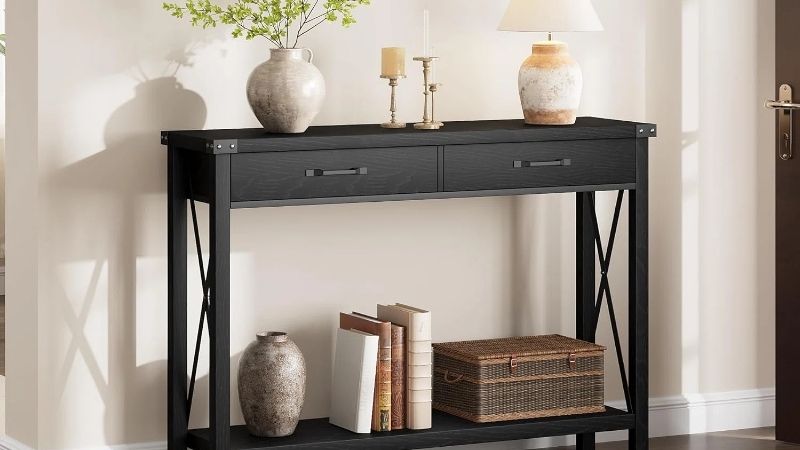
Measure Depth Before Width
Depth is the number that decides whether a console works in a hallway. These run from the West Elm Profile Narrow at just 8 inches to the IKEA HAVSTA at 13.75, with the Article Faydra and CB2 Crescent both at exactly 12 inches, so the shallowest here projects barely more than half as far into a walkway as the deepest does.
Measure the corridor or entryway and subtract the depth to see what walkway remains. A hallway needs room for people to pass with bags and coats, so an 8-inch console preserves far more of that path than a 13.75-inch one. Check the depth first, because width can usually be absorbed along a wall in a way depth cannot.
Two of these tie exactly at 12 inches, so do not rank the Faydra and Crescent against each other on depth. Where depths match, the choice shifts to width, material and what the console must hold. Reserve the shallow-versus-deep comparison for the real gap between the 8-inch Profile and the 13.75-inch HAVSTA at the other end.
Calculate the Full Floor Footprint
Footprint, width times depth, shows the total floor a console claims. The Profile Narrow covers about 1.22 square feet, the Crescent 3.00, the Faydra 3.42 and the HAVSTA 3.76, so the slimmest option occupies under a third of the floor the deepest one does despite all four being sold as console tables for tight spaces.
Use the footprint to compare honestly across different widths. A long, shallow console and a shorter, deeper one can look similar on a listing yet take very different floor, so multiply the two dimensions before deciding. In a narrow hall the footprint matters less than depth alone, but in a small room it is the better guide.
Balance footprint against usefulness. The 22-inch-wide Profile saves floor but offers a small surface, while the 41-inch Faydra gives far more room for keys, lamps and post at the cost of more floor. Decide how much surface you actually need, then take the smallest footprint that delivers it rather than the smallest number outright.
Check Load and Storage Against the Slimmer Frame
A slim console still has to hold things, and the published limits vary widely. The West Elm Profile Narrow lists a total capacity of 140 pounds on its iron frame with two open compartments, while the IKEA HAVSTA lists 44 pounds on the tabletop and 22 on the shelf, so the frame material matters more than the width does.
Match the limit to what you will put on it. A 44-pound top handles a lamp, a tray and mail comfortably but not a heavy mirror leaning against the wall or a stack of books, while a 140-pound iron frame has far more headroom. Add up the real weight of what lives on the console before trusting a slim table with it.
Storage shape matters alongside load. Open compartments like the Profile’s keep baskets reachable, the HAVSTA’s shelf suits shoes or trays, and a sculptural console may offer no storage at all. Decide whether the console is purely a surface or needs to hold things below, since a shallow shelf limits what will actually fit.
Match Console Height to Entryway or Sofa Placement
Height decides whether a console suits an entryway or sits behind a sofa. These range from the HAVSTA at 24.75 inches to the Profile Narrow at 34, with the Faydra at 30 and the Crescent at 31, so the tallest stands more than nine inches above the shortest and they suit noticeably different positions in a home.
For an entryway, a taller console around 30 to 34 inches puts the surface at a comfortable height to drop keys without bending. Behind a sofa, aim for a console at or just below the sofa back so it reads as part of the seating rather than looming over it. Measure your sofa back before choosing a height for that spot.
A low console in an entryway means stooping, and a tall one behind a sofa blocks sightlines, so the height is not interchangeable between those two uses. The HAVSTA’s 24.75 inches suits a low placement or a child-height spot more than a standard entry. Decide the location first, then pick the height that matches it.
Top Picks
Each console below fills a clear role, with depth, footprint, load and build drawn from the makers’ listings, current as of October 2026. Prices move and one is on clearance, so confirm before buying. The table pairs the depth with the main catch for each before the fuller notes that follow below it.
| Product | Best For | Key Spec | Watch Out For |
|---|---|---|---|
| West Elm Profile Narrow | Best Overall | 8 in deep; 1.22 sq ft; 140 lb | Clearance price is variant-specific |
| Article Faydra | Best Wood-Mix Design | 12 in deep; 41 in wide | Larger footprint than the Profile |
| CB2 Crescent 36 | Best Sculptural Narrow Console | 12 in deep; 36 in wide; resin | Final sale; price changes often |
| IKEA HAVSTA | Best Solid-Pine Storage | solid pine; shelf; 44 lb top | 13.75 in deep and only 24.75 in tall |
West Elm Profile Narrow: Best Overall
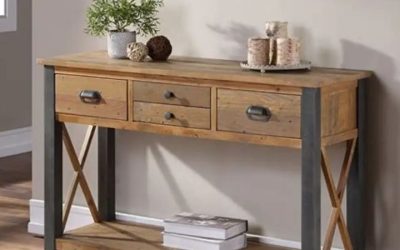
The West Elm Profile Narrow is the overall pick because it is genuinely shallow without being flimsy. At 22 inches wide by 8 deep by 34 tall it covers about 1.22 square feet, carries a 140-pound total capacity on an iron frame with two open compartments, and lists around $229.99 at West Elm as of October 2026 on a clearance White variant.
It suits a tight hallway or a small entry where every inch of walkway counts, since the 8-inch depth barely intrudes and the 34-inch height puts the surface at a natural drop-your-keys level. The iron frame and 140-pound rating handle a lamp, baskets and more. Measure the hallway and subtract the 8 inches before you buy.
The catch is scale and pricing. At 22 inches wide the surface is modest, so it is a drop zone rather than a display console, and the clearance price applies to a specific White variant, so confirm the figure for the finish you want. Open compartments also leave stored items visible, which suits baskets more than loose clutter.
Article Faydra: Best Wood-Mix Design
The Article Faydra is the pick for a wider console with a designed wood look. It measures 41 inches wide by 12 deep by 30 tall in Black Ash, built from solid and veneered ash with MDF and steel to a Contract Grade spec, and lists around $349 at Article as of October 2026 in the mid tier for a console of this size.
It suits an entry or living-room wall that can give up a little more floor in exchange for a generous 41-inch surface, enough for a lamp, a tray and decor together. The 30-inch height sits well behind a standard sofa too. Measure the 12-inch depth against the walkway, which is still shallow for a console of this width.
The catches are footprint and construction. At about 3.42 square feet it takes nearly three times the floor of the Profile, so it needs a wall with room to spare, and it mixes solid and veneered ash with MDF rather than being all solid wood. Set expectations on the material, since veneer edges can chip with hard use.
CB2 Crescent 36: Best Sculptural Narrow Console
The CB2 Crescent 36 is the pick when the console should read as a design object. It measures 36 inches wide by 12 deep by 31 tall in cast resin and fiberstone composite with a raffia texture, and lists around $399.97 at CB2 as of October 2026 on a clearance, final-sale snapshot that has moved down from a higher regular price.
It suits a room where the console is meant to be seen, since the composite build and textured surface give it a sculptural presence that wood or iron pieces do not. The 12-inch depth keeps it walkable. Measure the 36-inch width and 3.00-square-foot footprint against the wall, and treat the surface as decorative rather than heavy-duty.
Two cautions apply. The price has moved across snapshots and is marked final sale, so confirm the current figure and the return terms before buying, and a cast resin composite is a different material from wood with its own chip and scratch behavior. Choose the Crescent when the sculptural look is the point of the purchase.
IKEA HAVSTA: Best Solid-Pine Storage
The IKEA HAVSTA is the pick for solid wood and a storage shelf at the lowest price. It measures 39.375 inches wide by 13.75 deep by 24.75 tall in solid pine with a black stain, lists 44 pounds on the tabletop and 22 on the shelf, and sells for around $219.99 at IKEA as of October 2026, reduced from a higher regular price.
It suits a spot where you want real pine construction and a lower shelf for baskets, shoes or trays, with a generous 39-inch surface above. The solid-wood build holds fixings better than engineered board. Confirm the 44-pound top limit covers what you plan to set on it, since it is the lowest published ceiling in this group.
The catches are depth and height. At 13.75 inches it is the deepest console here, projecting furthest into a walkway, and at 24.75 inches tall it sits low for an entryway, better suited behind a low sofa or along a wide wall. Measure both before committing, because the depth is what makes it least suited to a truly narrow hall.
Frequently Asked Questions
Buyers of slim consoles ask the same practical things, mostly about depth, usability, placement and capacity. Each answer below leads with the direct reply, then adds the condition that changes it, so you can apply it to your hallway or living room rather than a single idea of how deep a console table should be.
How deep should a narrow console table be?
For a hallway, aim for something in the 8-to-12-inch range, which is where three of these picks sit. The West Elm Profile Narrow at 8 inches preserves the most walkway, while 12 inches, as on the Faydra and Crescent, still leaves a corridor passable. Beyond about 14 inches a console starts behaving like a sideboard instead.
The right depth depends on the corridor width and traffic. Measure the hallway, subtract the console depth, and check that the remaining path lets people pass comfortably with bags or a child. A wide entry can absorb a deeper console, while a narrow one needs the shallowest option you can find that still holds what you need.
Trade depth against usefulness honestly. An 8-inch top takes a lamp, keys and a small tray but not much more, so if you need real surface, a 12-inch depth is the better compromise. Choose the shallowest depth that still does the job rather than the smallest number, since an unusable console saves space but serves nothing.
Is an 8-inch-deep console table usable?
Yes, for its intended job. An 8-inch depth, as on the West Elm Profile Narrow, holds keys, a slim lamp, mail and a small tray, which is what an entryway console is usually for, and its 140-pound frame capacity means strength is not the limit. The constraint is surface area, not sturdiness, at that shallow depth.
What it will not do is hold deeper objects. A large vase, a wide bowl or a stack of books can overhang an 8-inch top, and anything that projects risks being knocked in a busy hallway, so measure your items’ footprints. Pair a shallow console with wall hooks or a mirror above to get function without adding depth.
The payoff is the walkway. In a narrow hall, an 8-inch console leaves far more passing room than a 12 or 13.75-inch one, which is often worth more than extra surface. If the hallway is tight enough that depth is the problem, a usable shallow console beats a deeper one that technically fits but makes the corridor awkward.
Can a console table go behind a sofa?
Yes, and height is what makes it work. Aim for a console at or just below the sofa back so the surface sits level with or under the top rail, which is where the 30-inch Faydra or 31-inch Crescent usually land well. Measure your sofa back height before choosing, since sofas vary more than consoles do.
Depth matters there too, because the console sits in the room rather than against a wall. A shallow 12-inch console tucks behind a sofa without pushing it far from the wall, while a deeper one eats into the walkway behind. Leave a path between the console and the wall if people need to pass behind the seating.
A tall console reads wrong in that spot. The 34-inch Profile Narrow suits an entry wall better than a sofa back, where it would stand above the cushions, while the low 24.75-inch HAVSTA may disappear behind a tall sofa. Match the height to the sofa first, then check the depth against the space you have behind it.
Does a narrow console hold less weight?
Not necessarily, because capacity follows the frame material rather than the depth. The 8-inch-deep West Elm Profile Narrow lists a 140-pound total capacity on its iron frame, far above the solid-pine HAVSTA’s 44-pound tabletop limit despite the HAVSTA being much deeper, so slim does not automatically mean weak here.
What changes with a narrow top is stability and leverage, not just the rating. A shallow console has a smaller base, so a heavy item placed near the front edge can make it less stable even within the stated limit, which is why wall anchoring matters for tall, slim pieces. Keep heavy items centered and low where possible.
Always read the published figure for the exact model rather than guessing from the look. Where no load is listed, judge conservatively by the material and build, and keep well under any stated number. A published limit of 44 pounds on a top is ample for everyday entryway use but rules out heavy decor or a leaning mirror.
Final Thoughts
Choosing a narrow console table means leading with depth, not width: measure the walkway, work out the footprint, check the load against the slim frame, and match the height to an entry wall or sofa back. The shallow Profile Narrow, wider Faydra, sculptural Crescent and solid-pine HAVSTA each suit a specific spot.