
Key takeaways
- Shopping for a box spring mattress gets confusing fast, because the term often means the foundation that sits beneath a mattress, not a mattress itself. This guide uses it that way: a base placed under your mattress. The right one…
Shopping for a box spring mattress gets confusing fast, because the term often means the foundation that sits beneath a mattress, not a mattress itself. This guide uses it that way: a base placed under your mattress. The right one depends on your mattress’s rules, the profile height and whether your size needs center support.
As an Amazon Associate we earn from qualifying purchases.
By KK Home Furnishings Editorial Team
How to Choose a Box Spring or Mattress Foundation
Four things decide whether a foundation supports your mattress or voids its warranty: your mattress’s own compatibility rules, the profile height you need, whether your size requires center support, and the finished bed height you end up with. Start with the mattress maker’s requirements, because those override any general advice about what a box spring should be.
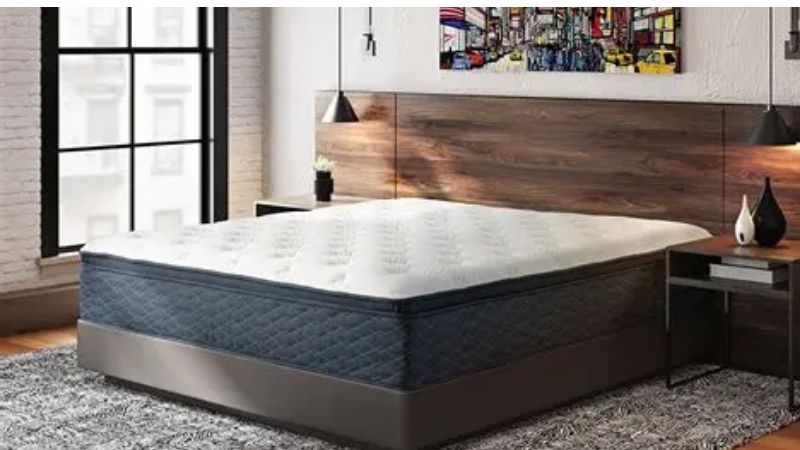
Check Mattress Compatibility First
The foundation has to match what your mattress asks for, and those rules vary by brand rather than following one standard. TEMPUR-Flat, for example, is engineered specifically for Tempur-Pedic mattresses, while Casper lists 4-inch slat spacing for its Foundation, so a base that suits one mattress is not automatically right for another.
Read your mattress warranty before you shop for a base. Many foam and hybrid makers tie coverage to the type of support underneath, and the gap between slats is a common requirement, so confirm whether your mattress needs a solid surface, closely spaced slats or a traditional sprung box spring. Buying the base first and checking the rule second is how people accidentally void a warranty.
Compatibility also affects how the mattress wears. The wrong support lets a foam mattress sag between slats or over an unsupported span, which shows up as body impressions well before the mattress should fail, so matching the base to the maker’s rule is a durability decision, not just a warranty formality.
Choose Standard or Low Profile
Foundations come in different heights, and the choice changes how your whole bed sits. The Serta Foundation is offered in a 6-inch low and a 9-inch standard profile, the Sealy StableSupport comes in 5 or 9 inches, and the TEMPUR-Flat is available in 2, 5 and 9-inch profiles, so you can tune the base height to the look and feel you want.
Pick the profile based on your frame and your getting-in-and-out height. A standard 9-inch profile gives a traditional tall bed, while a low 5 or 6-inch profile keeps a thick modern mattress from sitting too high on a platform or storage frame; measure from the floor to your preferred mattress-top height and work backward through the mattress and base.
Profile is easy to overlook and annoying to fix later. Go too tall and a thick mattress on a standard frame can feel like climbing into bed, go too low and the bed looks sunken; because swapping a foundation means stripping the bed, it is worth getting the profile right the first time rather than living with the wrong finished height.
Check Queen and King Center Support
Larger foundations need support in the middle, not just at the edges. Serta explicitly requires a platform or traditional base with center support to the floor for its Queen and King foundations, which tells you that a wide base without a center leg can flex under weight no matter how solid it looks on paper.
Count the whole load the base carries: the mattress, one or two sleepers and bedding, not body weight alone. On a Queen or King that total sits over a wide unsupported span, so a center support leg to the floor is what keeps the foundation from bowing over time; confirm your frame provides that support or that the foundation includes it for your size.
Skipping center support is a slow failure. A wide foundation may feel fine at first and then develop a dip down the middle as the span sags under nightly load, which the mattress faithfully copies, so treat the center-support requirement as mandatory on larger sizes rather than optional, especially under a heavy hybrid mattress.
Measure Finished Bed Height
The number that actually affects daily life is the total height once everything is stacked: frame plus foundation plus mattress. A 9-inch foundation under a thick mattress on a tall frame can produce a surprisingly high bed, while a low-profile base keeps a modern mattress at a comfortable step-in height.
Work out the finished height before you order the base. Add your frame deck height, the foundation profile and the mattress thickness, and compare that total to a comfortable seated height for getting in and out; foundation dimensions are usually close to nominal mattress sizes, so a Queen base listed near 60 by 80 inches, or slightly under, is normal rather than a mistake.
Finished height is also a safety and access issue for some households. A very tall bed is harder for shorter adults, children or anyone with mobility limits, while a very low bed can be hard to rise from, so size the whole stack to the people using it rather than defaulting to a standard-profile base out of habit.
Top Picks
These four span the realistic choices, from a traditional-style foundation to a multi-profile base and a brand-matched option, across four different makers. Specs come from each manufacturer’s listings; pricing on foundations shifts by size and retailer, so each pick carries a tier and you should check the current price before ordering.
| Product | Best For | Key Spec | Watch Out For |
|---|---|---|---|
| Serta Foundation | Best Overall Foundation | 6-in low / 9-in standard; center support required | Needs center support to floor on Queen/King |
| Sealy StableSupport | Best for Profile Options | 5 or 9 in; flat foundation | Queen listed near 79 x 60 in |
| TEMPUR-Flat Foundation | Best for Tempur-Pedic | 2 / 5 / 9 in; solid flat support | Engineered for Tempur-Pedic mattresses |
| Casper Foundation | Best Slatted Foundation | Slats spaced 4 in | Exact Queen profile to confirm |
Serta Foundation – Best Overall Foundation
The Serta Foundation is the pick for a traditional box-spring-style base with clear support guidance. It comes in a 6-inch low and a 9-inch standard profile, shows Queen dimensions around 60 by 80 inches, and the maker spells out that it needs a supporting frame with center support to the floor on Queen and King sizes. It reads as a mid-tier foundation, so check the current price.
Its strength is clarity: by stating the center-support requirement outright, Serta makes it easy to set up correctly, and offering both a low and standard profile lets you dial in the finished bed height. For someone replacing an old box spring under a mainstream mattress, it is the straightforward, well-documented choice.
The caveat is that center support is not optional on larger sizes, so you must provide a frame with a center leg to the floor or the wide span can sag over time. Confirm your frame meets that requirement before ordering a Queen or King, since a foundation that flexes in the middle will telegraph a dip into the mattress.
Sealy StableSupport – Best for Profile Options
The StableSupport is the pick when finished bed height is your main concern. It is a flat foundation offered in 5 or 9-inch profiles, with a Queen listed near 79 by 60 inches, so you can choose a low base to keep a thick mattress at a comfortable height or a standard base for a traditional look. It sits in the mid tier, so check the current price.
Having two clear profiles makes it easy to match an existing frame or a preferred step-in height without guesswork, and a flat foundation gives a foam or hybrid mattress an even, continuous surface. For a buyer juggling a specific frame and a thick modern mattress, the profile flexibility is the reason to choose it.
Note the listed Queen dimension of about 79 by 60 inches, which is slightly under the nominal 80 by 60; that is normal for foundations, which can run marginally smaller than the mattress, and is not a defect to correct. As with any flat base, confirm your mattress warranty is satisfied by a solid flat foundation rather than a slatted one.
TEMPUR-Flat Foundation – Best for Tempur-Pedic
The TEMPUR-Flat is the pick if you own a Tempur-Pedic mattress, because it is engineered specifically for that line. It provides a solid, flat support surface and comes in 2, 5 and 9-inch profiles, which is the widest profile range here and lets you set almost any finished height from a very low platform look to a standard bed. It is a premium-tier base, so check the current price.
Matching the foundation to the mattress maker removes the compatibility guesswork entirely: the flat surface suits a dense foam mattress, and the 2-inch option is genuinely useful for keeping a thick Tempur-Pedic from sitting too high on a platform frame. For that ecosystem, it is the safest support choice.
Its specialization is also its limit: it is built around Tempur-Pedic mattresses, so do not assume its support profile is the right rule for an unrelated brand. If you own a different mattress, follow that maker’s own foundation requirement instead, since one brand’s support design does not transfer automatically to another.
Casper Foundation – Best Slatted Foundation
The Casper Foundation is the pick when you want a slatted base rather than a solid one. Casper lists its slats spaced 4 inches apart, which is the defining spec here and suits a mattress whose maker allows that gap, giving a supportive surface with some airflow underneath. It reads as a mid-to-premium option, so check the current price.
A slatted foundation with a defined 4-inch spacing is a clean, modern support for many foam and hybrid mattresses, and Casper positions its foundations as support options alongside platform and flat bases, which makes it a flexible choice within its own ecosystem. For a buyer who wants airflow and a lighter base, the slatted design has real appeal.
Confirm two things before buying: that your mattress warranty permits a 4-inch slat gap, since some foam makers require closer spacing, and the exact Queen profile and footprint on the current product page, which should be verified rather than assumed. Matching the slat rule to your specific mattress is what keeps the surface from letting the foam dip between slats.
Frequently Asked Questions
These are the questions buyers ask most when deciding what to put under a mattress, answered with the specifics from the foundations above.
Is a box spring the same thing as a mattress?
No. A box spring, or foundation, is the support base that sits under your mattress; the mattress is the sleeping surface on top. The term “box spring mattress” is often used loosely, but in this guide it means the foundation beneath the bed, which is a separate product from the mattress itself.
The distinction matters because the two do different jobs and have different rules. The mattress provides comfort and must meet flammability regulations such as 16 CFR 1632 and 1633 (CPSC), while the foundation provides support and must match what the mattress maker requires underneath; buying one does not substitute for the other.
If a listing seems to blur the two, read the dimensions and construction to tell which it is: a foundation lists a profile height and support details, while a mattress lists comfort layers and firmness. Knowing which product you are looking at prevents the common mix-up of buying a base when you needed a mattress, or the reverse.
Does memory foam need a box spring?
Usually not a traditional sprung box spring, no. Many modern foam mattresses are designed for a solid or closely slatted foundation rather than an old-style box spring, so what they need is a flat, firm support that meets the maker’s rule, which may be a flat foundation, a slatted base or a platform.
What matters is the support surface, not the name. A foam mattress on a traditional box spring with wide gaps can sag between the springs, so check your mattress warranty for its foundation requirement, including any slat-spacing limit; Casper’s foundation, for instance, lists 4-inch slats, while other brands set their own figures.
If your bed frame already has a suitable solid or closely slatted deck, you may not need a separate foundation at all. The practical step is to read your mattress’s support requirement first, then choose the base, rather than assuming either that foam needs a box spring or that any base will do.
Is a foundation better than a traditional box spring?
For most modern mattresses, a flat or slatted foundation is the better match, because today’s foam and hybrid beds are built for firm, continuous support rather than the give of an old sprung box spring. Several makers now sell foundations explicitly as a box-spring alternative for exactly this reason.
Which is better depends on your mattress, not a blanket rule. A dense foam mattress generally wants the solid support of a flat foundation or a closely slatted base, while an older innerspring mattress may still suit a traditional box spring; the deciding factor is what your mattress maker requires, so let the warranty guide the choice.
If you are replacing a worn box spring, treat it as a chance to match the base to your current mattress rather than buying the same thing out of habit. A foundation chosen to your mattress’s support rule, with center support on larger sizes, will hold the bed flatter for longer than a mismatched box spring.
Should I choose a 5-, 6- or 9-inch foundation?
Choose the profile by the finished bed height you want, since the support job is similar across heights. A 9-inch standard profile, like Serta’s or Sealy’s, gives a traditional tall bed, a 5 or 6-inch low profile keeps a thick mattress at a comfortable height, and a very low 2-inch option, like the TEMPUR-Flat’s, suits a platform look.
Work it out by stacking the numbers. Add your frame deck height, the foundation profile and the mattress thickness, then compare that total to a comfortable step-in height for the people using the bed; a thick mattress plus a 9-inch base on a tall frame can sit higher than expected, which is where a low profile helps.
Access needs can tip the decision. A very tall bed is harder for shorter adults or anyone with mobility limits, while a very low bed can be hard to rise from, so size the whole stack to the household rather than defaulting to a standard profile. The support is comparable, so profile is mainly about height and feel.
Final Thoughts
The right box spring mattress foundation is the one that matches your mattress’s rules, not a one-size answer: check the maker’s compatibility and slat-spacing requirement first, pick a profile that gives a comfortable finished bed height, and insist on center support on Queen and King sizes. Serta is the clear traditional-style base, Sealy offers the profile range, TEMPUR-Flat is the safe Tempur-Pedic match, and Casper is the slatted option; read your mattress warranty, then choose the base that keeps it flat and covered.
