Key takeaways
- A small entryway table is only genuinely small if its depth and footprint keep the hallway clear, not if a listing merely calls it compact. Depth, not width, decides how far it juts into the path, so this guide compares…
A small entryway table is only genuinely small if its depth and footprint keep the hallway clear, not if a listing merely calls it compact. Depth, not width, decides how far it juts into the path, so this guide compares four current consoles by real floor area and what you give up to gain it.
As an Amazon Associate we earn from qualifying purchases.
By KK Home Furnishings Editorial Team
How to Choose a Small Entryway Table
A small entryway table should be chosen by footprint and the trade-offs that come with it, not by marketing. Depth drives how much it intrudes, footprint is width times depth, and stability and usable top follow. These four range from 7.3 to 15 inches deep, so measure the hallway width before anything else.
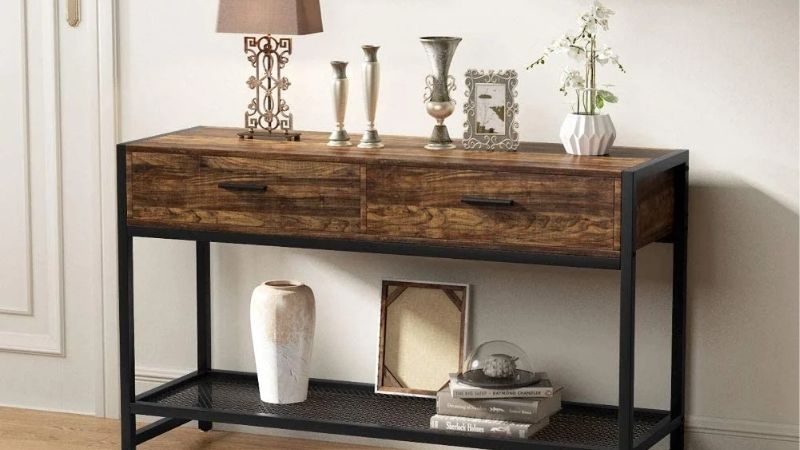
Lead With Depth, Not Width
Depth is the dimension that determines how far a console reaches into a narrow space. These four span 7.3 inches on the Yamazaki Tower, 12 on the West Elm Bridge and 15 on the Pottery Barn Folsom, so the shallowest juts out less than half as far as the deepest into the walkway.
Translate that to your hallway. In a tight entry, a shallow 7.3-inch table like the Yamazaki leaves the path largely clear, while a 15-inch console can noticeably narrow it. Measure the hallway width, then subtract the table depth to see how much walking room remains before choosing between these depths.
Width matters for the wall, but depth is what you feel when passing by. A wide but shallow table can fit a narrow entry better than a compact but deep one, so lead your choice with depth and treat width as the secondary dimension once the walkway clearance is settled.
Calculate the Real Floor Footprint
Footprint, width times depth, is the honest measure of floor used. The Yamazaki covers about 1.20 square feet, the Bridge 3.00 and the Folsom 5.42, so the Yamazaki uses roughly 60 percent less floor than the Bridge, a gap that is obvious in a small foyer or hallway.
Calculate the footprint rather than judging by width, since a wide shallow table can take less floor than a narrow deep one. Multiply the dimensions for each option and compare the square footage against the clear area you have, so you choose the table that genuinely fits rather than the one that looks small.
A smaller footprint usually means a smaller usable top, which is the core trade-off here. The Yamazaki saves floor but holds little, while the Folsom offers far more surface at the cost of space, so decide how much floor you can spare before deciding how much tabletop you need.
Check Stability and Levelers on Narrow Tables
Narrow and shallow tables can be tippy, so stability matters. The Yamazaki uses a steel frame with an ash top for a slim but rigid build, while the West Elm Bridge has a solid-wood frame with adjustable levelers to keep it steady on an uneven entry floor.
A shallow console has a small base, so it relies on frame rigidity and weight distribution to stay stable, especially if you set keys or a lamp on it. Levelers help on the uneven floors common near entries, so look for a sturdy frame and adjustment rather than assuming any narrow table stands firm.
Weight capacity reflects this too: the Yamazaki is rated to about 11 pounds while the Folsom states 200, so a very slim table suits light items like keys and mail, not a heavy lamp or a stack of books. Match the load you plan to place on it to the table’s stated capacity.
Weigh Usable Top and Storage Against Size
Every inch of smallness costs usable surface, so weigh the top against the footprint. The shallow Yamazaki holds keys, a wallet or a small plant, while the deeper Bridge and Folsom give room for a lamp, a tray and decor, reflecting their larger footprints.
Decide what the table must hold. If you only need a landing spot for keys and mail, a minimal shallow console is enough; if you want a lamp, a bowl and seasonal decor, you need the depth and width that come with a larger footprint, so match the surface to your real daily use.
Storage adds function but also bulk, so consider whether a shelf or drawer is worth the extra depth. A solid-wood console like the West Elm Anton brings durable material and a small-entry footprint, but added storage usually means a deeper table, so balance the convenience against the floor you can give up.
Top Picks
These four cover the realistic span of small entryway table buyers, from an ultra-shallow console to a deeper surface. Each lists at least two hard specs and its footprint where published; pricing runs across budget-to-mid and premium tiers, so confirm the current price and dimensions before you order.
| Product | Best For | Key Spec | Watch Out For |
|---|---|---|---|
| Yamazaki Tower Narrow Console | Best Overall | 7.3″ deep; about 1.20 sq ft | 11-lb capacity limits what it holds |
| West Elm Bridge Entry Console | Very tight spaces | 36 x 12″; adjustable levelers | 3.00 sq ft footprint |
| West Elm Anton Console | Solid-wood option | solid mango wood; small-entry design | verify depth before buying |
| Pottery Barn Folsom Console | More surface area | 52 x 15″; 200-lb capacity | not for very narrow hallways |
Yamazaki Tower Narrow Console — Best Overall
The Yamazaki leads for genuine smallness. It measures 23.6 inches wide by just 7.3 deep by 31.7 high for a footprint around 1.20 square feet, on a steel frame with an ash top, rated to about 11 pounds. It is designed for narrow entryways and sits in the budget-to-mid tier.
Its 7.3-inch depth barely intrudes into a hallway, making it the clear pick when the path must stay open, and the steel frame keeps it rigid despite the slim profile. For a landing spot for keys, mail and a phone by the door, it fits where almost nothing else will.
The trade-off is capacity and surface: at an 11-pound rating it holds light items only, not a heavy lamp or a pile of books, and the shallow top limits what you can display. Keep loads light and use it as a minimal drop zone rather than a decorative surface, which is exactly its intended job.
West Elm Bridge Entry Console — Best for Very Tight Spaces
The Bridge is the pick when you want a small footprint with a usable top. It measures 36 inches wide by 12 deep by 30 high for a 3.00-square-foot footprint, on a solid-wood frame with ash veneer and adjustable levelers. It sits in the premium tier.
At 12 inches deep it stays compact while offering more usable surface than the ultra-shallow Yamazaki, and the levelers keep it steady on an uneven entry floor. The solid-wood frame feels substantial, making it a practical balance between a tight footprint and a top that holds a lamp, a tray and keys.
The watch-out is its 3.00-square-foot footprint, larger than the Yamazaki, so measure the hallway to confirm the 12-inch depth still leaves comfortable passage. As a premium piece it costs more than basic consoles, but the build and levelers justify it for an entry that needs both compactness and everyday function.
West Elm Anton Console — Best Solid-Wood Option
The Anton is the pick for durable natural material in a small entry. In the 39-inch class, it is built from solid mango wood and is positioned by the maker for a small entryway footprint. It sits in the premium tier and suits buyers who want real wood over veneer or metal.
Solid mango wood gives it warmth and longevity that veneered or metal consoles lack, and its small-entry positioning means it is sized for a modest hallway rather than a large room. For an entry where material quality matters as much as footprint, it offers a lasting, natural-wood surface.
The caveat is to verify the depth before buying, since the exact depth was not confirmed in the data available, and depth is what drives hallway clearance. Check the dimensions page for your variant, and treat it as a solid-wood small-entry option whose precise footprint you confirm against your space before ordering.
Pottery Barn Folsom Console — Best for More Surface Area
The Folsom is the pick when you need a real surface and can spare the floor. It measures 52 inches wide by 15 deep by 30 high for a footprint around 5.42 square feet, with a stated 200-pound capacity. It sits in the premium tier as the most generous option here.
Its 15-inch depth and 52-inch width give room for a lamp, a bowl, mail and seasonal decor, and the 200-pound rating handles a heavy lamp or stacked books that slim consoles cannot. For a wider entry or a hallway with space to spare, it is the functional surface the compact tables cannot match.
The clear limit is that it is not a pick for a very narrow hallway, since its 15-inch depth and 5.42-square-foot footprint intrude far more than the slim options. Use it only where the entry has room, and measure the walkway, since its generous surface comes at the cost of real floor space.
Frequently Asked Questions
Small entryway tables raise questions about depth, fit and function. The answers below use the published dimensions of these four consoles and avoid absolute clearance rules, so you can match a table to your actual hallway width and daily use before deciding how small you need to go.
What depth is best for a narrow entryway table?
The shallower the better in a tight space, and these range from 7.3 to 15 inches. A depth around 7 to 12 inches keeps a console from crowding the walkway, with the 7.3-inch Yamazaki best for the narrowest halls and 12 inches a practical balance for a usable top.
Depth is the dimension you feel when passing, so it matters more than width in a hallway. The right depth depends on your hallway width: measure it, subtract the table depth, and keep enough remaining room to walk comfortably, since a console that narrows the path too much becomes a daily obstacle.
There is no single correct number, because it depends on your space, so avoid treating any figure as a universal minimum. If the hall is tight, lean toward 7 to 10 inches; if it is roomier, 12 to 15 inches gives a more usable surface without a universal clearance rule to force the choice.
Can a console table fit in a small hallway?
Yes, if you choose one shallow enough to keep the path clear. A slim console like the 7.3-inch Yamazaki fits many narrow hallways with room to pass, while a deeper 15-inch table like the Folsom needs a wider space, so the fit depends on depth and your hallway width.
Measure the hallway and subtract the table depth to see the remaining walkway, then confirm it leaves comfortable passage past the table and any open doors. A console that fits the wall but narrows the path too much is impractical, so the walkway clearance, not just the wall length, decides the fit.
For the tightest halls, prioritize the shallowest console and keep what you place on it light; for roomier entries, a deeper table adds surface. Matching the depth to the measured hallway, rather than assuming any console fits, is what makes a small entryway table work in a narrow space.
Is a 12-inch-deep entryway table deep enough?
Often yes, as a balance between footprint and usable top. A 12-inch depth, like the West Elm Bridge, holds a lamp, a small tray and keys while staying reasonably compact, which suits many entries that are tight but not extremely narrow. In a very narrow hall, though, a shallower console still fits better, so measure the hallway width first.
Whether it is enough depends on both your hallway and your needs. In a very narrow hall, 12 inches may still intrude more than you want, so a shallower console fits better; for a usable decorative surface, 12 inches gives more room than the ultra-slim options without the bulk of a 15-inch table.
Measure your hallway width against a 12-inch depth to confirm comfortable passage, and consider what you will place on it. If you need only a key drop, a shallower table suffices; if you want a lamp and decor, 12 inches is a sensible middle ground that balances footprint with function.
Should an entryway table have storage?
It depends on your needs and the space you can give up. A shelf or drawer adds handy storage for mail, gloves or keys, but it usually means a deeper, bulkier table, so storage trades floor space for function, which matters most in a tight entry.
If the entry is narrow, a minimal shallow console without storage keeps the path clear and still catches keys and mail. If you have more room and want to tuck items away, a deeper table with a shelf or drawer earns its larger footprint, so match the storage to the space available.
Consider a wall hook or a small basket on a shallow console as an alternative to a bulky storage table, keeping the footprint small while adding capacity. Decide what you need to store, then choose the smallest table that provides it, rather than adding storage that forces a larger footprint than the entry allows.
Final Thoughts
The best small entryway table keeps your hallway clear while holding what you need, not the one merely labeled compact. Lead with depth, calculate the real footprint, check stability on slim tables, and weigh the usable top against size. On that basis the Yamazaki leads, with the Bridge, Anton and Folsom close behind.