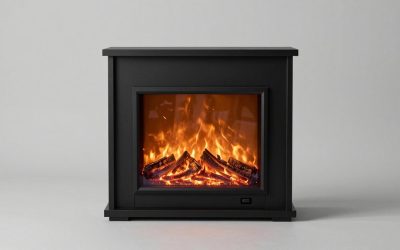
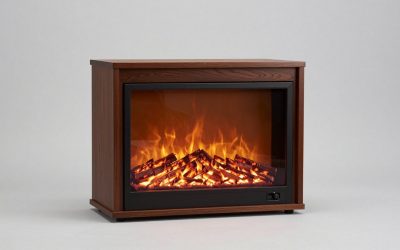
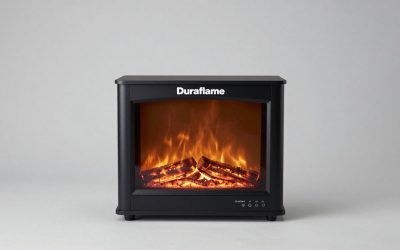
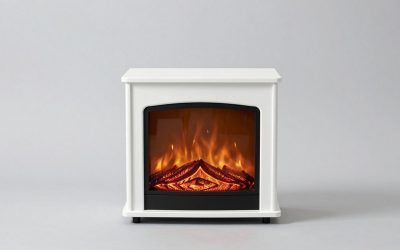
A wood stove can overheat nearby electronics even when its installation satisfies wall-clearance rules. For the question “how close can a tv be to a wood burner?” there is no universal safe number of inches. Check the exact stove, chimney connector, and TV requirements before planning a shared wall; a separate TV position is often the safer choice.
As an Amazon Associate we earn from qualifying purchases.
By KK Home Furnishings Editorial Team
How Close Can a TV Be to a Wood Burner? Check Three Limits
A combustible-material clearance, an electronics temperature limit, and a comfortable viewing height are three different measurements. None automatically substitutes for the others. Samsung advises against mounting its televisions over fireplaces, while Jotul publishes stove clearances by model and installation configuration. That is why a generic six-, twelve-, or eighteen-inch claim cannot authorize a television above a burning stove [Samsung, 2026; Jotul, 2025].
Read the Wood Stove and Flue Clearance Tables First
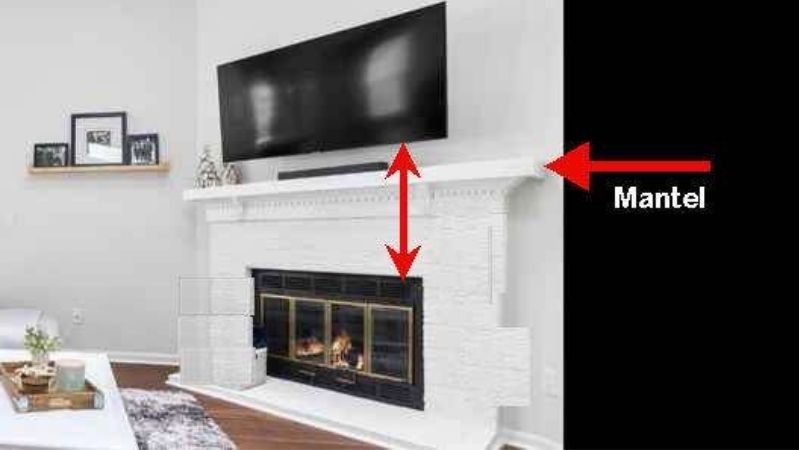
A listed stove manual sets distances to nearby combustible walls, trim, mantels, and sometimes ceilings, taking into account stove shields and chimney connector type. Jotul states that its tested clearances differ by appliance and configuration, with chimney connectors requiring separate attention. These figures are installation safety minima; they are not a tested safe mounting distance for a flat-screen television [Jotul, Wood Product Planning Guide, 2025].
For a concrete US example, the Jotul F 445 manual lists a 30-inch stove-top-to-mantel clearance for a mantel no deeper than 12 inches under the illustrated unprotected arrangement. It also publishes distinct figures for stove sides, rear surfaces, and connector pipes. The 30 inches describes that specific mantel condition, not a general approval to put a TV at that height or closer to another stove [Jotul F 445, 2024 manual].
Check the Television Temperature Limit at Its Actual Location
Samsung states in its US wall-mount guidance that it does not recommend a TV above a fireplace and that Samsung TVs should never exceed 104 degrees Fahrenheit. That number comes from Samsung guidance, not a universal threshold for all brands or a measured temperature for your wall. Another manufacturer or model may specify a different operating environment [Samsung US, 2026].
Heat exposure varies during startup, a vigorous burn, and the long period while a stove remains hot. A cooler-looking wall does not establish safe air temperature at the screen, power supply, or ventilation openings. Have the proposed location assessed under realistic stove operation, and seek the TV maker’s approval where needed. If its instructions prohibit installation near stoves, extra space alone does not cancel that restriction.
Separate the Flue, Mantel and Mounting Decisions
The stovepipe is a second heat source that may pass close to the screen even when the firebox sits lower down. The Jotul F 445 manual distinguishes a single-wall horizontal connector clearance of 18 inches to an unprotected combustible surface from other connector arrangements. Such numbers protect specified surfaces and must not be relabeled as minimum TV separation [Jotul F 445, 2024 manual].
A mantel, ventilated heat shield, or recessed mounting niche can alter how heat moves, but its mere presence does not certify the TV location. Stovax warns that a recess above a solid-fuel heater may bring electronics closer to a hot flue and trap rising heat. Its guidance is from the UK and is useful as a heat-flow caution, not a substitute for US local codes or the exact appliance manual [Stovax, manufacturer FAQ].
| What You Are Checking | Published Example | What It Actually Governs | TV Placement Decision |
|---|---|---|---|
| Stove top to combustible mantel | Jotul F 445: 30 in. for a mantel up to 12 in. deep in the stated setup | That stove and mantel configuration, not TV electronics | Do not substitute the mantel clearance for TV approval |
| Chimney connector to combustible surface | Jotul F 445: 18 in. for specified single-wall, unprotected arrangement | Pipe-to-surface separation | Evaluate the pipe route independently |
| Television heat exposure | Samsung US: TVs should not exceed 104 F | Samsung television thermal guidance | Use the exact TV model instructions and assess actual heat |
| Location directly over a fireplace | Samsung US: installation not recommended | Manufacturer placement advice | Prefer a different wall or ask the maker before installation |
| Heat shield or recessed opening | Jotul: only specified shielding reduces certain clearances; Stovax flags hot recesses | Approved protection and heat-flow design | Have a qualified installer review the whole assembly |
Adjust for Your Situation
The answer changes substantially with the kind of burner, its flue arrangement, and where the screen would sit. These six layout cases are decision guides, not new clearance rules. In every case, meet the stove and connector clearances first, check the TV’s own heat and mounting restrictions, and involve a qualified stove professional before modifying a working installation.
A TV Directly Above a Freestanding Stove
This is usually the hardest position to justify. Radiant heat comes off the stove while warm air rises toward the wall-mounted screen; a top-exit flue can add another hot surface between the two. Increasing the TV height may clear an appliance diagram yet still expose its casing, vents, and wall bracket to unsuitable temperatures. Samsung specifically advises against the over-fireplace placement [Samsung US, 2026].
Start by finding the model plate and the exact stove installation manual, then trace the flue and any permitted mantel or shielding geometry. Do not hang a screen merely because a tape measure exceeds a stove-to-mantel minimum. If no supported arrangement protects both the building materials and electronics, put the television on an adjacent wall and preserve a more comfortable viewing height.
A Television Above a Wood-Burning Fireplace Insert
An insert installed within an existing masonry fireplace is not automatically a cooler option. The hot firebox, surround, and any convection outlets can direct energy into the wall above the opening. Clearance diagrams for a freestanding stove do not govern a different inset appliance. Obtain the insert’s own installation instructions and note all restrictions on combustible mantel projections and facing materials.
A substantial masonry surround can change heat transfer without proving electronics are protected. Consider how cables, a soundbar, and a receiver would be routed through the area, because these components have their own temperature and ventilation needs. If the proposed screen location cannot be verified under the operating conditions and manufacturer rules, keep the fireplace as a focal point and move the display elsewhere.
A Mantel Between the Stove and the Television
A mantel sometimes changes the path of rising warm air, but it is not an all-purpose heat barrier. Its allowable depth, material, vertical position, and permitted protection system depend on the stove or insert. The Jotul F 445 example of a 30-inch clearance applies to a combustible mantel of specified depth; it does not say a TV becomes safe just above that mantel [Jotul F 445, 2024 manual].
Avoid attaching shelves or metal deflectors that were never evaluated for the appliance. Approved shielding details can involve stand-offs and ventilation gaps, and changing them can invalidate a previously compliant installation. A stove installer should confirm the mantel arrangement; the television maker still controls the electronic side of the decision. If either requirement cannot be met, changing the TV location is simpler than assuming the shelf solved the heat problem.
A Screen Beside the Burner on an Adjacent Wall
Moving the television to the side usually avoids the direct vertical plume above a stove, but lateral radiant heat and nearby flue sections still matter. Use the side-clearance chart for the exact stove arrangement, not a generic wood-burner distance. The screen, its cabinet, power cable, and bracket may each be exposed differently, especially if the display is mounted on a corner wall close to the firebox.
This is often the more practical living-room layout because it can keep the picture closer to seated eye level. Leave sufficient separation for the stove door to open fully, wood to be loaded safely, and servicing to take place. Check the TV maker’s required ventilation space separately from the stove’s safety clearance, and confirm that furniture and cables do not cross the protected hearth area.
A Pull-Down or Swiveling TV Mount Above the Stove
A movable mount can improve viewing angle when a screen is unusually high, but it creates more operating positions to assess. A television swung downward or outward could enter a hotter zone than the position marked during installation. It can also bring its cables, power brick, or soundbar closer to the stove and stovepipe. The bracket’s advertised range of motion is not a heat-safety rating.
Both the parked position and every position used while the fire is operating must comply with the relevant instructions. Do not count on remembering to retract a hot-exposed display before adding fuel. Check that the mounting structure supports the total hardware load and that accessible cords cannot touch heated metal. If the mount only becomes comfortable when it moves into a hazardous location, choose another wall.
An Older Stove With Missing Labels or Documentation
An unidentifiable older stove is a reason to postpone the TV project, not to borrow measurements from a similar-looking model. The required separation may vary with the unit’s tested listing, connector type, installed shielding, or whether the appliance is unlisted. Jotul’s guide explicitly treats clearance configurations as model-specific, which is why dimensions from another stove are unreliable [Jotul, 2025].
Ask a certified chimney sweep or qualified solid-fuel installer to identify the appliance, inspect its current placement, and establish applicable manufacturer requirements and local rules. EPA’s archived Burn Wise guidance likewise supports annual professional inspection of wood-burning appliances and venting [EPA, historical guidance, archived 2025]. Do not test a risky setup by placing a valuable television there first and waiting for a problem.
Frequently Asked Questions
Wood burners create two distinct questions: whether the heat source has been installed safely and whether sensitive electronics can function in that environment. These answers deal with common shortcuts that can create a false sense of permission even when the distance looks reasonable.
Is a 12-inch gap enough between a wood stove and a TV?
Not necessarily. Twelve inches is not a universal wood-stove-to-TV clearance. Some manuals use that distance for a particular protected wall or connector configuration, but the number does not establish safe air temperature at a display. The correct gap depends on the exact stove, installation geometry, flue, and television manufacturer’s restrictions [Jotul, 2025; Samsung US, 2026].
Compare the relevant drawings in both manuals rather than choosing the smallest published distance on either page. A side clearance cannot be applied above the stove, and a mantel clearance is not a screen-temperature approval. Where direct-over-stove placement remains uncertain, the safe planning decision is to move the TV away from the heater.
Does a heat shield make it safe to mount a TV above a wood burner?
No shield provides blanket approval for every TV position. Jotul describes clearance reductions only for particular protection methods and installation configurations, and those rules primarily address combustible construction. They do not certify that television electronics will stay within the manufacturer’s thermal operating limits [Jotul, Wood Product Planning Guide, 2025].
A properly designed shield may be one part of a compliant stove installation, but a metal plate attached casually to the wall is not an equivalent design. Heat may continue rising around the protection or through an enclosed TV niche. Have the stove, shielding, wall structure, and TV placement considered as one assembly before making alterations.
How can I check whether my proposed TV position gets too hot?
First use the manuals to determine whether that location is permitted at all. If it is, a qualified installer can assess the air and nearby surfaces at the intended television position while the stove is operated under representative conditions. Samsung suggests checking fireplace heat before considering such a mount, while warning that it does not recommend the installation in the first place [Samsung US, 2026].
Do not use a single quick reading on cold masonry, or a hand held briefly near the wall, as proof of safety. The stove can remain hot well after visible flames subside, and an infrared thermometer reading from shiny glass or metal can be misleading. If the maker cannot confirm the installation or conditions remain uncertain, do not mount the screen there.
Is an electric fireplace clearance suitable for a wood burner?
No. Electric fireplaces typically use a controlled electrical heating element and a particular air outlet, whereas a wood burner has a high-temperature combustion chamber, stove surfaces, and a hot flue. Its listed clearances and installation method come from a completely different manual. Instructions for putting an electric firebox under a TV cannot be transferred to a solid-fuel stove.
Look up the actual appliance identification and ask the installer to explain its vertical, side, mantel, and pipe requirements. The EPA also recommends keeping wood-burning equipment and vents professionally inspected as part of routine use [EPA, archived 2025]. A safe media-wall plan begins with the correct fuel type and model, not the appearance of the fireplace opening.
Final Thoughts
There is no universal distance that answers how close can a tv be to a wood burner. The stove’s combustible clearances, flue path, and TV heat restrictions must all be satisfied. If you cannot confirm every requirement, place the screen on another wall rather than treating a mantel or heat shield as automatic protection.