
Key takeaways
- The most useful what to look for electric fireplace tv stand checklist begins with three checks: whether the cabinet safely fits your actual television, whether the heater can operate in your room as instructed, and whether the layout works for…
The most useful what to look for electric fireplace tv stand checklist begins with three checks: whether the cabinet safely fits your actual television, whether the heater can operate in your room as instructed, and whether the layout works for your equipment. A beautiful flame display will not make up for a narrow TV base, an overloaded top, blocked heater airflow, or inaccessible power. Compare the cabinet and the electric firebox as two parts of one purchase, and verify their specifications for the exact model you plan to order.
As an Amazon Associate we earn from qualifying purchases.
By KK Home Furnishings Editorial Team
What Matters Most When Choosing an Electric Fireplace TV Stand
Start with the features that can rule a product out before you consider color, flame effects or decorative hardware. A TV-compatible furniture label, published load rating and original heater instructions tell you more than a lifestyle photo. This early checklist is for comparing candidates, not a claim that one design suits every home.
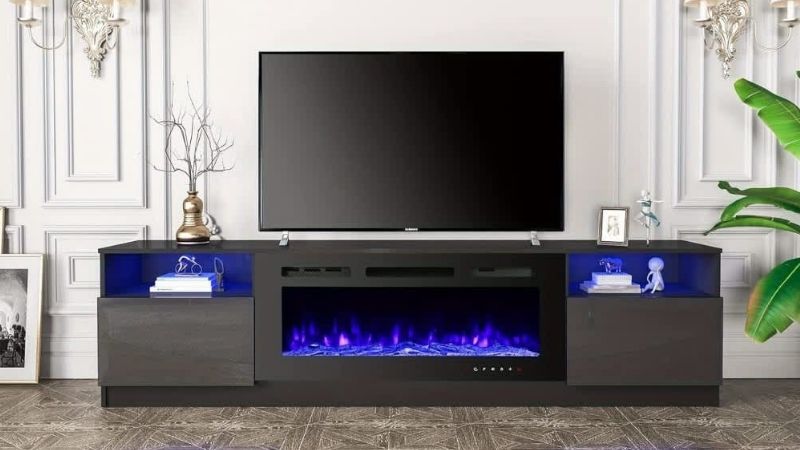
| Buying Check | What to Verify | Why It Changes the Decision | When to Pass |
|---|---|---|---|
| TV compatibility | Maximum diagonal TV size, maximum top load and actual TV-footprint width/depth | Screen diagonal does not tell you whether both TV feet fit securely | The feet overhang or the TV exceeds any published limit |
| Room and cabinet fit | Assembled width, depth, height, door swing and walkway clearance | The unit must fit without blocking furniture movement or forcing a poor screen position | Placement obstructs traffic or an opening door |
| Heater suitability | Actual watt rating, rated voltage, thermostat and flame-only capability | Supplemental heating and decoration are different use cases | Features are promised in a listing but absent from the firebox manual |
| Ventilation and power | Firebox-specific clearances, vent location, cord routing and suitable wall receptacle | Heat outlets and power connections need a safe installation plan | Required spacing or electrical connection cannot be provided |
| Media storage | Clear shelf dimensions, rear cable passages and ventilation around electronics | A gaming console, receiver or router must physically fit and dissipate its own heat | The storage space only fits the equipment with vents obstructed |
| Delivery and ownership | Assembly steps, packaged dimensions, part availability, warranty coverage and returns | Oversized shipments and separate cabinet/firebox terms affect the real ownership experience | The product information omits essential installation or service details |
There is no universal load rating for this category. For example, the Ameriwood Home Lumina Deluxe model 1822908COM is described as supporting most televisions up to 70 inches and 120 pounds, while the Real Flame Marlowe model 2770E specifies televisions up to 70 inches with a 100-pound mantel limit [Ameriwood Home, 1822908COM assembly instructions; Real Flame, Marlowe product specifications, accessed October 2026]. These are model-specific limits, not targets for all TV stands.
1. Match the TV Footprint, Weight and Cabinet Height
Measure your television rather than shopping by a single screen-size number. Its advertised 65-inch or 70-inch class refers to the screen diagonal, not the width of the two feet or center pedestal. Check the manufacturer’s TV stand-foot spacing, the depth of those feet, and the fully assembled cabinet’s usable top. Leave a practical margin so the television does not balance at a sharp edge; your TV and furniture instructions take precedence over decorative sizing rules.
Check two capacity statements separately: the maximum TV diagonal and the maximum supported TV weight. The Real Flame Tracey Grand, for instance, lists accommodation for TVs up to 80 inches but a 100-pound mantel load, while the Ameriwood model above carries a different size-and-load combination [Real Flame, Tracey Grand model 8720E specifications; Ameriwood Home, 1822908COM instructions]. Even a much lighter wall-mounted TV does not make cabinet stability irrelevant, because stored items and the furniture itself still need suitable support.
Finally, consider viewing comfort. A high fireplace mantel may position a large TV above your usual seated eye line. Measure floor-to-screen-center height from the actual TV dimensions and seating rather than assuming all fireplace stands share a standard height. In a compact room, cabinet depth and enough space for plugs behind the television may matter more than the decorative width of its mantel.
2. Verify the Heating System, Controls and Electrical Requirements
Many full-size electric fireboxes are rated around 1,500 watts at 120 volts in the US, but confirm the rating printed for the candidate you want. Real Flame’s Marlowe and Tracey Grand list 1,500-watt infrared heating and a selectable no-heat flame effect [Real Flame, models 2770E and 8720E product specifications, accessed October 2026]. Their listed room coverage is an estimate under manufacturer assumptions, not a promise to warm every open-plan living space or replace central heating.
Look for independently controlled heat and flame effects if year-round ambiance matters. A remote is convenient, but the buying decision should also account for accessible physical controls, thermostat options, timer behavior and the documented response to overheating. Automatic shutoff is a protective feature, not a reason to leave a heater operating contrary to its instructions. If the listing cannot explain how to disable heat, do not assume the decorative flames can operate independently.
Read the firebox owner’s manual for actual air-inlet and outlet locations, required clearances and permitted electrical hookup. Real Flame’s safety guidance directs owners to the complete instructions for their exact fireplace [Real Flame, Safety guidance, accessed October 2026]. The US Consumer Product Safety Commission advises plugging portable electric space heaters directly into wall outlets rather than extension cords or power strips; a built-in electric fireplace TV stand must follow its own manufacturer-specific electrical instructions as well [CPSC, Keep Warm and Safe This Winter, 2026]. Do not copy a spacing rule from another fireplace style or block a heater outlet with a decorative basket.
3. Evaluate Materials, Storage and the Warranty as One System
A fireplace cabinet combines furniture construction and an appliance. Examine the cabinet’s materials, assembled hardware, doors and shelves alongside the separate firebox design. Laminate-coated particleboard may offer an economical finish but can be sensitive at damaged or wet edges; veneered MDF or a metal-and-wood combination has different weight, finish-care and moving considerations. Product wording such as “wood look” does not establish solid-wood construction.
Check the exact interior dimensions and cable-access openings instead of relying on the exterior width. Tall game consoles need open air paths; a receiver may require clearance above its top vents according to its own manual. Adjustable shelves help if their new positions do not interfere with the fireplace, rear panel or media cooling. Closed doors hide clutter but may not be suitable for electronics that need unobstructed ventilation or infrared remote access.
Look for an assembly booklet, anti-tip hardware instructions, firebox model number and a clear warranty or parts policy before purchase. Real Flame’s Marlowe lists an anti-topple device and a one-year limited warranty covering the mantel and firebox; its heavier Tracey Grand ships in multiple boxes [Real Flame, Marlowe 2770E and Tracey Grand 8720E product listings]. Verify what applies to the exact finish and retailer listing, including whether assembly damage, cosmetic wear, electronics or a failed fan are covered. An appealing discount cannot replace usable documentation.
Six Buying Situations and the Features That Matter
The right combination of size, storage and heater features depends on the room. Instead of treating every electric fireplace TV stand as a universal solution, use these six situations to identify the one or two specifications that deserve priority. Each scenario assumes that the basic TV load, assembly and firebox safety checks above have already passed.
For a Small Apartment or Narrow Living Room
Measure the width of the wall where the cabinet will sit and the clear walking path after installation. A shallow unit can preserve floor space, but measure the cabinet with handles, rear plugs and any front-opening doors in use. Real Flame’s Penrose Slim model 7770 lists a cabinet approximately 58 inches long and 10 inches deep, with a 100-pound mantel limit and support for televisions up to 55 inches [Real Flame, Penrose Slim product specifications, accessed October 2026]. Those dimensions illustrate a shallow design, not a fit guarantee for your room.
In a narrow space, prioritize a flush-looking silhouette, appropriate ventilation and accessible controls over adding more shelves. A compact cabinet may also have shallow side storage that will not accept deep audio equipment. Mock up the assembled footprint with painter’s tape, including the clearance for walking or opening an adjacent closet, before checking out. If the television feet or your console do not fit, the slim profile is not enough to justify the purchase.
For a Family Room With Children or Pets
Prioritize anchoring provisions, a stable cabinet and a TV restraint plan before decorative flame color. The CPSC’s Anchor It! campaign advises using furniture designed to support televisions, securing TVs and heavy furniture, and keeping objects that invite climbing away from elevated surfaces [CPSC, AnchorIt.gov; CPSC, TV and Furniture Safety, February 2026]. Confirm whether the supplied restraint is appropriate for the room’s wall structure and follow the hardware instructions.
Evaluate the heat outlet position at the same time. A unit that blows warm air into a frequently used play area may be inconvenient even if the mantel is well secured. Keep blankets, toys, cables and pet bedding out of the heater’s specified clearances. Glass doors and flame effects are aesthetic elements, not indicators that the appliance face remains cool during heating. A product with a convenient flame-only setting may better serve households that want ambiance without supplemental heat much of the year.
For a Room That Needs Supplemental Heat
Choose by verified output, thermostat behavior and the room’s realistic heating needs, not solely by the square-footage headline. Real Flame lists 1,500 watts and 5,100 BTUs of output for its Marlowe model, with manufacturer-stated supplemental coverage up to 1,000 square feet [Real Flame, Marlowe 2770E specifications]. That coverage is a marketing claim tied to conditions not established for every home. Poor insulation, an open stairwell or very high ceilings can change the practical result significantly.
Decide whether the fireplace is chiefly decorative or expected to warm people sitting nearby. For frequent heater use, review the location of the outlet, fan noise reports from credible owner documentation, accessible filters if any, and the retailer’s return policy. Do not assume an electric fireplace is cheaper to operate than another electric resistance heater with the same measured electricity use. Cost belongs in a separate ownership calculation based on your actual electric rate and usage rather than an unsupported savings promise.
For Gaming Consoles, Streaming Devices and Sound Systems
A fireplace stand should manage media equipment as carefully as it supports the TV. Compare the clear interior dimensions of each shelf with your console or receiver, then check the electronics manufacturer’s required ventilation. A partly open back can simplify cable routing but still leave a top shelf cramped. If the equipment must run with a glass door closed, verify it can receive remote signals and reject any setup that traps hot exhaust air.
Think through cable access before assembling the cabinet against a wall. Ideally, HDMI cables and power cords can be installed or replaced without moving the entire heavy unit or threading cables close to the heater outlet. A soundbar may need a shelf tall and deep enough for the whole device without obstructing the television screen. Built-in accent LEDs are optional decoration; they do not substitute for shelf capacity, audio clearance or electronics cooling.
For a Large TV With Widely Spaced Feet
Large TVs are not automatically safe on wide fireplace cabinets. Check the distance between the outer edges of the TV’s feet against the usable support surface, and check total television weight against the cabinet’s stated top limit. For comparison, the Real Flame Tracey Grand specifies up to 80-inch TVs and 100 pounds, while the Ameriwood Lumina Deluxe 1822908COM specifies up to 70-inch TVs and 120 pounds [Real Flame, 8720E; Ameriwood Home, 1822908COM]. Neither limit means that any TV within that diagonal range has compatible feet.
Consider cable port position and viewing height as you compare designs. A central pedestal can make footprint planning easier if the TV manufacturer approves that base, but never replace the original stand components with improvised hardware. If the room calls for a wall-mounted screen, the cabinet may serve as storage and a separate supplemental heater; it should not be treated as a mounting bracket. Consult the TV wall-mount and fireplace instructions independently before arranging either component.
For Corners or Unusual Room Layouts
In a corner, the visible front width does not tell you how much floor area the cabinet consumes. Measure along both walls and project the furthest front point into the room. The Real Flame Lynette Corner model 1750E illustrates the difference: it is a purpose-built corner media cabinet with stated support for TVs up to 55 inches and 100 pounds [Real Flame, Lynette Corner specifications, accessed October 2026]. A wide rectangular cabinet placed diagonally in the same space may waste more usable floor area.
Before deciding, identify where the power cord exits and whether a direct wall outlet is accessible without stretching, pinching or hiding the cord under a rug. Check for nearby curtains and furniture that might obstruct the firebox’s specified air path. Corner models can also complicate access to shelves and rear cables, especially after a large television is installed. Favor a layout you can safely operate and maintain over a shape that only looks efficient in a catalog photograph.
Frequently Asked Questions
These follow-up questions address issues that often arise after a buyer has compared basic dimensions and features. They are useful checks, but your final decision should still be based on the exact cabinet and fireplace documentation.
Is a Fireplace TV Stand a Good Replacement for a Traditional Fireplace?
It can replace the visual focal point of a traditional fireplace and provide convenient supplemental electric heat, but it is not a substitute for the performance or design of every wood- or gas-burning installation. Electric fireboxes do not require wood, a chimney or gas piping for normal operation. Their heat comes from electricity and is limited by the actual unit rating and installation requirements, so they are best evaluated as a furniture-and-appliance combination.
The decision is especially different if you want to heat an entire house, already have a functioning fireplace or need a solution during power outages. An ordinary plug-in electric fireplace requires electricity, and its advertised coverage should not be treated as measured performance in your particular home. Buy it for the furniture layout, ambiance and realistic supplemental warmth that suit your use case, not as an unsupported whole-house heating upgrade.
Can the Television Be Wall-Mounted Instead of Resting on the Mantel?
Often the TV can be mounted independently, provided the television, mount, wall structure and fireplace installation all satisfy their own instructions. That approach removes the television’s weight from the cabinet top, but it does not remove the need for furniture anchoring where appropriate. Nor does it give permission to place the TV inside a heated airflow path or ignore the fireplace’s clearance instructions.
Check how the mounted TV’s screen height relates to seating and whether power and signal cables will run near heated openings. The wall-mount maker defines the approved anchors and mounting method; the firebox maker defines heater clearances. A professional installer may be worthwhile for an unfamiliar wall type or heavy screen. Avoid buying an extra-tall mantel merely because you expect the TV to be wall-mounted above it.
Should I Buy a Cabinet With a Removable Fireplace Insert?
A separately identifiable, manufacturer-supported insert can make service, parts inquiries or replacement more straightforward, but “removable” does not mean every owner is authorized to detach or swap it. The cabinet opening, mounting system, electrical conditions and airflow must match the manufacturer-approved assembly. An insert sold separately for another fireplace may be the wrong dimensions or require different clearances even if its front glass appears to fit.
Ask the seller for both the cabinet part number and the firebox model number, then check whether warranty support covers each component. Ameriwood’s 1822908COM assembly instructions, for example, identify a specific fireplace insert and separately direct owners to the fireplace operating manual for electrical safety [Ameriwood Home, 1822908COM assembly booklet]. That type of documentation is more useful than a vague promise that any replacement heater will fit later.
What Should I Check as Soon as the TV Stand Arrives?
Before discarding the packaging, match the boxes and parts list to the ordered model and finish. Inspect the cabinet panels for cracks, swollen corners or missing fasteners; inspect the firebox glass, power cord and controls for visible shipping damage. Record any damage promptly according to the seller’s claim process, and do not energize a visibly damaged appliance. Large cabinets may arrive in more than one package, so a single delivered carton may not mean the order is complete.
Read both manuals before assembly and make sure the final location allows the published electrical connection and required ventilation. Have any specified wall anchors and mounting hardware ready for the correct wall structure. After safe assembly, confirm the television stands fully on its intended supports and the doors open without striking nearby furniture. Only then test ordinary flame and heater functions exactly as the operating manual directs.
Final Thoughts
The best way to choose an electric fireplace TV stand is to reject unsafe or incompatible options first. Confirm your TV’s real footprint and weight, the cabinet’s published limits, the firebox’s power requirements, clearances and heater controls, then assess storage, assembly logistics and warranty support. A smaller cabinet with a usable layout can be a better purchase than a larger one that crowds the room; flame-only operation can matter more than decorative color options if the unit is primarily for ambiance. Verify every decisive claim against the exact model before you order, and treat installation instructions as part of the product rather than optional fine print.
